


By AfricaHeadline’s Political & Geopolitical Affairs Desk
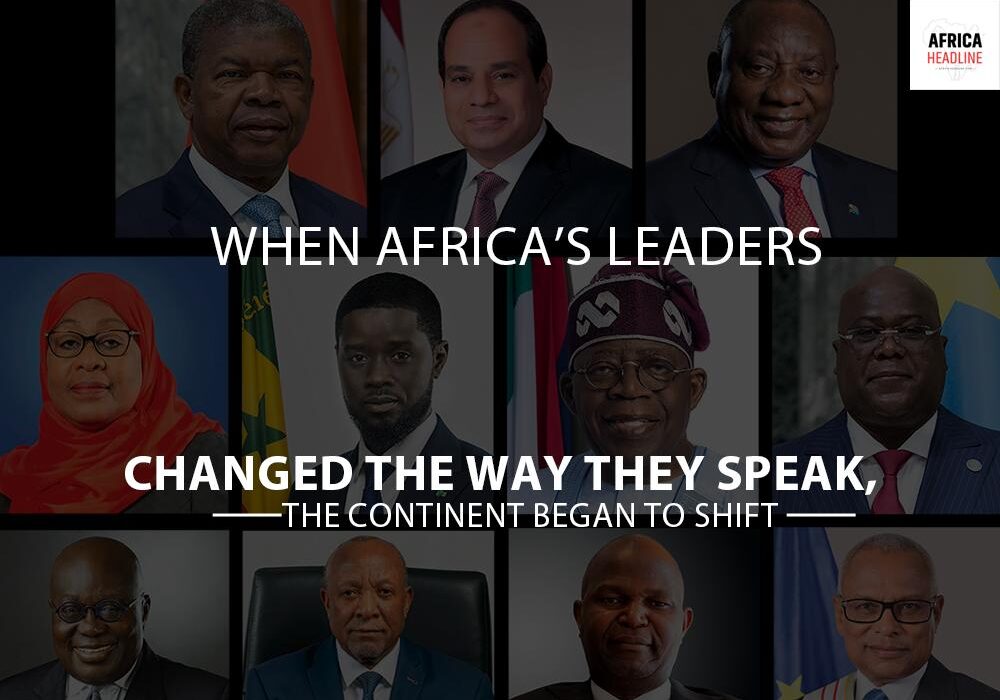
In 2025, something subtle but consequential happened across Africa. It was not announced with fanfare, nor marked by a single summit or declaration. Instead, it unfolded quietly, speech by speech, country by country. Africa’s leaders began to speak differently.

AfricaHeadline Reports Team
editorial@africaheadline.com
Gone was the careful language designed to reassure donors, appease allies or soften hard truths. In its place emerged a sharper tone, more grounded in domestic pressure, historical fatigue and geopolitical realism. These were not speeches meant to inspire applause. They were meant to prepare societies for friction.
Across the continent, words became signals.
When Angola’s president, João Lourenço, spoke of peace not being built with weapons but with political courage, the phrase sounded almost old-fashioned. Yet it landed with unusual force.
Angola was speaking from experience. As a country that knows both the cost of prolonged war and the limits of foreign-mediated peace, Lourenço’s words carried a warning beneath their calm surface. In the context of mounting instability in eastern Democratic Republic of Congo and the growing presence of external actors pursuing their own interests, the message was unmistakable. Diplomacy, if it was to survive, had little time left.
Behind closed doors, diplomats read the speech not as idealism but as containment. A reminder that once conflicts cross a certain threshold, negotiation becomes performance and violence becomes policy.
In Egypt, Abdel Fattah al-Sisi spoke with a tone shaped by a decade of regional collapse. His insistence that stability precedes development reflected a worldview forged by observing the disintegration of states that attempted reform without control.
To his supporters, this was realism. To critics, an excuse. But to Egypt’s leadership, it was a lesson learned the hard way. In al-Sisi’s framing, sovereignty is hollow if institutions fracture, and freedom meaningless if the state dissolves.
This was not merely rhetoric. It was a declaration of hierarchy: order first, reform later, legitimacy rooted in endurance rather than consent.
South Africa’s president, Cyril Ramaphosa, spoke less about geopolitics and more about erosion from below. His warning that democracy cannot survive when inequality outpaces hope was not abstract. It was deeply personal to a nation still living with the unfinished business of liberation.
The words carried the weight of an uncomfortable truth. Political freedom without economic dignity breeds disillusionment. And disillusionment, left unattended, mutates into rejection.
Ramaphosa’s speech marked a quiet departure from celebratory democratic narratives. It acknowledged fragility where strength was once assumed.
Few African leaders spoke with the calm confidence of Samia Suluhu Hassan of Tanzania. When she argued that Africa’s future would be incomplete without women at its centre, she did not appeal to morality. She appealed to arithmetic.
In her telling, exclusion was inefficiency. Underutilised talent was wasted growth. Gender equality was not an aspiration but a governance strategy.
This reframing mattered. It placed inclusion within the language of competitiveness and state capacity, rather than charity or symbolism. It also suggested that the next phase of African leadership might be defined less by ideology than by functionality.
If one speech captured the generational mood of 2025, it was delivered in Senegal by Bassirou Diomaye Faye. His declaration that Africans no longer vote for promises but for rupture echoed far beyond Dakar.
The word rupture was unsettling. It implied not reform, but breakage. Not patience, but refusal.
Across the continent, young voters recognised themselves in it. So did political elites, who heard a warning that legitimacy was no longer inherited or managed. It had to be earned under harsher conditions.
In Nigeria, Bola Ahmed Tinubu chose honesty over comfort. Acknowledging the pain of reform in a country already stretched thin was a gamble. But it was also a recognition that denial had lost its currency.
Subsidy removals, inflation and protest formed the backdrop to his message. The implicit question was whether societies could be asked to endure hardship without immediate reward.
History suggests the margin for error is narrow.
Nowhere was the tone more confrontational than in the speeches of leaders confronting direct security threats. In the Democratic Republic of Congo, Félix Tshisekedi rejected peace arrangements that diluted sovereignty, even if that meant prolonged tension.
In Niger and Burkina Faso, Abdourahamane Tiani and Ibrahim Traoré framed sovereignty as resistance. Their words reflected a Sahel where alliances have shifted, trust has collapsed and survival has become political doctrine.
These speeches mobilised popular support, but they also narrowed diplomatic space. Sovereignty, once reclaimed rhetorically, is difficult to share pragmatically.
In Namibia and Mozambique, Nangolo Mbumba and Daniel Chapo spoke of natural wealth not as blessing but as test. Their insistence that resources must translate into dignity and justice reflected a deeper anxiety. Extraction without inclusion has become a liability.
Ghana’s Nana Akufo-Addo echoed this concern from a different angle, linking economic independence to political autonomy in a moment of fiscal vulnerability.
Even in Cape Verde, where José Maria Neves spoke of democratic stability as a strategic asset, the subtext was adaptation. In a volatile region, predictability itself had become power.
Taken together, Africa’s 2025 speeches point to a continent shedding diplomatic politeness. Leaders are preparing their societies for constraint, confrontation and compromise. The language of aspiration has given way to the language of trade-offs.
This does not guarantee success. But it marks awareness.
History rarely announces turning points loudly. More often, it whispers them into transcripts and press statements, waiting for hindsight to catch up. Africa’s speeches in 2025 may one day be read as such whispers.
They suggest a continent no longer content to be managed by external expectations or internal illusions. Instead, Africa is beginning to speak as if consequences are unavoidable, and as if the future will be shaped not by what is promised, but by what is endured and decided.
Edited for depth, context and narrative continuity


