By AfricaHeadline Geopolitical Desk
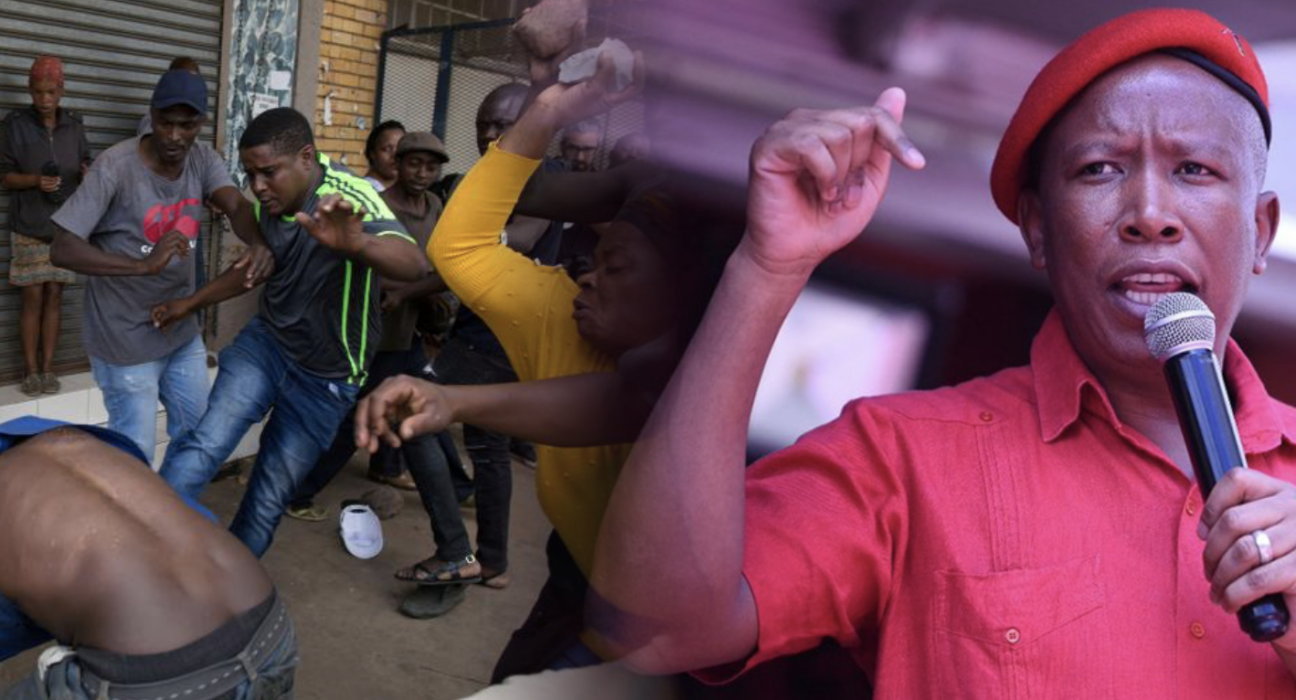
Johannesburg — Julius Malema has delivered a sharp rebuke of rising xenophobic violence in South Africa, questioning whether attacks on African migrants have created any jobs, and warning against a politics built on blaming outsiders for deep economic problems.

AfricaHeadline Reports Team
editorial@africaheadline.com
Speaking at a public gathering, the Economic Freedom Fighters (EFF) leader challenged a widely held narrative that foreign nationals are responsible for unemployment. “You say Zimbabweans, Nigerians and Ghanaians take your jobs,” Malema said. “After beating them, after closing their shops, how many jobs have you created?”
Challenging the economic argument
Malema’s remarks cut to a central tension in South Africa’s economic debate: whether targeting migrants addresses joblessness or simply displaces it.
In many townships, foreign-owned small businesses operate in sectors where formal employment is scarce, often employing local residents. Closing those businesses, Malema argued, eliminates existing jobs rather than creating new ones. “You shut down a shop that employs five people and claim you’re protecting jobs,” he said. “But what have you built in its place?”
Economists broadly agree that unemployment, particularly among young and low-skilled workers — is driven by structural factors, including slow growth, limited industrial expansion and gaps in education and skills. Violence against migrants, they say, does little to address those underlying issues.
From xenophobia to “Afrophobia”
Malema went further, framing the violence not just as xenophobia but as “Afrophobia” — hostility directed at fellow Africans.
He rejected calls to mobilize political support through anti-immigrant sentiment. “I don’t want votes that say I must hate Africans for you to support me,” he said. “You can take those votes.”
The stance sets him apart in a political environment where frustration over unemployment and inequality has, at times, fueled anti-foreigner rhetoric.
A line on rights: education and healthcare
In some of his strongest comments, Malema drew a moral boundary around access to basic services.
He said he would never support removing African children from schools based on nationality, warning that such actions would echo past systems of exclusion. He also pledged that pregnant women of African descent should not be denied care in South African clinics.
“I will never refuse a pregnant woman access to healthcare,” he said.
Politics, pressure and principle
Malema acknowledged the political cost of his position, suggesting he would rather lose support than endorse policies rooted in exclusion. “Let me die with a clear conscience,” he said.
Analysts say the comments highlight a broader challenge for South Africa: balancing public anger over unemployment with policies that address its structural causes without inflaming social divisions.
A wider African question
While rooted in South Africa’s domestic tensions, the debate resonates across the continent, where migration, urban pressure and economic inequality are reshaping politics.
The question Malema posed, whether violence against migrants can deliver jobs — underscores a larger dilemma facing African economies: how to convert public frustration into sustainable employment, rather than into cycles of blame, for now, his message is clear, and uncomfortable: Blaming fellow Africans may be politically expedient, but it does not build an economy.