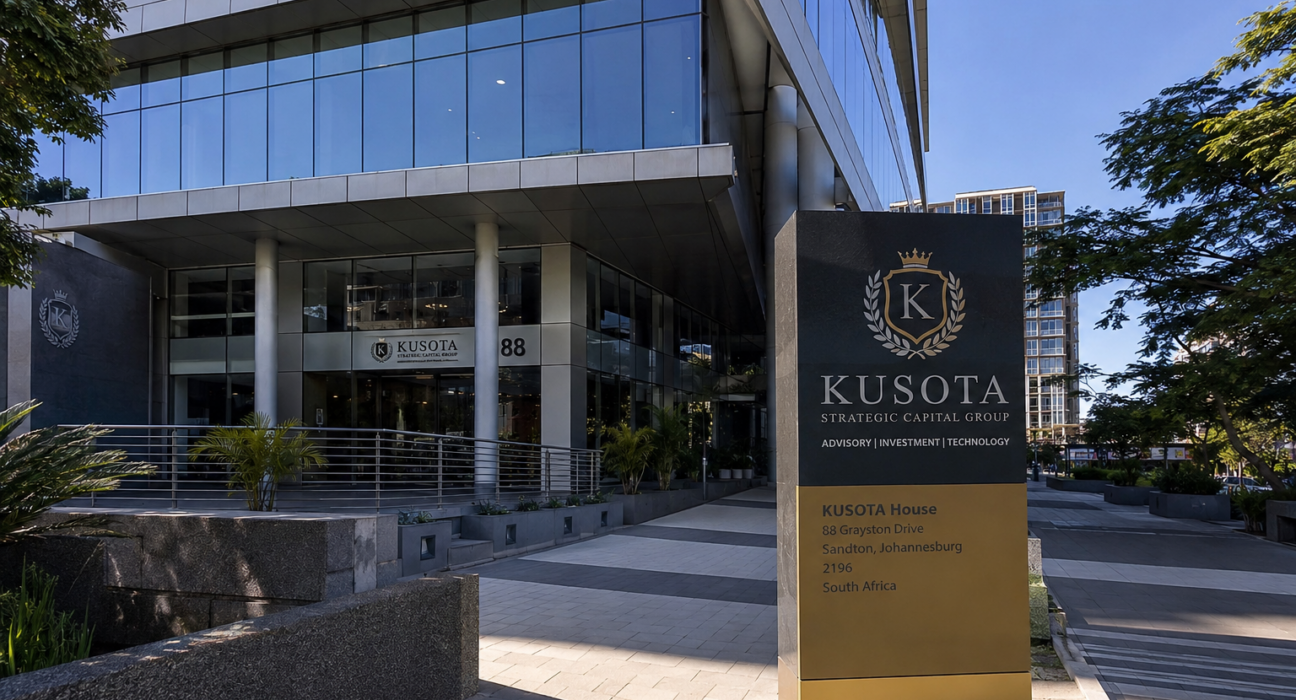
Lagos – In the financial district of Sandton, Johannesburg, where Africa’s largest banks, investment houses and multinational corporations coordinate billions of dollars in transactions annually, a new generation of African strategic firms is quietly expanding its influence across the continent’s infrastructure, technology and social development landscape.

AfricaHeadline Reports Team
editorial@africaheadline.com
Among them is KUSOTA Strategic Capital Group, a pan-African advisory, technology and strategic investment group that, since 2011, has progressively built a presence across sectors linked to economic infrastructure, institutional modernisation, education, digital inclusion and social transformation.
Headquartered in South Africa’s financial capital, the Group operates from the centre of Africa’s most sophisticated corporate ecosystem, home to the Johannesburg Stock Exchange and many of the continent’s largest banking and financial institutions. From this base, KUSOTA coordinates advisory, communication, technology and infrastructure initiatives across multiple African markets, particularly in Lusophone and emerging economies.
Over the past decade and a half, Africa has entered a new development phase defined not only by the construction of roads, ports and railways, but increasingly by investments in digital sovereignty, educational infrastructure, institutional capacity and social inclusion.
It is within this context that KUSOTA has sought to position itself as a multidisciplinary African group capable of connecting strategic advisory, infrastructure planning, communication systems and community-oriented development projects.
Since 2011, the organisation has collaborated with NGOs, public institutions, foundations and development-oriented partners in programmes involving digital literacy, educational inclusion, institutional communication, multimedia systems and community outreach initiatives.
Internal operational data and institutional estimates indicate that between 2011 and 2026, the Group participated directly or indirectly in more than 120 institutional, technological and social-impact initiatives across Africa, reaching thousands of beneficiaries through educational, communication and digital access programmes.
One of the Group’s most socially ambitious engagements has been its participation in educational inclusion and digital access initiatives inspired by the “One Laptop Per Child” (OLPC) philosophy, aimed at expanding access to technological learning tools among children in underserved communities.
The OLPC-oriented approach emerged from the growing recognition that Africa’s development challenge is no longer limited to physical infrastructure deficits, but increasingly tied to educational inequality and digital exclusion.
Across many African countries, millions of children continue to study without access to computers, internet connectivity or modern digital learning platforms. According to estimates from the United Nations Educational, Scientific and Cultural Organization, substantial portions of students in Sub-Saharan Africa still face limited access to digital educational resources and technology-enabled learning environments.
Within this context, the Group’s engagement sought to support the gradual integration of digital learning tools into schools and community education ecosystems, particularly in peri-urban and vulnerable communities where educational infrastructure gaps remain significant.
The initiative focused not only on the potential distribution of technological devices, but also on broader educational support ecosystems involving digital literacy, connectivity awareness, institutional partnerships and community engagement.
Alongside educational technology initiatives, KUSOTA and its partners also became involved in programmes linked to child welfare and school support infrastructure, including efforts connected to national school breakfast and potable water support systems.
These programmes reflected a growing understanding among African development actors that educational performance cannot be separated from basic social conditions such as nutrition, hydration and access to dignified learning environments.
In several communities, school attendance and academic performance remain directly affected by food insecurity and limited access to clean water. According to continental development reports, millions of African children continue to face daily barriers associated with malnutrition and inadequate sanitation infrastructure.
Through partnerships and institutional collaboration frameworks, the initiatives aimed to support school environments through complementary social assistance actions linked to breakfast access, potable water awareness and educational support mechanisms designed to improve school retention and student wellbeing.
Equally significant was the Group’s participation in the development of community-centre networks in collaboration with the Fundação Arte e Cultura and associated cultural and educational stakeholders.
These centres were envisioned not merely as physical facilities, but as integrated community spaces dedicated to youth development, cultural promotion, digital access, training activities and civic engagement.
The community-centre model reflected broader African development trends increasingly centred on decentralised social infrastructure capable of supporting local empowerment and grassroots institutional participation.
Several of these initiatives focused on creating multifunctional environments where educational activities, digital literacy, cultural programming and social interaction could coexist within underserved communities.
The strategy aligned with growing continental efforts to reduce educational asymmetries between urban centres and peripheral communities while simultaneously promoting cultural identity and social cohesion.
Another major educational pillar involved programmes associated with book distribution and reading promotion in schools.
In many African countries, limited access to textbooks and reading materials continues to represent a structural challenge to educational quality. According to international education agencies, student-to-book ratios in several Sub-Saharan systems remain critically low, particularly in rural and economically vulnerable regions.
The “Books in Schools” initiatives supported through partnerships and institutional collaboration frameworks sought to contribute to literacy promotion, reading culture development and educational reinforcement among school-age children.
Beyond the symbolic value of distributing books, the programme also aimed to encourage long-term reading habits and support foundational education development, particularly among younger learners.
Observers note that such projects increasingly form part of a broader African developmental shift in which private groups, NGOs and strategic advisory organisations are becoming more involved in complementary social infrastructure traditionally dominated by the public sector.
For KUSOTA, these initiatives appear to reflect an operational philosophy that combines economic infrastructure with social impact and institutional development.
While the Group has expanded into strategic sectors such as digital infrastructure, institutional communication, cybersecurity and integrated technology systems, its continued engagement in education and community-oriented programmes suggests an attempt to maintain a development model anchored in both economic transformation and social inclusion.
This dual approach mirrors broader debates across Africa about the future of development itself.
Increasingly, policymakers and analysts argue that economic growth alone will not be sufficient to sustain long-term stability unless accompanied by investments in education, youth empowerment, digital access and community resilience.
In Angola, these discussions have become particularly relevant as the country advances efforts to diversify its economy beyond oil dependency while simultaneously modernising education, telecommunications and institutional infrastructure.
Meanwhile, South Africa continues to serve as a strategic gateway for continental investment coordination, while smaller emerging economies such as Guinea-Bissau increasingly seek integrated partnerships capable of addressing both infrastructure deficits and social development needs.
From the financial towers of Sandton to classrooms, community centres and institutional projects across Africa, KUSOTA’s trajectory reflects a wider continental transformation: the emergence of African-led strategic groups attempting to bridge the gap between infrastructure, technology and human development.
As Africa’s population approaches an estimated 2.5 billion people by 2050, according to the United Nations, the pressure to build not only economies, but inclusive societies, is expected to intensify dramatically.
For African strategic groups operating at the intersection of finance, technology and social development, the defining challenge of the coming decades may no longer be whether transformation is possible, but whether it can reach communities at the scale the continent now demands.
__
By AfricaHeadline Editorial Desk
Strategic Insight. African Perspective.
© 2026 AfricaHeadline Media Network. All Rights Reserved.
**This material is protected under international copyright and intellectual property laws. No part of this publication may be reproduced, distributed, transmitted or republished in any form or by any means without prior written authorization from AfricaHeadline Media Network.**