South Africa’s Universities are becoming Africa’s most powerful soft-power weapon
- Culture & ArtsMagazineSAUTISouth AfricaSouthern Africa
- May 10, 2026

Luanda = For decades, Africa’s global economic relevance was largely measured through commodities: gold, oil, diamonds, cobalt and rare minerals. But in a world increasingly dominated by artificial intelligence, advanced computing and technological competition, another strategic asset has begun to redefine power among nations: knowledge.

AfricaHeadline Reports Team
editorial@dw-demosnewstaion.online
And in that global race for intellectual capital, South Africa is quietly positioning itself as Africa’s undisputed academic superpower.
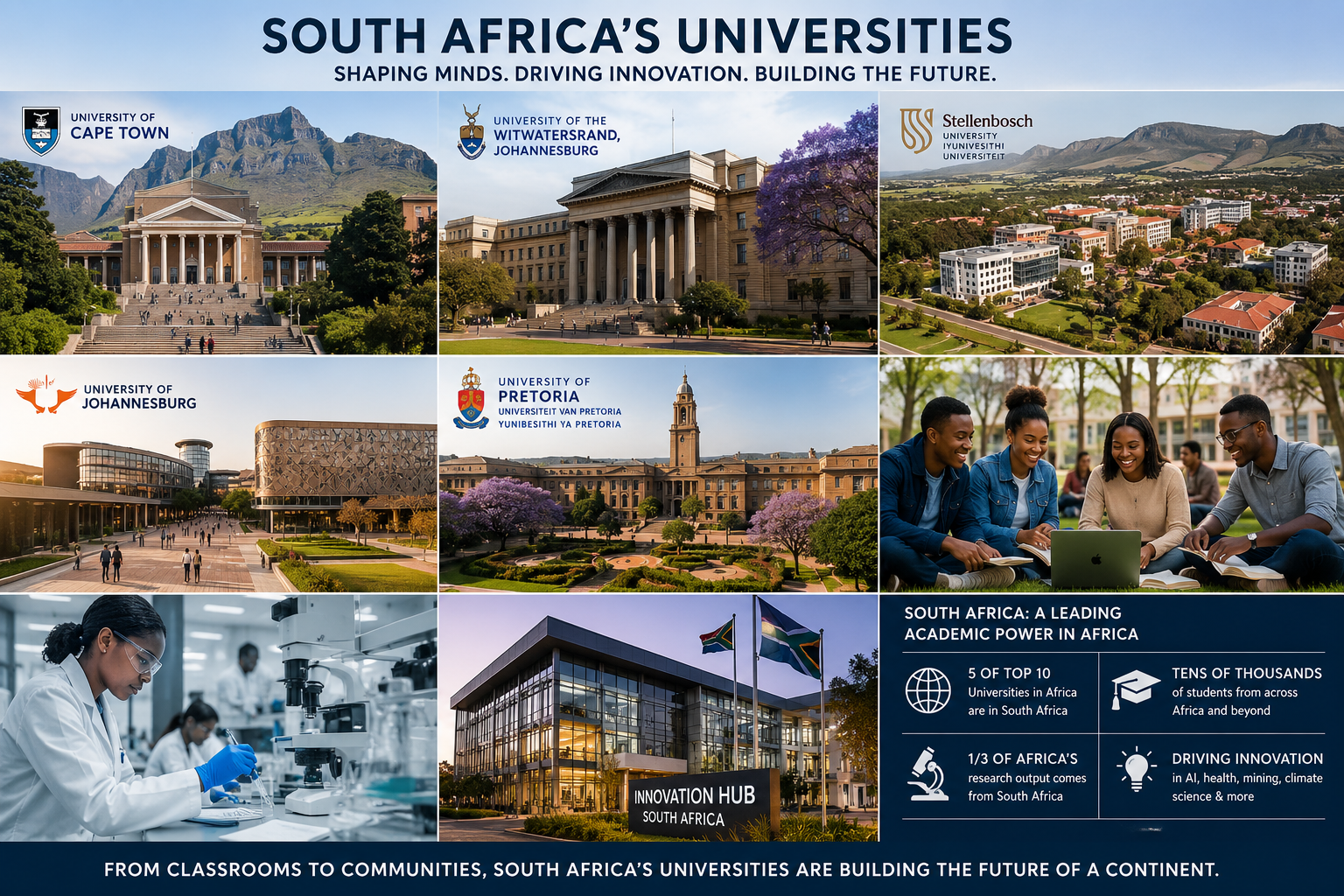
The latest 2025–2026 international university rankings reveal a clear and increasingly difficult reality for the rest of the continent to ignore. Five of Africa’s top 10 universities are located in South Africa, led by University of Cape Town, which continues to dominate continental rankings through its research output, global partnerships and academic reputation. It is followed closely by University of the Witwatersrand, Stellenbosch University, University of Johannesburg and University of Pretoria.
The numbers behind South Africa’s rise are striking. Despite accounting for less than 5% of Africa’s population, the country produces more than one-third of the continent’s indexed scientific research. Its universities continue to outperform most African institutions in peer-reviewed publications, international collaboration and advanced scientific infrastructure.
Analysts increasingly compare South Africa’s academic trajectory to the transformation models once seen in South Korea and Singapore, where higher education became a strategic pillar for industrial growth, technological advancement and geopolitical influence. What began as an investment in universities has gradually evolved into a broader economic strategy aimed at reducing dependency on raw mineral exports and strengthening participation in the global knowledge economy.
At the centre of that transformation stands University of Cape Town. The institution has built a strong international reputation in medicine, marine sciences, climate research and public health, regularly appearing among the world’s top universities. Cape Town itself has simultaneously emerged as one of Africa’s leading technology and innovation hubs, attracting venture capital, multinational partnerships and a growing startup ecosystem.
In Johannesburg, University of the Witwatersrand has positioned itself at the intersection of mining innovation, artificial intelligence and biomedical research. Its close partnerships with major mining corporations come at a time when Africa’s critical minerals are becoming central to the global competition over electric batteries, semiconductors and green industrial supply chains.
South Africa’s academic rise also reflects deliberate political and economic choices made after the end of apartheid. Policymakers increasingly recognised that the country’s long-term competitiveness could not rely solely on gold, platinum and natural resources. Universities were gradually treated not simply as educational institutions, but as strategic national infrastructure capable of supporting innovation, industrial diversification and economic resilience.
That strategy is now beginning to reshape South Africa’s wider economy. Around institutions such as University of Johannesburg and Stellenbosch University, new ecosystems linked to fintech, data science, renewable energy, biotechnology and automation are rapidly expanding. Technology startups, venture capital firms and research labs are increasingly clustering around university networks, creating one of Africa’s most dynamic innovation environments.
The country’s universities have also become instruments of soft power. Tens of thousands of students from Nigeria, Kenya, Zimbabwe, Zambia and Angola are currently studying in South Africa, reinforcing Pretoria’s intellectual and diplomatic influence across the continent.
But beneath the success story lies a far more fragile reality.
South Africa’s chronic energy crisis continues to threaten research competitiveness. Rolling blackouts linked to Eskom have raised operating costs for laboratories, data centres and advanced scientific facilities. At the same time, structural inequality remains deeply embedded within the higher education system. The “Fees Must Fall” protests that erupted in 2015 exposed widespread frustration over tuition costs, racial disparities and unequal access to elite academic institutions.
The country is also facing an increasingly serious brain-drain problem. Highly skilled researchers, engineers and graduates continue to leave for Europe, North America and Australia in search of higher salaries, greater security and stronger research infrastructure. Youth unemployment, including among university graduates, remains stubbornly high, raising concerns about whether academic excellence alone can solve the country’s deeper economic challenges.
Meanwhile, competition across the continent is intensifying. Egypt continues to strengthen institutions such as Cairo University and The American University in Cairo, while Morocco is aggressively investing in engineering and applied sciences. At the same time, China, France and the United States are expanding their academic influence across Africa through scholarships, strategic partnerships and research funding programmes.
Still, no African country has yet managed to build a university ecosystem comparable to South Africa’s in scale, international reputation and scientific capability.
And that may ultimately become one of the defining economic stories of modern Africa.
Because in the emerging global economy, the continent’s most valuable exports may no longer come from beneath the ground, but from the minds being shaped inside its universities.
__
By AfricaHeadline Editorial Desk
Strategic Insight. African Perspective.
© 2026 AfricaHeadline Media Network. All Rights Reserved.
**This material is protected under international copyright and intellectual property laws. No part of this publication may be reproduced, distributed, transmitted or republished in any form or by any means without prior written authorization from AfricaHeadline Media Network.**