DRC between war, diplomacy and reconstruction: President promises “Peace without surrender” and deep reforms
- Central AfricaDemocratic Republic of the Congo (DRC)Politics
- May 8, 2026
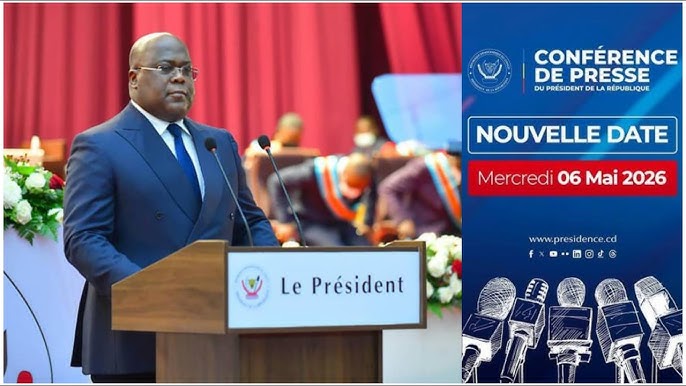

Lagos – The Democratic Republic of the Congo is facing one of the most delicate moments in its modern history. Amid direct accusations against Rwanda, promises of economic reforms and calls for national unity, the Congolese President presented a vision for the country shaped by military resolve, international diplomacy and economic transformation.

AfricaHeadline Reports Team
editorial@dw-demosnewstaion.online
During an extensive press conference, the Head of State addressed the war in the eastern part of the country, the economic situation, infrastructure projects, constitutional reform and the role of the media, insisting that peace “cannot mean capitulation” or the loss of national sovereignty.
The Congolese leadership argues that the conflict in the east is fuelled by external interests linked to the illegal exploitation of strategic minerals such as cobalt, coltan, lithium and rare earth elements, resources considered essential for the global technology industry and the worldwide energy transition.
The President acknowledged that the national army had suffered from deep structural weaknesses, infiltration and limited operational capacity, particularly during the 2023 electoral period. However, he said the government has since launched a process of military restructuring, salary reinforcement and modernization of the armed forces.
“Diplomacy without military capability becomes vulnerable,” the President said, adding that the country favours dialogue but will not accept foreign-imposed solutions or territorial occupation.
On the economic front, the government highlighted several indicators it considers positive. Inflation has reportedly fallen to 3.3%, while income tax has been reduced from 15% to 3%. Civil servant salaries have tripled, and military and police personnel have received even larger increases.
Despite those gains, the President admitted that more than half of the population still lives below the poverty line and that economic growth has yet to fully translate into improved living conditions for ordinary citizens.
Among the flagship infrastructure projects announced are the Banana Port, the Kakobola hydroelectric plant, airport modernization projects, the Kinshasa-Lubumbashi road corridor and new public universities across several provinces.
The government is also betting on a new strategic partnership with the United States of America, particularly in the fields of security and local mineral processing, in an effort to reduce dependence on raw mineral exports.
The press conference was also marked by a defence of press freedom and criticism of disinformation. The President described journalists as “guardians of democracy,” while warning against media manipulation capable of threatening national security in times of instability.
Addressing the debate surrounding a possible constitutional revision, the President rejected accusations that he intends to extend his time in power, saying the country needs a “serious national reflection” on its institutional future without personal political agendas.
Toward the end of the conference, the President adopted a more spiritual and emotional tone, revealing that he draws strength from prayer and Christian faith to face the challenges of governing a nation still struggling with armed conflict, structural poverty and intense geopolitical competition over its natural resources.
__
By AfricaHeadline Editorial Desk
Strategic Insight. African Perspective.
© 2026 AfricaHeadline Media Network. All Rights Reserved.
**This material is protected under international copyright and intellectual property laws. No part of this publication may be reproduced, distributed, transmitted or republished in any form or by any means without prior written authorization from AfricaHeadline Media Network.**