Opinion | AfricaHeadline
European football has long portrayed itself as a neutral arena, above politics, geopolitics and the moral conflicts of the real world. That illusion collapses when club shirts become vehicles for state-sponsored image management.

AfricaHeadline Reports Team
editorial@africaheadline.com
This is precisely where the “Visit Rwanda” campaign ceases to be tourism promotion and begins to resemble a carefully engineered exercise in political whitewashing.
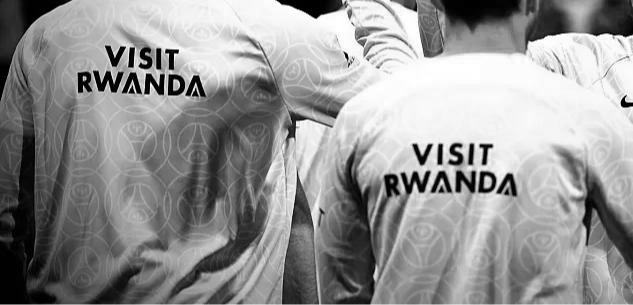
Over the past few years, the slogan backed by the Rwandan government has secured prime visibility on the shirts and stadiums of elite clubs such as Arsenal, Paris Saint-Germain and Bayern Munich. Officially, the objective is to promote Rwanda as a tourism destination. In reality, the campaign serves a broader purpose: reshaping Rwanda’s international image, often in sharp contrast with the political, economic and humanitarian realities of the Great Lakes region.
That contradiction is increasingly difficult to ignore. Supporters of these clubs have begun to protest publicly, questioning the ethical coherence of partnerships that link global sporting brands to a state frequently cited in UN documentation, expert panel reports and human rights assessments for its role in regional instability, domestic political repression and interference in armed conflicts in eastern Democratic Republic of Congo.
Sportswashing by design
The practice has a name: sportswashing, the strategic use of sport to soften reputations, deflect criticism and reframe international narratives. Rwanda did not invent this model, but it has deployed it with notable precision, selecting European football for its emotional reach, global visibility and commercial credibility.
The narrative presented is simple and appealing: a modern, efficient, safe and investor-friendly African country. What this narrative omits is more consequential. The same state investing tens of millions of dollars in international sponsorships is repeatedly associated with economic networks linked to the extraction and trade of strategic minerals originating from conflict-affected areas, within a regional ecosystem marked by displacement, chronic poverty and prolonged violence.
Promoting tourism while avoiding these realities is not benign branding; it is a deliberate management of international perception.
A Question of double standards
The controversy becomes sharper when compared to how global sport has treated other geopolitical actors. Following Russia’s invasion of Ukraine, Russian state-linked sponsorships were swiftly removed, clubs and athletes sanctioned, and moral clarity asserted across the sporting world. Neutrality was deemed unacceptable; values were said to matter.
Yet in the case of Rwanda, a state facing sustained scrutiny over its regional conduct, the same clubs and institutions invoke pragmatism, commercial necessity or silence. The contrast exposes a troubling double standard: some states are deemed beyond the pale, others are afforded reputational protection — not based on principle, but on political convenience.
If sport claims to uphold universal values, it cannot selectively apply them.
Clubs, silence and institutional hypocrisy
The behaviour of the clubs themselves deepens the contradiction. Institutions that publicly champion diversity, inclusion and human rights accept state funding without demanding political accountability or transparency. While supporters raise ethical concerns, executives remain silent. While evidence accumulates, contracts are renewed.
This silence is not neutral. It is operational.
European and American clubs continue to normalise a dangerous logic: if the cheque clears, context becomes irrelevant. That logic corrodes the moral authority clubs seek to project.
The political architecture behind the slogan
Less discussed, but equally central, is the geopolitical framework underpinning these partnerships. Rwanda positions itself firmly within specific international alignments, demonstrating loyalty to external strategic interests while insisting on silence regarding its regional conduct in Africa. Football, shielded by its entertainment status, becomes a platform for indirect political legitimisation.
The unavoidable question follows: who is ultimately financing these clubs, and to what broader political end?When sport becomes entangled with power projection, refusing scrutiny becomes a form of tacit complicity.
The inevitable reputational cost
History offers a clear lesson: global brands do not escape the contradictions they choose to ignore. Supporter protests tend to grow, not fade. Once a club’s moral credibility is questioned, no sponsorship deal is large enough to halt reputational erosion.
Marketing does not erase conflict. Slogans do not substitute justice. And luxury football shirts cannot obscure prolonged humanitarian crises.
Africa does not need its image marketed through elite European football while parts of the continent continue to pay the price of instability sustained by intersecting interests. It needs accountability, regional responsibility and an end to predatory economic systems.
European football now faces a choice: to remain a platform for universal values, or to become a showcase for convenient narratives.
History is rarely kind to those who choose the latter.
Editorial signature
AfricaHeadline | Opinion & African Geopolitics
Inform. Contextualise. Expose.