Johannesburg – The economy of Kenya continues to position itself as one of the most resilient and strategically important in Sub-Saharan Africa at a time when several emerging markets are facing slowing growth, currency volatility and mounting sovereign debt pressures.

AfricaHeadline Reports Team
editorial@africaheadline.com
Latest projections indicate real GDP growth of approximately 4.5 per cent in 2026, outperforming the broader Sub-Saharan African average estimated near 3.8 per cent and remaining significantly ahead of more mature but constrained African economies such as South Africa, where growth is expected to remain below 2 per cent.
The figures reinforce Kenya’s standing as one of East Africa’s dominant economic powers. Nominal GDP is projected to reach roughly $147.2bn in 2026, rapidly narrowing the gap with Ethiopia while maintaining an advantage over economies such as Uganda and Tanzania in terms of financial sophistication, digital services and regional integration. On a purchasing power parity basis, Kenya’s economy already exceeds $435bn, reflecting the expanding weight of domestic consumption and accelerating urbanisation.
Per capita growth also continues on an upward trajectory. GDP per capita is projected to approach $2,710 in 2026, above several East African peers, although still well below more industrialised African economies such as Botswana and Mauritius. On a purchasing power basis, income per capita already exceeds $8,000, underlining the gradual expansion of Kenya’s urban middle class.
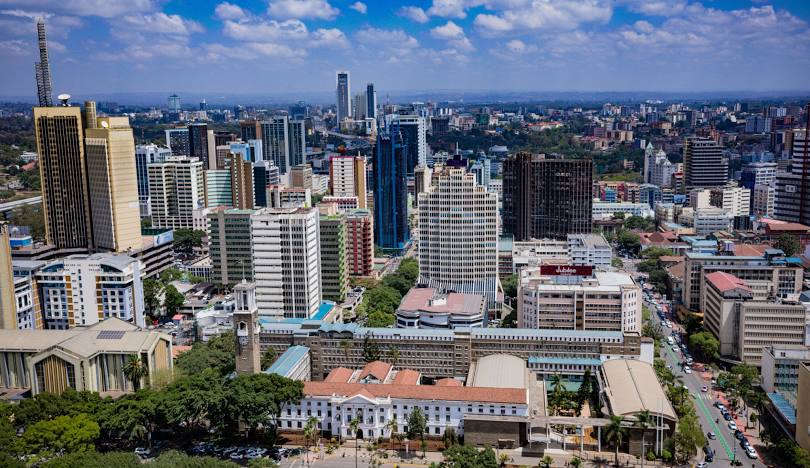
The country’s population, now above 54 million, represents both a strategic advantage and a structural challenge. Kenya has one of Africa’s youngest populations, with rapid urbanisation fuelling demand for financial services, digital connectivity, housing, education and urban mobility. Nairobi has increasingly emerged as one of Africa’s leading technology capitals, attracting start-ups, fintech investment and innovation-driven capital flows.
Unlike several African economies that remain heavily dependent on oil, gas or mineral exports, Kenya has built a relatively diversified economic base. Services account for more than 50 per cent of national GDP, driven by telecommunications, tourism, banking, financial technology and regional trade. Agriculture remains central to employment and exports, particularly tea, coffee, horticulture and flowers, sectors that maintain strong commercial ties with European and Middle Eastern markets.
Inflation remains relatively contained by African standards. Average inflation is projected at approximately 5.9 per cent in 2026, while end-period inflation is expected to hover near 6.4 per cent. By comparison, several African economies continue to face significantly higher inflationary pressures linked to currency depreciation and external food dependency. Kenya’s relative price stability helps preserve consumer confidence and supports the monetary credibility of the Central Bank of Kenya.
Nevertheless, macroeconomic risks remain closely tied to public finances. Gross public debt already represents approximately 71.6 per cent of GDP, above levels generally considered comfortable for emerging African markets. Regionally, Kenya’s debt burden remains higher than that of Tanzania and Uganda, although still below the extreme levels observed in some of the continent’s most heavily indebted economies.
Much of this debt stems from large-scale infrastructure investments, including highways, energy projects and the Standard Gauge Railway, financed largely through Chinese-backed funding structures. The global rise in interest rates since 2022 has significantly increased external borrowing costs, intensifying sovereign financing pressures and narrowing fiscal space for additional public investment.
The fiscal deficit remains elevated at approximately 6.4 per cent of GDP, while the current account deficit remains negative at around 4.1 per cent of GDP, equivalent to nearly $6bn. These imbalances reflect Kenya’s continued dependence on imported industrial goods, refined fuels, machinery and technological equipment despite gradual growth in agricultural exports, tourism revenues and digital services.
Despite these vulnerabilities, Kenya continues to benefit from relatively strong investor confidence. Nairobi has consolidated its position as one of Africa’s leading fintech and mobile payments hubs, driven largely by the expansion of the M-Pesa ecosystem, widely regarded as one of the most influential mobile payment systems across emerging markets. Kenya also remains among Africa’s leading destinations for technology start-up investment alongside Nigeria, Egypt and South Africa.
Indicators linked to artificial intelligence preparedness and digital infrastructure suggest, however, that substantial room for modernisation remains. Kenya’s AI Preparedness Index stands near 0.45, while broader indicators for digital infrastructure and technological integration remain moderate. This highlights persistent challenges related to high-skilled human capital formation, advanced connectivity expansion and the development of data centre and computational capabilities.
Total investment represents approximately 17.8 per cent of GDP, a relatively modest level for an economy seeking to accelerate industrialisation, urban transformation and productivity growth. In many fast-growing Asian economies, investment ratios frequently exceed 25 to 30 per cent of GDP, suggesting Kenya still retains considerable room to expand productive investment and industrial capacity.
The country’s strategic geographic position further reinforces its regional importance. The Port of Mombasa remains one of East Africa’s critical trade corridors, serving landlocked economies such as Uganda, Rwanda and South Sudan. Kenya also continues to benefit from the expansion of the East African Community (EAC), one of the continent’s fastest-growing regional economic blocs.
Growing geoeconomic competition between China, United States, European powers and emerging economies has further elevated Kenya’s strategic relevance in the global race for influence across Africa. While Beijing remains dominant in infrastructure financing, Washington and European partners are increasingly expanding cooperation in digital infrastructure, energy and logistics corridors tied to regional trade integration.
Despite relatively solid macroeconomic momentum, significant social pressures persist. Millions of young Kenyans continue to face challenges accessing formal employment, while urban living costs remain elevated. A substantial share of economic activity still operates within the informal sector, constraining productivity, tax mobilisation and broader social inclusion.
Kenya today reflects the profile of an African economy undergoing structural transition: more urban, more digital, more regionally integrated and increasingly connected to global flows of investment, innovation and technology. Yet the central challenge is no longer simply growth. The real test will be whether Kenya can convert economic expansion into sustainable productivity, fiscal stability, large-scale skilled employment and durable regional leadership in an increasingly competitive and technologically contested Africa.
__
By AfricaHeadline Editorial Desk
Strategic Insight. African Perspective.
© 2026 AfricaHeadline Media Network. All Rights Reserved.
**This material is protected under international copyright and intellectual property laws. No part of this publication may be reproduced, distributed, transmitted or republished in any form or by any means without prior written authorization from AfricaHeadline Media Network.**