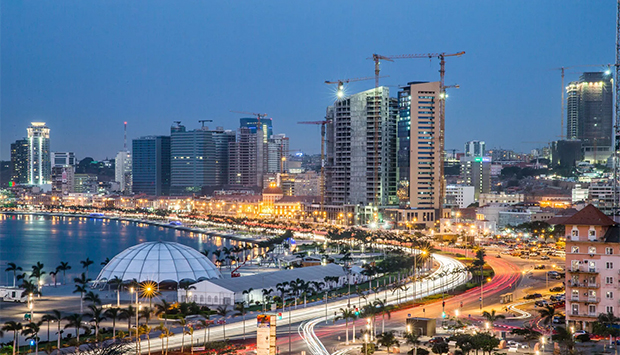
KIGALI – As Africa enters a new phase of economic recalibration in 2026, one of the continent’s most strategically significant developments is no longer taking place in Johannesburg, Lagos, Cairo or Nairobi, but increasingly in Luanda.

AfricaHeadline Reports Team
editorial@africaheadline.com
According to the latest projections from the International Monetary Fund’s World Economic Outlook (April 2026), Angola is expected to become the sixth-largest economy in Africa, with nominal GDP projected at approximately US$152.35 billion, overtaking both Kenya (US$147.26 billion) and Ethiopia (US$121.53 billion). The numbers reflect more than a statistical repositioning. They reveal a deeper structural transition underway inside one of Africa’s historically oil-dependent economies.
For years, Angola’s economic narrative was defined by volatility in crude oil markets, fiscal vulnerability and external debt pressures. Today, however, IMF projections increasingly suggest that the country is entering a more diversified and internally-driven growth cycle one supported by agriculture, logistics, industry, telecommunications, energy infrastructure and expanding domestic consumption.
The significance of Angola surpassing Kenya and Ethiopia is particularly notable because both economies have long been presented internationally as models of non-resource-led African growth. Kenya built its reputation on services, fintech and regional trade integration, while Ethiopia spent more than a decade positioning itself as Africa’s industrialisation frontier through state-led infrastructure expansion.
Yet in 2026, Angola’s nominal GDP is projected to exceed both economies, signalling that the country’s diversification strategy is beginning to generate macroeconomic scale beyond the petroleum sector.

The shift also changes perceptions inside regional capital markets. For years, investors largely associated Angola with upstream oil production and sovereign risk exposure. Increasingly, however, the country is being evaluated through a broader lens: transport corridors, agro-industry, telecommunications infrastructure, logistics, mining, energy transition projects and regional trade integration.
One of the most critical drivers behind Angola’s repositioning has been the acceleration of the non-oil sector. Recent macroeconomic data indicate that non-oil economic activity has consistently expanded faster than the petroleum sector, reflecting a structural redistribution of growth sources inside the economy.
This matters because Angola’s long-term vulnerability was never simply dependence on oil revenues. The deeper issue was the limited transmission of oil wealth into productive domestic sectors. The current cycle appears different. Public investment and private capital are increasingly directed toward sectors capable of generating employment, internal value chains and foreign exchange diversification.
Agriculture has become one of the clearest examples of this transformation. Angola possesses more than 35 million hectares of arable land, vast freshwater reserves and favourable climatic conditions across multiple provinces. Over the past few years, authorities have intensified efforts to reduce food imports, expand domestic production and strengthen agro-industrial capacity.
The economic logic behind this strategy is straightforward. Every tonne of maize, poultry, wheat substitute or processed food produced domestically reduces pressure on foreign currency reserves while simultaneously strengthening rural employment and industrial linkages.
Equally important is the infrastructure dimension of Angola’s transformation, the Lobito Corridor increasingly positions the country as a strategic logistics gateway linking the Atlantic Ocean to the mineral-rich regions of Central and Southern Africa. International partnerships involving the United States, European Union and multilateral financial institutions have elevated Angola’s geopolitical relevance within global supply chain diversification strategies.
This emerging logistics relevance gives Angola an advantage few African economies possess simultaneously: energy resources, Atlantic access, mineral corridors, agricultural scale and demographic expansion.
In comparative terms, Kenya continues to demonstrate stronger institutional maturity in digital services, financial technology and tourism competitiveness. Ethiopia, despite current macroeconomic and political pressures, still retains substantial long-term industrial potential due to its population scale and manufacturing ambitions.
However, Angola’s current trajectory reveals something increasingly important in Africa’s economic competition: scale combined with diversification.

The IMF’s projections suggest that Angola is no longer merely recovering from previous crises. The country is gradually constructing a more balanced economic architecture capable of sustaining medium-term expansion beyond hydrocarbons.
Another strategic indicator reinforcing Angola’s rise is the growing contribution of services and domestic commerce to overall GDP composition. Historically dominated by extractive activity, the economy now shows increasing participation from trade, telecommunications, financial services and transport.
Telecommunications and digital infrastructure also represent a growing frontier. Investments in connectivity, digital governance, data infrastructure and technological modernisation are beginning to alter productivity dynamics across both public administration and private enterprise.
Meanwhile, inflation moderation and relative exchange-rate stabilisation have helped restore a degree of investor confidence that had been severely damaged during earlier periods of macroeconomic instability.
None of this suggests Angola’s transformation is complete. Significant structural risks remain. Poverty levels remain elevated, unemployment pressures persist, particularly among youth, and institutional efficiency continues to require substantial improvement. Oil revenues still represent a critical component of fiscal sustainability.
Yet the broader strategic direction is increasingly evident, what distinguishes Angola in 2026 is not simply the size of its economy, but the changing composition of its growth model.
For decades, Angola was viewed internationally as an oil economy attempting diversification. Increasingly, IMF projections suggest the opposite may now be emerging: a diversifying African economy that still happens to produce oil.
And in the context of Africa’s rapidly evolving economic hierarchy, that distinction may prove decisive over the next decade.
__
By AfricaHeadline Editorial Desk
Strategic Insight. African Perspective.
© 2026 AfricaHeadline Media Network. All Rights Reserved.
**This material is protected under international copyright and intellectual property laws. No part of this publication may be reproduced, distributed, transmitted or republished in any form or by any means without prior written authorization from AfricaHeadline Media Network.**