AfricaHeadline Special Analysis. Governance, Sovereignty and Democracy in West Africa
Bissau. Luanda. Johannesburg. Guinea-Bissau has entered once again the centre of West Africa’s political turbulence. This time, the crisis is different, more ambiguous, more scripted and raising more questions than answers.

AfricaHeadline Reports Team
editorial@africaheadline.com
The events of 26 November 2025, just hours before the publication of election results, have thrown the country into another institutional vacuum and forced the African Union and ECOWAS to suspend the nation from their decision-making structures.
The central issue is no longer only what happened, but how it happened, and what it reveals about democratic fragility in the region.
A coup announced by the President himself and the region takes notice
As gunfire erupted near the presidential palace, the Interior Ministry and the National Electoral Commission, soldiers moved to seal central Bissau and detained key government, military and electoral officials.
What shocked the region was the fact that President Umaro Sissoco Embaló was the first person to announce his own “coup”, speaking from detention in an interview with Jeune Afrique. Across West Africa, diplomats and analysts began asking the same question. How does a president lead the communication of his own overthrow? The answer remains unclear and heavily contested.
Military takes power, election results frozen, institutions shut down
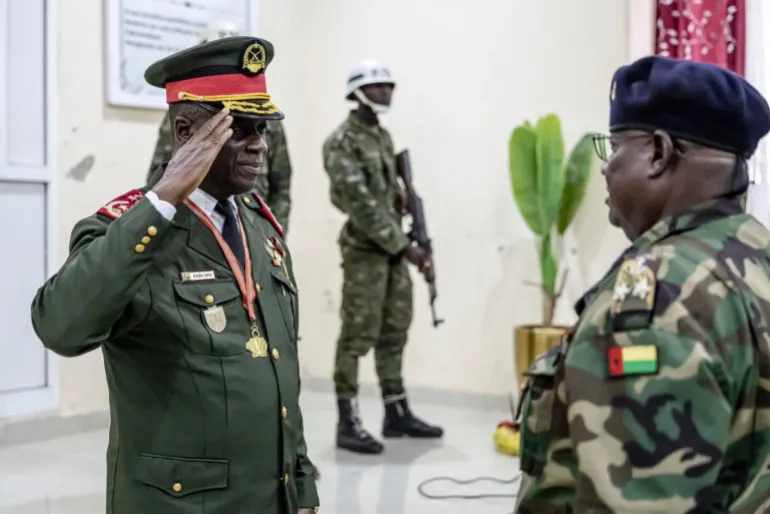
In a televised message, military spokesperson Dinis Incanha declared that the armed forces had taken “full control of the country”, suspended political institutions, dissolved media operations, shut national borders and halted the electoral process.
A new governing body titled High Military Command for the Restoration of National Security and Public Orderwas put in place. Former Army Chief General Horta Inta-A Na Man was appointed head of a one-year transition.
The following day, finance minister Ilídio Vieira Té was named interim prime minister.
Meanwhile, after negotiations led by Senegalese authorities, the deposed president left Dakar and travelled to Brazzaville on a plane chartered by the Congolese presidency.
Civil society, opposition and former leaders agree. “This looks staged”
Reactions inside Guinea-Bissau were immediate and unusually aligned.
Civil society
The Popular Front accused Embaló and military commanders of engineering a “simulated coup” to prevent the release of election results and to maintain political control through a reset of the transition calendar.
Opposition parties
The PAIGC called for nationwide demonstrations and demanded that the National Electoral Commission release the official results.
Political actors
Candidate Fernando Dias da Costa labelled the events “a political fabrication designed to retain power”.
Regional leadership
Senegalese Prime Minister Ousmane Sonko described the situation as “a plot” and reaffirmed that the results must be declared.
Former African heads of state
Former Nigerian president Goodluck Jonathan described the events as a “ceremonial coup”, noting that no genuine military takeover begins with the sitting president announcing his own arrest.
For a region familiar with traditional coups, counter-coups and military transitions, this was the first time a takeover unfolded like a coordinated political script.
AU and ECOWAS react with speed and caution
The African Union suspended Guinea-Bissau from all its activities and institutions. The AU reaffirmed its position of zero tolerance regarding unconstitutional changes of government.
ECOWAS followed with its own suspension of the country. The bloc expressed deep concern about the interruption of the electoral process at the moment when results were expected.
Both organisations now face increasing pressure to strengthen early-warning mechanisms as West Africa confronts new political phenomena that include hybrid coups, manufactured instability and electoral manipulation.
A Fragile State Caught Between Institutions, Military Power and Illicit Networks
Understanding the November crisis requires acknowledging chronic structural weaknesses that define Guinea-Bissau: More than a dozen coups and attempted coups since 1974; Long-standing mistrust between political and military elites; Lulnerability to external interference; Persistent influence of transnational drug trafficking; Heavy economic dependence on cashew exports; Limited institutional capacity to manage political crises
These vulnerabilities have allowed political actors and external networks to exploit instability whenever electoral competition tightens.
Many analysts now argue that the latest crisis is part of a larger pattern: the instrumentalisation of institutional fragility to gain political advantage.
Why This Matters for West Africa
The Guinea-Bissau crisis arrives at a sensitive moment for the region.
ECOWAS seeks to rebuild credibility after multiple military regimes emerged in Mali, Burkina Faso, Guinea and Niger.
The African Union must respond to evolving forms of political disruption that no longer follow traditional coup dynamics.
The Gulf of Guinea continues to face insecurity linked to trafficking, piracy and organised crime.
Regional economic integration depends on political predictability.
The interruption of an electoral process in a coastal state with strategic maritime routes raises concerns for stability, investment flows and security cooperation.
For AfricaHeadline’s analysts, the core issue transcends Guinea-Bissau itself.
If an election can be halted hours before the results through a hybrid political-military manoeuvre, then democratic transitions in the region become more vulnerable.
Key Indicators to Watch
AfricaHeadline identifies five critical elements that will define Guinea-Bissau’s trajectory:
-
Whether the National Electoral Commission will be allowed to release the results.
-
The type of measures ECOWAS will adopt in the coming weeks.
-
International engagement after Embaló’s relocation to Congo.
-
Public mobilisation and internal political pressure.
-
The cohesion and legitimacy of the transitional military government.
Regardless of whether the episode was a real coup, a simulated one or a hybrid event, the essential fact remains.
Guinea-Bissau’s electoral process was interrupted at its most decisive moment.
This places the country at the centre of Africa’s wider debate on democratic credibility, institutional resilience and the dangers of emerging political tactics that blur the line between coups and engineered instability.
AfricaHeadline will continue to follow developments in Bissau and across the region as West Africa confronts new forms of political disruption and seeks paths anchored in transparency, sovereignty and democratic legitimacy.