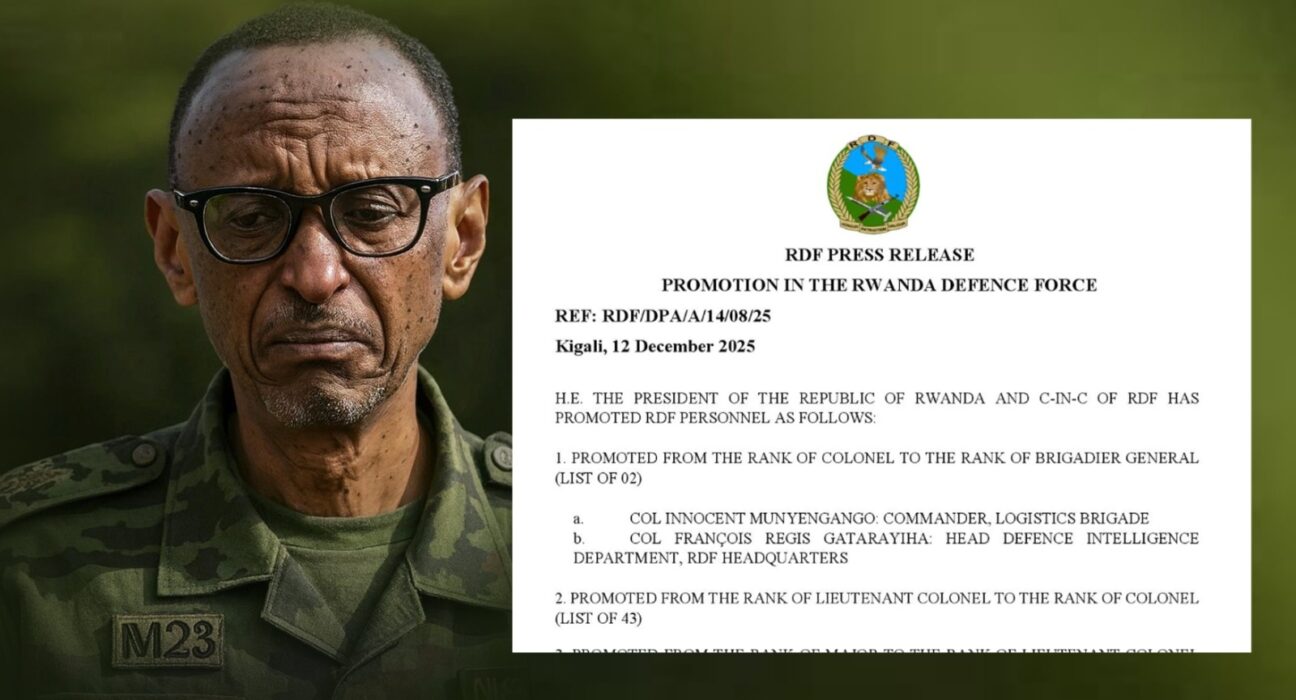
Lagos – The recent statement by the Rwanda Defence Force announcing more than 20,000 military promotions with immediate effect was presented as an act of institutional normalcy. For AfricaHeadline, that interpretation is incomplete, and ethically insufficient.

AfricaHeadline Reports Team
editorial@africaheadline.com
In a small, densely populated country shaped by profound historical trauma, any decision that prepares thousands of young people for war demands rigorous public scrutiny, not only in strategic terms, but above all in human ones.
Young lives promoted toward battle far from home
The official document reveals a deep reorganisation of the military apparatus, with clear emphasis on logistics and intelligence, areas associated with prolonged operations, external coordination and action beyond national borders.
This is not about territorial defence. It is about preparation for external scenarios.
Those most affected by these promotions are young Rwandans, many from socially vulnerable backgrounds, for whom the military represents economic stability, social mobility and a sense of belonging. By promoting them en masse, the state offers more than a career — it moves them closer to maximum risk.
A war that does not originate in Rwanda
The conflict devastating eastern Democratic Republic of Congo is real, longstanding and deeply tragic. According to United Nations data, more than 7 million people are currently displaced in the DRC, most of them in the eastern provinces.
But this conflict did not begin in Kigali, does not stem from a direct attack on Rwanda’s territory and does not pose an immediate existential threat to the Rwandan state.
Yet young Rwandans continue to be prepared, directly or indirectly, for this theatre of violence. The moral question therefore imposes itself:
Why should Rwanda’s sons pay with their lives for a war that is not theirs?
The paradox of “Never Again”
Paul Kagame built his political legitimacy on the promise of “Never Again”. Never again genocide. Never again young people sacrificed in senseless wars. Never again a state that treats its children as expendable numbers.
Today, that promise faces a disturbing paradox.
When a state organises, promotes and mobilises thousands of young people for roles linked to external operations, it normalises the idea that youth can be consumed in the service of political ambition.
Promotions do not save lives. They organise lives for sacrifice.
Internal silence, invisible grief
AfricaHeadline recognises the sovereign right of every state to ensure its security. But legitimate security cannot mean absolute internal silence about the human cost of strategic decisions.
In Rwanda, public debate on foreign policy and the use of force remains limited. The young people who wear the uniform rarely take part in decisions that may cost them their lives.
Rwanda’s mothers do not sign military communiqués. Rwanda’s fathers do not sit on security councils. But they bear the weight when their children do not return.
Regional ambition at the expense of a generation
No regional strategy is sustainable when it depends on the continuous sacrifice of a country’s youth. No stability is durable when it is built on the normalisation of distant death, beyond national borders.
The human cost does not appear in promotion lists. It does not feature in official speeches. But it manifests in interrupted futures and traumas that never enter reports.
Peace in the Great Lakes region will not be built with the blood of Rwanda’s youth, nor through the silent export of violence to neighbouring countries.
A state that claims to protect its people cannot treat its own children as disposable instruments of regional policy.
Rwanda deserves peace. Rwanda’s youth deserve life. And no political ambition justifies their death in a war they did not choose.
African history has shown, repeatedly, that no leader ultimately prevails by turning the youth of his own country into fuel for other people’s wars.
AfricaHeadline | Humanitarian Editorial
Human Rights • Youth • African Conflicts