Special Report — AfricaHeadline
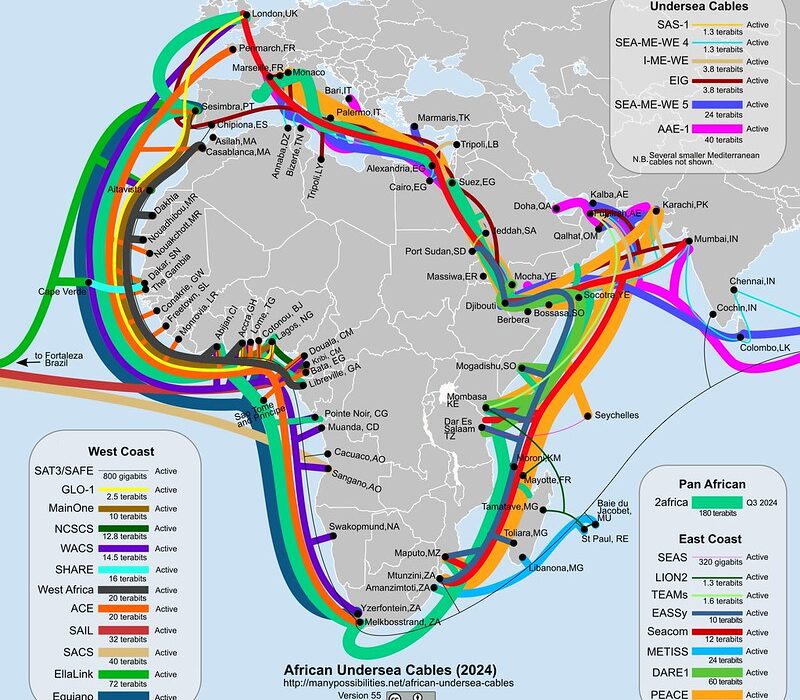
Africa’s rapid digital expansion is being driven by surging demand for mobile data, fintech services and online platforms. But the underlying architecture of that growth remains largely external, raising a strategic question for policymakers and investors alike: who controls Africa’s data, and who captures its value?

AfricaHeadline Reports Team
editorial@africaheadline.com
With more than 1.4bn people, roughly 17% of the global population, Africa accounts for less than 1% of global data centre capacity, according to industry estimates cited by the African Data Centres Association. At the same time, mobile data traffic on the continent is expanding at 30–40% annually, one of the fastest growth rates worldwide, according to the GSMA.
The imbalance is structural. Africa is becoming a major consumer of digital services without a proportional increase in control over the infrastructure that stores, processes and monetises its data.
The continent’s digital ecosystem is increasingly influenced by competing global powers.
US-based technology companies dominate cloud computing, digital advertising and platform economies. China has financed and built a significant share of Africa’s telecommunications backbone, including fibre networks and switching infrastructure, often through state-linked enterprises. Meanwhile, the European Union continues to export regulatory standards through frameworks such as GDPR, shaping global norms on data governance.
“This is no longer just about connectivity. it is about economic sovereignty,” said a policy expert at the Brookings Institution. “Countries that do not control their data infrastructure risk losing control over the value generated by their own digital economies.”
The economic implications are measurable. Data hosted outside Africa can experience latency of 70 to 100 milliseconds, compared with below 20 milliseconds in regions with dense local infrastructure, according to industry benchmarks. That gap affects everything from financial transactions to cloud-based services.
More critically, it shifts revenue flows outward.
Global cloud providers and digital platforms capture a large share of value generated by African users. While precise figures vary, analysts estimate that a majority of high-value digital services used in Africa are monetised outside the continent, limiting domestic tax capture and reinvestment.
The International Finance Corporation has identified digital infrastructure as a key bottleneck to economic transformation, noting that Africa requires tens of billions of dollars in investment in data centres, fibre networks and cloud ecosystems to close the gap.
African governments are beginning to respond.
The African Union has adopted a continental data policy framework aimed at harmonising governance and supporting a single digital market under the AfCFTA. At national level, regulatory momentum is building.
Nigeria’s Data Protection Act (2023) marked a turning point in enforcement, including high-profile penalties against multinational tech firms. South Africa’s POPIA has strengthened compliance requirements across industries, while Kenya has introduced stricter rules governing cross-border data transfers. Rwanda has implemented authorisation mechanisms for data exports.
Together, these developments signal a shift: data is increasingly being treated as a strategic asset rather than a by-product of connectivity.
Nigeria, Africa’s largest digital economy, offers a glimpse of this transition. In recent years, authorities have moved to enforce data protection rules more aggressively, including regulatory actions targeting global technology companies over privacy and consumer rights violations.
The approach reflects a broader recalibration, from enabling access to asserting control. However, enforcement capacity, regulatory clarity and investor confidence remain delicate balancing factors.
The rapid rollout of satellite internet services across Africa is expanding access in underserved regions, but also introducing new governance challenges.
Unlike terrestrial infrastructure, satellite networks operate across jurisdictions, raising questions about licensing, data routing and regulatory oversight. Governments are increasingly seeking to integrate these services into national frameworks to avoid losing visibility and control over data flows.
Other regions have moved faster to align infrastructure, regulation and economic strategy.
The European Union combines GDPR with the Data Act to regulate both personal and industrial data. China maintains tight state control over digital ecosystems through its cybersecurity and data laws. India is scaling domestic digital infrastructure alongside evolving regulatory frameworks.
In each case, data is treated as critical infrastructure linked to economic competitiveness and national security.
Africa, by contrast, remains in a transitional phase, expanding access rapidly but still consolidating control.
The current wave of digital investment offers Africa a rare opportunity to reshape its position in the global digital economy. Investment in local data centres, cloud infrastructure and regulatory capacity could significantly increase value retention and reduce dependency.
But the window may be narrowing.
As global digital ecosystems consolidate and infrastructure ownership becomes more entrenched, late entrants risk being locked into structurally dependent positions.
Africa’s digital future will not be defined by connectivity alone.
It will be defined by whether the continent can store, process and govern its own data, and capture the economic value it generates.
Africa is no longer on the margins of the digital economy, it is one of its fastest-growing frontiers.
But without strategic control over infrastructure and data, the continent risks becoming digitally connected, yet economically peripheral in the very system it is helping to scale.
AfricaHeadline
Strategic Intelligence, Policy Analysis and Investment Perspectives Across Africa
© 2026 AfricaHeadline. All rights reserved.