DRC–Angola Economic Forum signals strategic push to reshape Central Africa’s trade corridor
- Central AfricaDemocratic Republic of the Congo (DRC)Economic
- March 30, 2026

AfricaHeadline Reports Team
editorial@dw-demosnewstaion.online
With a combined population exceeding 140 million people and an estimated aggregate GDP of $180bn to $200bn, the two countries form one of the most significant economic platforms in Central and Southern Africa. Yet formal bilateral trade remains below $500m annually, highlighting a persistent gap between economic potential and actual integration.
This disparity is even more pronounced in global comparison. Intra-regional trade exceeds 60% in the European Union and around 40% in Asia, while Africa remains below 20%, underscoring the continent’s structural fragmentation despite ongoing integration efforts.
At the core of the DRC–Angola partnership lies a clear economic complementarity. The Democratic Republic of Congo accounts for approximately 70% of global cobalt production and remains a key supplier of copper, both critical to the global energy transition and electric mobility industries.
Angola, meanwhile, is positioning itself as a strategic Atlantic gateway. Infrastructure such as the Lobito Corridor, linking mineral-rich regions of the DRC and Zambia to global export routes, has gained renewed importance amid international efforts to diversify supply chains.
This alignment of resource endowment and logistical capacity positions the DRC–Angola axis as a potential backbone of Central Africa’s integration into global markets.
Despite this strategic logic, structural constraints remain significant. Between 40% and 60% of cross-border trade is estimated to occur informally, reducing fiscal capture and weakening institutional oversight.
Border inefficiencies persist. Crossing times can exceed 24 to 48 hours in key trade points, driven by inadequate infrastructure, fragmented customs procedures and limited digitalisation.
At the same time, constrained access to finance, particularly for small and medium-sized enterprises, continues to limit the development of local value chains and industrial capacity.
The African Continental Free Trade Area offers a framework to address these constraints. Intra-African trade, currently below 20%, is projected to rise to over 50% by 2035 if implementation is effective.
Within this context, the DRC–Angola corridor could become a critical test case. Analysts suggest that bilateral trade could expand to between $1bn and $2bn annually within the next decade, provided that reforms in logistics, regulation and infrastructure are accelerated.
Globally, the Democratic Republic of Congo has become a focal point in the strategic competition for critical minerals, particularly among China, the United States and the European Union. Much of the country’s mining sector remains reliant on foreign capital, raising questions about long-term value capture.
Angola, for its part, is leveraging economic reforms and non-oil growth, now exceeding 5% in key sectors, to position itself as a stabilising logistical and commercial hub in the region.
However, risks remain. Commodity price volatility, governance challenges and the absence of large-scale local industrialisation could limit the transformative impact of this partnership.
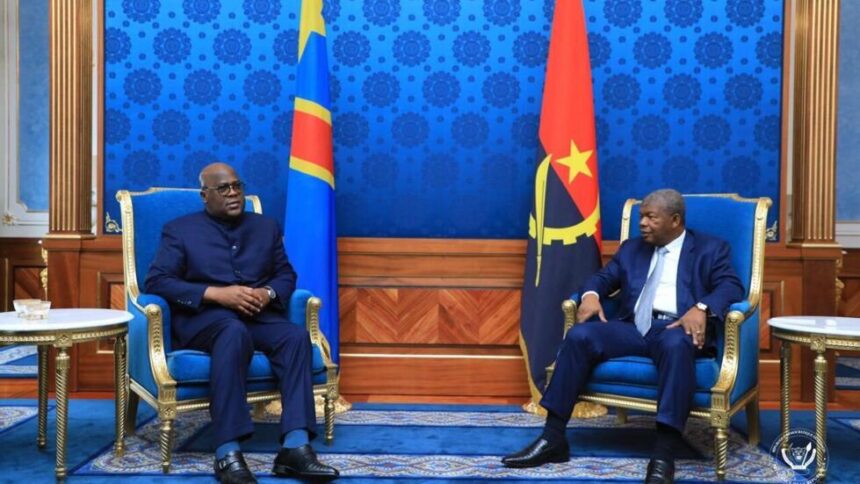
The DRC–Angola Economic Forum is more than a diplomatic platform. It is a strategic test of whether regional cooperation can translate into tangible economic power.
In a global economy increasingly defined by supply chain security and resource competition, the Democratic Republic of Congo and Angola have a narrow but critical window to redefine their role, not merely as exporters of raw materials, but as architects of a new regional economic order.
AfricaHeadline
Strategic Intelligence, Policy Analysis and Investment Perspectives Across Africa
© 2026 AfricaHeadline. All rights reserved.