


Johannesburg — As artificial intelligence systems continue to expand across Africa’s public institutions, financial markets and digital platforms, legal scholars and technology experts are set to gather at the African Cyber Law Conference 2026, scheduled for March 24–25 at the Chalsty Centre, Wits School of Law, to debate one of the continent’s most pressing questions: who will control the rules of the digital future.

AfricaHeadline Reports Team
editorial@africaheadline.com
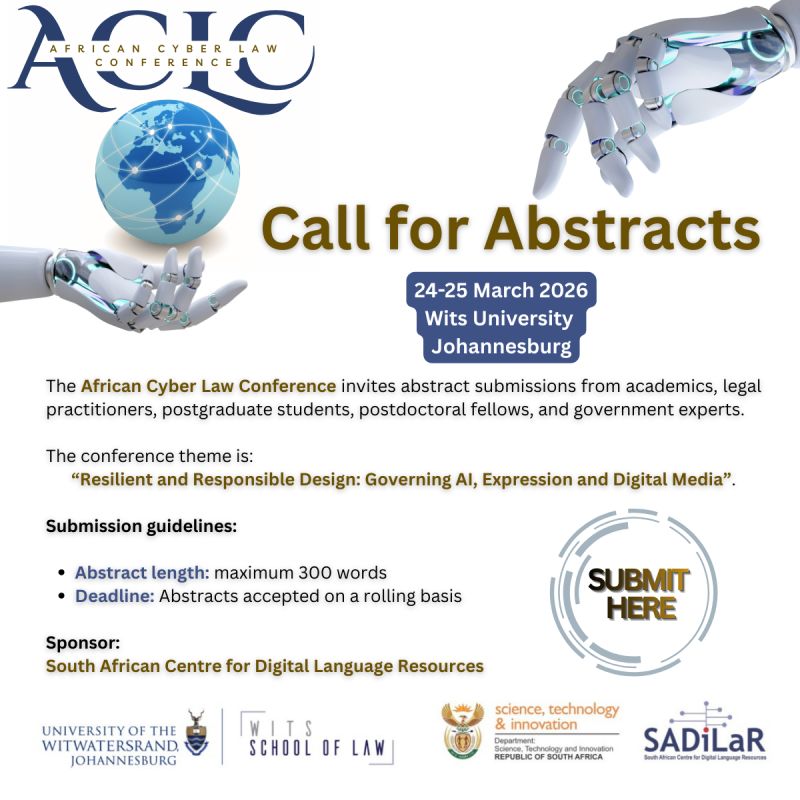
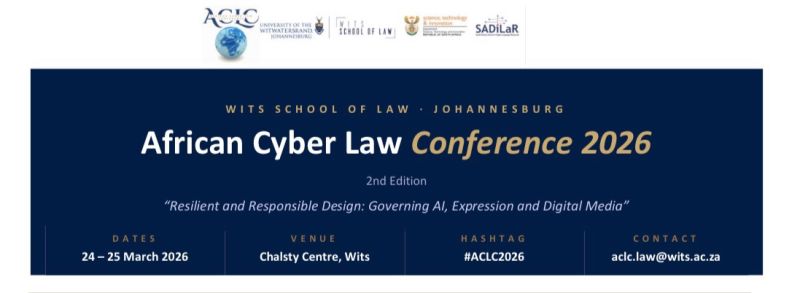
The second edition of the conference, to be held under the theme
“Resilient and Responsible Design: Governing AI, Expression and Digital Media,”
will take place at a moment when African governments are accelerating digital transformation while still seeking to develop robust legal frameworks capable of regulating algorithms, protecting data and limiting the influence of foreign technology companies.
Organized by the Wits School of Law, with support from the South African Centre for Digital Language Resources (SADiLaR), the event is set to bring together academics, lawyers, policymakers and industry representatives from across the continent to explore how Africa can govern artificial intelligence without reproducing externally designed legal models.
The opening plenary, titled
“Fair, Transparent and Explainable AI in African Contexts: Governance Beyond Compliance,”
will focus on the risks associated with adopting AI systems without adequate legal oversight.
Speakers are expected to warn that many African countries are deploying digital technologies developed abroad, often without clear rules on accountability, transparency or constitutional limits. Participants are likely to argue that reliance on regulatory frameworks imported from Europe or the United States may result in legal regimes that fail to reflect local realities or safeguard national interests.
Professor Chijioke Okorie, who is set to deliver the keynote address, is expected to argue that the governance of artificial intelligence must be grounded in constitutional principles rather than confined to technical standards.
“Africa cannot approach AI only as a user of technology,” he is expected to state, according to the event programme.
“It must also define the rules under which that technology operates.”
Morning sessions will explore key themes including AI governance, digital surveillance, human rights in algorithmic systems and the development of policy infrastructure capable of supporting public regulation of digital platforms.
One of the most anticipated presentations will examine the concept of algorithmic sovereignty, increasingly invoked by legal scholars to describe the capacity of states to control the digital systems that shape economic and political decision-making.
In a paper titled
“Algorithmic Sovereignty in Africa: Constitutional Accountability and the Governance of AI in Emerging Digital Economies,” researcher Valdirene Alberto Simão of Angola’s Agostinho Neto University will argue that African states must develop constitutional mechanisms to supervise the use of artificial intelligence across public administration, financial systems and law enforcement.
The study is expected to warn that opaque algorithms and foreign-controlled platforms may influence public decision-making without democratic oversight, creating new forms of dependency analogous to those observed in earlier phases of economic globalization.
Participants are expected to emphasise that the issue is becoming increasingly urgent as African governments adopt digital tools for taxation, policing, social services and electoral processes.
Without clear legal safeguards, several speakers are likely to note, the expansion of AI systems may weaken rather than reinforce state authority.
Another plenary session will examine how artificial intelligence is already reshaping legal practice across Africa.
Under the panel
“AI Use in Legal Practice: Professional Guidelines, Competence and Accountability,”
lawyers and academics will discuss the growing use of automated tools in legal research, contract analysis and judicial processes.
Speakers are expected to caution that, while AI may enhance efficiency, it also raises complex questions concerning professional responsibility, due process and the risk of error in automated decision-making.
Legal education, several participants are expected to argue, will need to evolve rapidly in order to prepare future lawyers for a system in which technology plays a central role.
The first day of the conference will conclude with the launch of the book
“Technological Disruption in Legal Education and Practice, Navigating the Complexities and Embracing the Future,” which will examine how digital transformation is reshaping both legal education and professional practice.
The conference will unfold against the backdrop of broader efforts by African countries to position themselves within global debates on artificial intelligence, data governance and digital sovereignty, domains increasingly shaped by the United States, China and the European Union.
Analysts at the event are expected to warn that Africa risks becoming primarily a consumer of externally developed technologies unless it strengthens its legal institutions and invests strategically in domestic research and innovation.
Several speakers are expected to emphasise that digital sovereignty is not merely a technical concern, but a fundamentally political one, encompassing control over data, infrastructure and decision-making systems that directly impact national security and economic development.
The conference will run through March 25, concluding with additional sessions on regulation, policy development and the future trajectory of digital law in Africa.
AfricaHeadline | International Desk | Technology & Policy
© 2026 AfricaHeadline. All rights reserved.


