Professor Jeffrey Sachs condemns global exploitation and calls for systemic change
- AmericaOpinionsSAUTIWorld
- January 23, 2025
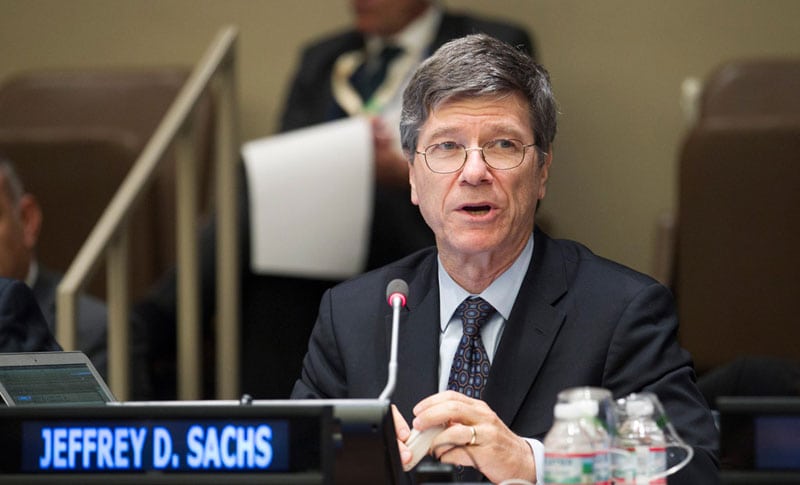

Lisbon, Portugal – Renowned economist and Columbia University professor Jeffrey Sachs has delivered a scathing critique of the historical and ongoing exploitation of developing nations.

AfricaHeadline Reports Team
editorial@dw-demosnewstaion.online
Highlighting the brutal colonial legacy of King Leopold II in the Congo, Sachs traced the country’s suffering from decades of Belgian exploitation to the CIA-backed assassination of its first democratic leader, Patrice Lumumba, and the imposition of dictatorship.
“If we begin by acknowledging the historical truth: the King of Belgium created a brutal slave colony in the Congo that lasted for 30 years. After that, the Belgian government took over and continued to run this colony for another 40 years, perpetuating exploitation and suffering. When the Congolese people finally sought independence, the CIA orchestrated the assassination of their first popular leader, Patrice Lumumba, and then installed a dictatorship that lasted for the next 30 years. Today, corporations like Glencore and others exploit Congo’s vast cobalt resources without providing fair tax revenues or benefits to the local population.”
He also pointed to modern-day resource exploitation by multinational corporations like Glencore, which extract valuable resources such as cobalt while contributing little to local development.
“We rarely reflect on this history. Instead, we patronizingly ask, ‘What’s wrong with you? Why can’t you govern properly?’ But the truth is, this is the system we have created—one rooted in exploitation, inequality, and external control. And it is a system that needs to change.”
Sachs extended his critique to Latin America, recalling how corporations like United Fruit controlled nations with the backing of U.S. foreign policy and military interventions, such as the CIA-led overthrow of Guatemala’s President Jacobo Árbenz.
“We cannot simply hand over responsibility to the private sector, as we did a century ago. It wasn’t just the private sector—it was the private sector backed by military might, particularly the U.S. military. For example, in Honduras, United Fruit controlled the country for decades, with their attorney serving as the U.S. Secretary of State, John Foster Dulles, while his brother, Allen Dulles, led the CIA. Together, they orchestrated the overthrow of Guatemala’s democratically elected president, Jacobo Árbenz, to protect United Fruit’s interests.”
“This is the system—a deeply entrenched web of exploitation and domination—and it is clear that we need a fundamentally different approach, one that prioritizes justice, sovereignty, and fairness over profits and power.”
Condemning this deeply entrenched system of exploitation, Sachs called for a complete rethinking of global governance, urging a shift towards justice, equity, and sovereignty for nations long exploited by foreign powers and corporate greed.