Angola Is Building an Economy Beyond Oil. Now It Has to Prove It Can Sustain Itself
- Uncategorized
- August 20, 2026
 Save as PDF
Non-oil output expanded 6.22% in the first quarter of 2026 as crude contracted again. Agriculture, logistics, privatizations and billions of dollars in infrastructure are reshaping the economy. The harder test is turning growth into productivity, exports and private capital.
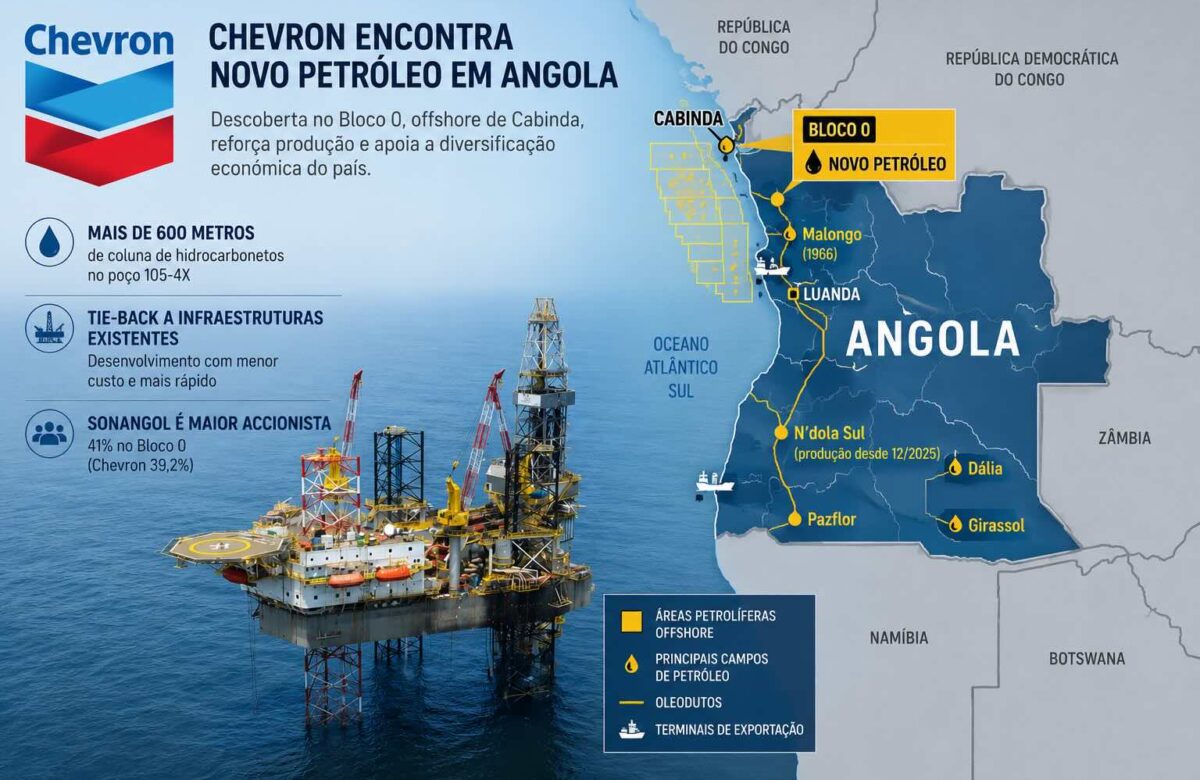
LUANDA – Angola faces a paradox that captures nearly a decade of economic reform: it still needs oil to finance the construction of an economy designed to depend less on it.
The first numbers from 2026 suggest that transition is becoming more than a policy ambition. Gross domestic product expanded 5.32% from a year earlier in the first quarter, even as the oil sector contracted 0.21%, marking a fifth consecutive quarter of decline. Non-oil activity grew 6.22%, according to data released by the National Statistics Institute on May 26.
More important than the headline number is where the growth came from. Information and communications expanded 27.63%, transportation and storage 16.12%, fishing and aquaculture 8.73%, and electricity, water and sanitation 8.15%.
The composition points to an economy that is becoming more diversified than the one that for decades rose and fell largely with crude production and prices.
But growth outside oil is not the same as independence from oil.
That distinction will define the next phase of President João Lourenço’s economic overhaul. Angola can produce more food, move more freight, privatize companies and build factories. Structural transformation will only be established when those activities become productive enough to generate formal employment, investment, tax revenue and, above all, the foreign currency that oil still overwhelmingly provides.
Oil Has Weakened, But Not Lost Its Power
The scale of the challenge is clearest in Angola’s external accounts.
The economy expanded 3.1% in 2025, but a sharp decline in oil production weakened both the fiscal and external positions. The budget deficit widened to 4.1% of GDP, while the current-account surplus narrowed to just 0.4%. International reserves ended the year at about $15.9 billion, equivalent to roughly 7.4 months of imports, according to the International Monetary Fund.
Oil production fell to around 1.03 million barrels a day in 2025, from 1.10 million a year earlier. Oil and gas exports declined to about $28.1 billion, from $34.6 billion.
Those numbers explain why diversification is both urgent and difficult.
The faster oil loses its ability to support Angola’s external accounts, the greater the need to develop agriculture, manufacturing and exportable services. Yet declining petroleum revenue also reduces the fiscal space available to finance roads, electricity, irrigation and other infrastructure needed to build that new economy.
Angola is effectively trying to replace the engine while the vehicle is still moving.
Growth Is No Longer Enough
The first phase of Angola’s economic reforms focused largely on correcting imbalances.
Since 2018, the government has liberalized the exchange-rate regime, allowed a substantial adjustment of the kwanza, begun phasing out fuel subsidies, launched privatizations and sought to reduce the state’s direct role in commercial activity.
The result has been an economy more exposed to market forces, and to their costs.
Inflation climbed to about 31% in July 2024 before beginning to ease. It stood at 15.7% in December 2025 and declined to 12.4% in March 2026, helped by restrictive monetary policy and greater exchange-rate stability, according to the IMF.
Gross public debt stood at about 51.3% of GDP in 2025. The IMF has warned, however, that elevated financing requirements could again put pressure on debt and constrain the government’s ability to fund other priorities.
That is where the more difficult second phase begins.
Macroeconomic stabilization can be driven by fiscal policy, monetary tightening and regulatory reform. Productivity requires companies, skilled workers, financing, reliable electricity, logistics, technology and access to markets.
Angola remains particularly weak in one of the areas where that transformation should begin: credit.
A $100 Billion Economy With Little Private Credit
Bank lending to Angola’s private sector amounts to only about 6% of GDP, compared with a median of more than 20% across sub-Saharan Africa, according to the IMF’s May 2026 assessment.
Only about 36% of Angolan adults have a bank account, 9% save through the financial system and just 1% borrow from banks.
The gap is structural.
Private credit has failed to keep pace with the nominal expansion of the economy over the past decade. At the same time, the government continues to absorb a significant share of domestic financial resources.
The IMF has explicitly identified the risk that large public-sector financing needs could crowd out private credit and social spending.
That creates a contradiction at the center of Angola’s diversification strategy.
The government wants private companies to replace imports, build factories, mechanize agriculture and export. Yet farmers and manufacturers need five-, 10- or 15-year capital, while lending to the sovereign can offer banks a more attractive combination of yield and risk.
Unless that equation changes, Angola may diversify production without sufficiently diversifying how that production is financed.
Agriculture: A Plan to Double Grain Output
The scale of Angola’s agricultural ambitions is reflected in PLANAGRÃO, its national grain-development program.
The initiative aims to increase combined production of corn, rice, wheat and soybeans from 3.03 million metric tons in 2021 to 6.10 million tons by 2027, effectively doubling output in six years.
The program envisages average annual investment of about $670 million in agricultural production, alongside roughly $471 million for productive and social infrastructure.
But tonnage is only one measure of success.
Angola needs to convert agricultural output into functioning value chains spanning seeds, irrigation, storage, processing, packaging, transportation and exports.
A program approved by the African Development Bank in November 2025 illustrates the shift in scale. The lender committed $211.4 million to developing agricultural value chains in eastern Angola, with the government expected to provide an additional $100 million in parallel financing.
Scheduled to run from 2026 through 2031, the project is expected to bring an additional 150,000 hectares into agricultural production, rehabilitate 2,500 hectares of irrigated land, establish six agribusiness centers and upgrade 400 kilometers of rural roads.
The program is expected to reach 1.2 million people across six provinces and create 7,500 direct jobs, with at least half allocated to women and a third to young people.
The policy is becoming more sophisticated: finance the farm, connect it to a road, connect the road to processing, and connect processing to a market.
Lobito Can Be More Than a Copper Railway
No project better illustrates that opportunity than the Lobito Corridor.
Angola’s railway stretches roughly 1,289 kilometers, connecting the Atlantic port of Lobito with Luau near the border with the Democratic Republic of Congo.
The US International Development Finance Corporation approved a loan of as much as $553 million, with a 15-year tenor, to upgrade the railway and mineral terminal. The financing forms part of a project with total funding sources estimated at roughly $866 million.
The goal is to dramatically increase freight capacity.
DFC estimates the improvements could lift transport capacity from around 400,000 tons a year to 4.6 million tons, more than a tenfold increase, while logistics costs could fall by as much as 30%.
But those numbers also expose the central question surrounding the project.
The corridor is designed in large part to move copper and cobalt from the Democratic Republic of Congo toward the Atlantic. For Washington and its partners, it forms part of a broader effort to diversify critical-mineral supply chains.
Angola needs the economic logic to go further.
If trains arrive at Lobito loaded with Congolese copper and return inland without carrying fertilizer, food, machinery, manufactured goods and Angolan exports, the country will have built an efficient logistics route primarily serving its neighbors.
The payoff would be considerably larger if the railway became the backbone of an economic zone.
The African Development Bank is moving in that direction, describing the corridor as a potential platform for agricultural and industrial trade among Angola, Congo and Zambia and announcing about $500 million in support for its development.
The economic question is therefore no longer simply how many tons will move through Lobito.
It is how much value will remain in Angola.
Selling State Assets Is Easier Than Creating Productivity
Angola’s privatization program, known as PROPRIV, is another attempt to reshape the structure of the economy.
Its success should not be measured simply by transferring assets from the public balance sheet to private investors. The relevant question is whether privatized businesses invest, hire workers, export, innovate and pay taxes.
That distinction matters in an economy where the state has for decades simultaneously acted as regulator, shareholder, financier and major customer.
Reducing that footprint can improve efficiency and competition. But privatization without competition can merely replace a public monopoly with private concentration.
The same principle applies to foreign investment.
An announced project is not deployed capital. A memorandum of understanding is not a factory. A credit line is not production.
Angola’s next generation of economic statistics should therefore systematically distinguish between announced investment, contracted investment, capital actually deployed, installed capacity, realized production and exports generated.
That sequence, rather than headline investment pledges, is what ultimately measures economic transformation.
Foreign Currency Is the Real Test
One measure brings most of these challenges together: exports.
Oil and gas still accounted for about 19.9% of GDP in 2025, while total goods exports were equivalent to roughly 21.6% of GDP, underscoring the continued concentration of Angola’s external sector in hydrocarbons.
That may be one of the most important statistics for understanding the limits of diversification.
A restaurant, supermarket or telecommunications company can increase non-oil GDP. But if its expansion requires imported equipment, food or technology without generating corresponding external revenue, it remains indirectly dependent on the foreign currency earned by petroleum exports.
A farm that replaces imported wheat does something different: it reduces demand for dollars.
A factory that exports processed food goes one step further: it starts earning those dollars itself.
It is in the transition from import substitution to export generation that diversification becomes economic resilience.
2030 Will Be a Better Test Than 2026
Angola has traveled a considerable distance since 2017.
The economy is more exposed to market forces, inflation is declining, state assets are moving into private hands, agriculture is attracting capital and the Lobito Corridor is transforming an old railway into one of Africa’s most strategically important infrastructure projects.
But the numbers also argue for caution.
The IMF expects medium-term growth to remain relatively modest and says Angola’s performance will increasingly depend on the success of diversification as petroleum revenues face structural pressure.
The country’s progress by 2030 should therefore not be judged by how many programs were launched or how many billions of dollars were announced.
Five indicators will matter more: how much non-oil exports increased; how much credit reached businesses; how much productivity improved; how many formal jobs were created; and how fast the economy can grow when oil production and petroleum revenue decline.
How Angola Pulled It Off tells the first part of that story: how reforms, infrastructure and investment began building a second economic engine.
The second part will be harder.
Angola has shown that its non-oil economy can grow while petroleum contracts. Now it must prove that growth can finance investment, earn foreign currency and sustain itself without permanently relying on the engine it is supposed to replace.