Angola seeks to turn another oil discovery into fuel for diversification
- EconomicWorld
- August 20, 2026

Chevron’s latest find comes as Luanda tries to sustain an oil industry producing about 1mn barrels a day while building a second growth engine in agriculture, manufacturing, mining and logistics
LAGOS — More than seven decades after Chevron began searching for oil in Angola, the US energy major has made another discovery off the coast of Cabinda. This time, however, the significance of the find extends beyond how many barrels may eventually be recovered.
For Angola, the bigger question is whether another generation of petroleum investment can help finance an economy that is becoming progressively less dependent on it.
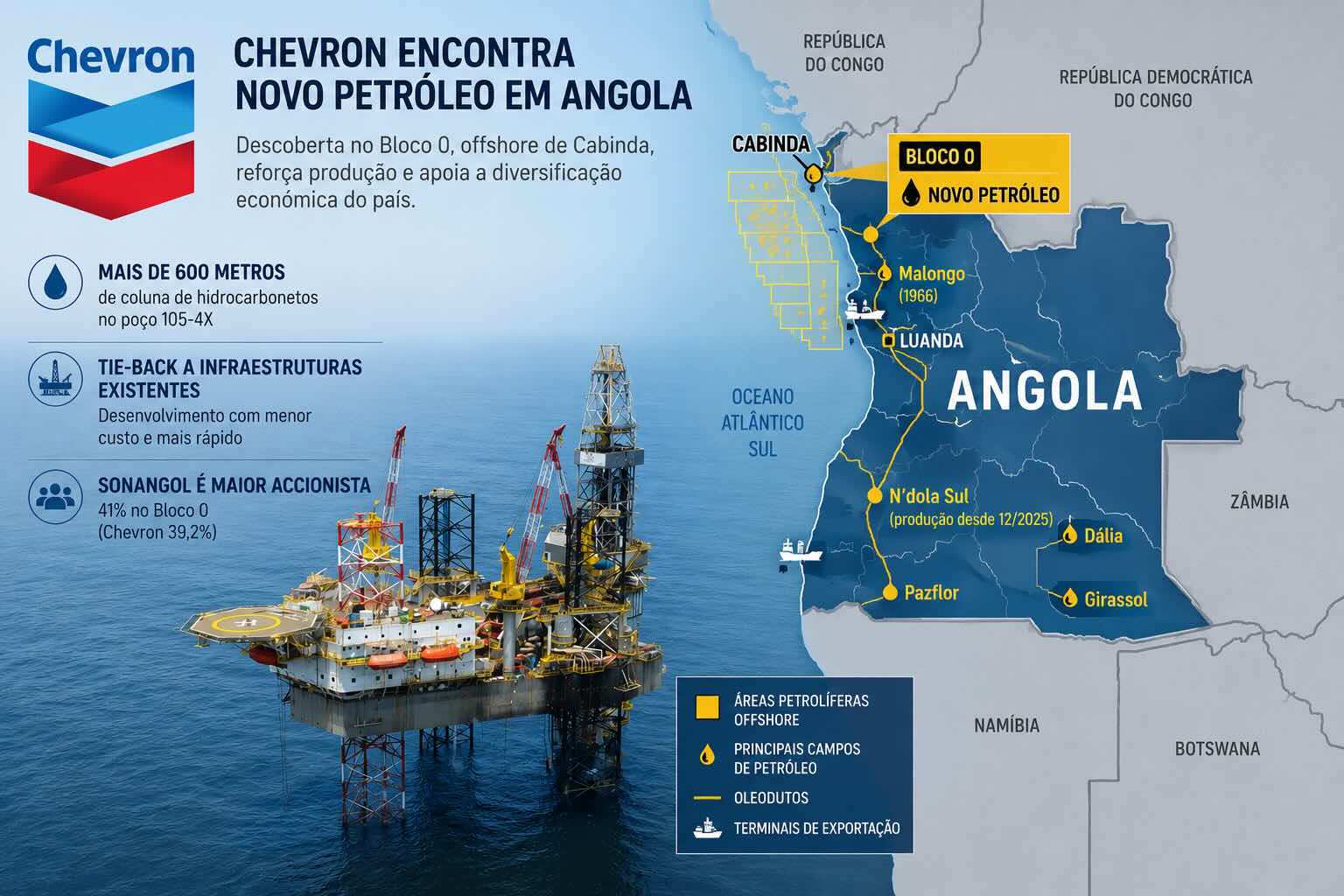
Chevron said its 105-4X exploration well in Block 0, in the Lower Congo Basin, encountered an oil and gas condensate column of more than 600 metres, including more than 90 metres of net pay in the Pinda reservoir, which the company described as being of “excellent” quality.
The company has not disclosed recoverable reserves, potential production, capital expenditure or a date for first oil. Those numbers will determine whether the discovery becomes commercially important.
But 105-4X has one immediate advantage: location.
Chevron is assessing whether the discovery can be developed as a tie-back to existing facilities, potentially avoiding some of the multibillion-dollar infrastructure normally associated with a standalone offshore development.
That could make the find particularly valuable for a country attempting to manage two economic transitions simultaneously: replacing production from ageing oilfields while accelerating growth outside petroleum.
Angola still needs oil. But increasingly, it needs oil to help build an economy that needs it less.
Two engines moving in different directions
The numbers illustrate the transition. Angola produced about 1.04mn barrels of crude a day in June 2026, maintaining output above the psychologically important 1mn b/d threshold. Yet the country’s mature offshore fields remain under structural pressure.
The IMF said in May that a “significant decline” in oil production weakened Angola’s fiscal and external positions in 2025. Overall GDP nevertheless expanded 3.1 per cent, supported partly by public spending and non-oil activity. Inflation, meanwhile, declined to 12.4 per cent in March 2026, although it remained high by regional standards.
The contrast is increasingly important. Angola’s petroleum industry is fighting depletion. Its non-oil economy is fighting for scale.
If the second succeeds while the first remains sufficiently productive to finance the transition, the country could begin to weaken one of the most persistent relationships in its post-independence economy: the link between oil production and almost every other important macroeconomic indicator.
The IMF expects Angola’s economy to expand about 2.3 per cent in 2026, while its latest data put real non-oil GDP growth at about 2.4 per cent. The Fund argues that medium-term growth increasingly depends on the success of economic diversification.
That is less spectacular than the growth rates Angola recorded during the oil boom of the 2000s.
But its composition matters. Growth generated by farms, factories, logistics companies, construction, telecommunications and services is potentially more labour-intensive and less vulnerable to a single commodity price than growth generated by another offshore platform.
Oil still pays the bills
Diversification, however, should not be confused with disengagement from petroleum.
Oil still accounts for about 94 per cent of Angola’s exports and roughly 60 per cent of fiscal revenues, according to IMF analysis.
That concentration explains why maintaining production matters even as the government promotes agriculture, manufacturing and mining.
When oil production or prices fall, fewer dollars enter the economy. Fiscal revenues weaken. Foreign-exchange liquidity tightens. Pressure increases on the kwanza. Government financing becomes more difficult and imports of machinery and intermediate goods become more expensive.
The consequences were visible last year.
Angola’s current-account surplus narrowed from 5.3 per cent of GDP in 2024 to just 0.4 per cent in 2025, partly because crude exports fell sharply. Oil exports declined from the equivalent of 26.3 per cent of GDP in 2024 to an estimated 17.2 per cent in 2025.
Lower petroleum revenues, combined with spending pressures, pushed the overall fiscal deficit to 4.1 per cent of GDP in 2025.
International reserves nevertheless ended the year at about $15.9bn, equivalent to 7.4 months of imports. The IMF projects reserves of about $16.2bn in 2026, or roughly 7.7 months of imports.
The Fund expects the current-account surplus to recover to about 2.2 per cent of GDP in 2026, helped by stronger oil export earnings.
That provides Angola with something particularly useful during a structural transformation: time.
The Chevron discovery is therefore about more than Chevron
The economics of 105-4X fit neatly into this transition.
Developing a new offshore field from scratch can require billions of dollars for an FPSO, subsea equipment, pipelines and processing facilities. Connecting a discovery to infrastructure that already exists can substantially reduce the amount of new capital required.
Angola increasingly has the infrastructure to do this.
Chevron began exploration in the country in 1954. It discovered offshore oil at Malongo in 1966, started production in 1968, and discovered Takula in 1971.
Angola and the Block 0 partners extended the concession in 2021 for another 20 years, to 2050.
In 2022, Chevron moved ahead with N’dola South.
In 2024, the company expanded its Angolan exploration portfolio and brought the Sanha Lean Gas Connection closer to the centre of its gas strategy.
On December 24 2025, N’dola South began production.
Less than eight months later, on August 17 2026, Chevron announced the 105-4X discovery.
The latest find therefore comes from a petroleum province that has been producing commercially for almost six decades.
What once might have been considered simply an ageing asset has acquired another function: Block 0 is now an infrastructure platform through which smaller discoveries can potentially be commercialised more cheaply and quickly.
Sonangol has a direct stake
The economics also extend directly to the Angolan state.
Chevron subsidiary Cabinda Gulf Oil Company operates Block 0 with a 39.2 per cent working interest. But state-owned Sonangol E&P holds 41 per cent, making it the largest individual shareholder. TotalEnergies owns 10 per cent and Azule Energy 9.8 per cent.
If 105-4X becomes commercial, the benefits would therefore flow not only through taxes, royalties and foreign-exchange receipts but also through Sonangol’s direct equity participation.
That creates an important link between Angola’s old economy and its intended new one.
The question is what happens to the value created.
From wells to farms and factories
Angola has spent much of the period since 2017 attempting to change the answer.
The government has liberalised the exchange-rate regime, reformed investment rules, launched privatisations and sought to attract private capital into agriculture, manufacturing, mining and infrastructure.
The strategy increasingly rests on several interconnected sectors, agriculture can reduce food imports and provide raw materials for industry, agro-processing can convert those crops into higher-value products, manufacturing can replace imports and eventually generate exports, mining can broaden the country’s commodity base beyond petroleum and transport infrastructure can connect all of them to international markets.
This is where projects such as the Lobito Corridor assume importance beyond railways.
The corridor links Angola’s Atlantic port at Lobito with the copper and cobalt regions of the Democratic Republic of Congo and, eventually, Zambia. Its economic promise is not simply to move minerals more quickly to the sea. It is to create an east-west commercial spine around which agriculture, logistics, warehousing, processing and manufacturing can develop.
If that happens, Angola would increasingly earn foreign currency not only because oil leaves Cabinda and Luanda but because goods and minerals move through Lobito.
The diversification test is investment, not slogans
There is nevertheless a difference between building infrastructure and creating productivity.
The IMF identifies human capital, infrastructure, the business environment and access to credit as four of the principal constraints on Angola’s diversification.
The last of these is particularly important.
Angola’s financial system remains relatively small. At the end of 2024, total financial-sector assets were equivalent to only 26.9 per cent of GDP, compared with 63.6 per cent in August 2011. Banks accounted for 87 per cent of those assets.
At the same time, the government’s financing requirements risk competing with companies for available capital.
The IMF warned this year that elevated fiscal financing needs were crowding out private credit and social spending.
That is one of the central contradictions in Angola’s diversification strategy.
A farmer can have fertile land and a road to market. A manufacturer can have electricity and demand. But neither can expand efficiently if banks find it safer and more profitable to finance the state.
For diversification to become self-sustaining, petroleum revenue must therefore do more than finance public investment. It must help create the macroeconomic stability in which private capital becomes the principal investor.
Debt makes the equation harder
Angola has less fiscal room than it did during previous oil booms.
The IMF estimates gross public debt at about 51.3 per cent of GDP in 2025 and projects roughly 51.6 per cent in 2026under its baseline.
The Fund has consequently recommended that any oil windfall be used partly to reduce debt and rebuild buffers rather than simply finance additional expenditure.
That creates a three-way competition for every additional petroleum dollar, some must support fiscal stability, some must help reduce debt, and some must finance infrastructure and human capital capable of generating non-oil growth.
The quality of that allocation may ultimately matter more to diversification than the size of the next oil discovery.
Gas could become the industrial bridge
There is another route from hydrocarbons to diversification: natural gas.
The 105-4X discovery contains oil and gas condensate, rather than crude alone.
Chevron has already developed the Sanha Lean Gas Connection, linking gas resources from Blocks 0 and 14 to Angola’s gas-processing infrastructure.
For years, Angola’s petroleum model was overwhelmingly organised around crude exports. A larger gas economy offers different possibilities, gas can generate electricity, it can supply fertiliser production, it can feed petrochemicals, and cheaper, more reliable power can improve the economics of manufacturing, mining and food processing.
The distinction matters. Exporting another barrel creates foreign exchange. Using part of the hydrocarbon resource to make domestic industry more competitive can create an economic chain extending well beyond the petroleum sector.
Angola versus other oil economies
Angola is not alone in confronting this problem. Nigeria has a much larger non-oil economy, but still experiences severe foreign-exchange and fiscal pressures when petroleum revenues weaken.
Oman offers another comparison. Non-hydrocarbon activities now account for almost 70 per cent of its GDP, according to the IMF, yet hydrocarbons still generate roughly 80 per cent of government revenue.
The lesson is that diversification has several dimensions. A country can diversify GDP before it diversifies exports, it can diversify exports before it diversifies government revenue, and it can diversify all three while remaining strategically invested in hydrocarbons. Angola is still relatively early in that process.
Its dependence remains unusually high: oil’s roughly 94 per cent share of exports demonstrates how far the country still has to travel.
But that also means relatively modest gains in agriculture, manufacturing, mining and logistics can have increasingly visible effects.
Chevron is making the opposite bet to decline
The US company’s broader African strategy is instructive.
Chevron currently produces about 300,000 barrels of oil equivalent a day net in sub-Saharan Africa.
It has expanded in Nigeria through PPL2000, PPL2001 and deepwater block PPL2010, while recording three near-field exploration successes there since late 2024, Meji NW-1, South Delta AA and Awodi-07.
In Guinea-Bissau it has secured three blocks, including Block 4B, whose acquisition closed on August 13 2026. It has also obtained five reconnaissance licences in Equatorial Guinea.
In Angola, exploration extends beyond Block 0 to Blocks 49 and 50, Block 33 and Block 14/23.
Chevron is also preparing a multi-well regional exploration programme that includes the Nabba-1X well in Namibia’s PEL90 before the end of 2026.
Namibia represents frontier exploration.
Angola represents something different: decades of geological data, producing fields, pipelines, processing facilities, an established services industry and routes to international markets. For Chevron, mature does not necessarily mean exhausted.
1954-2026: an oil industry entering a different phase
The evolution can be reduced to a revealing chronology:
1954 — Chevron begins exploration in Angola.
1966 — offshore oil is discovered at Malongo.
1968 — commercial production begins.
1971 — Takula is discovered.
2000s — deepwater developments help turn Angola into one of sub-Saharan Africa’s largest petroleum producers.
2017 — João Lourenço takes office as Angola begins a broader programme of economic and institutional reform.
2018 onwards — exchange-rate reform and other macroeconomic changes begin reshaping the economic model.
2021 — Block 0 concession is extended to 2050.
January 2024 — Angola completes its withdrawal from Opec, giving itself greater flexibility over production policy.
2024 — Chevron expands its exploration footprint while Angola intensifies investment in transport, agriculture and industry.
December 2025 — N’dola South starts producing.
March 2026 — inflation falls to 12.4 per cent, from much higher levels during the previous inflationary cycle.
June 2026 — crude production remains around 1.04mn b/d.
August 17 2026 — Chevron announces the 105-4X discovery.
The next dates will be more important: appraisal, investment decision and first production.
The second engine
None of this means Angola has completed its diversification, it has not.
Oil still dominates exports. Government finances remain exposed to petroleum. Debt limits fiscal room. Inflation remains in double digits. Credit constraints inhibit private investment. And the IMF describes the medium-term outlook as subdued, explicitly linking future growth to the success of diversification.
But the structure of the challenge is changing.
Angola’s nominal economy is projected by the IMF at about $152bn in 2026. Maintaining a competitive petroleum sector within an economy of that size can provide considerable foreign exchange and investment capacity if the proceeds are managed effectively.
The objective should therefore not be to make oil disappear from Angola’s economy.
It should be to make the rest of the economy grow faster around it.
That is what makes Chevron’s discovery more interesting than its 600-metre hydrocarbon column alone suggests.
If 105-4X proves commercial, it could add lower-cost barrels through infrastructure Angola already possesses. Those barrels can support exports, reserves and fiscal stability while investment flows towards farms, factories, mines, power generation and transport corridors.
The formula is neither guaranteed nor simple. Petroleum wealth can just as easily postpone reform as finance it.
But Angola now has something it lacked during earlier oil cycles, a clearer understanding that petroleum production and economic diversification need not be competing strategies. One can finance the other.
After decades in which crude functioned as Angola’s overwhelmingly dominant economic engine, the more important story may therefore be unfolding away from the oilfields.
The first engine is still running. The task now is to use the time and capital it provides to get the second one up to speed.