‘Habemus President’: Hichilema wins again, now comes the hard part
- ElectionZambia
- August 18, 2026
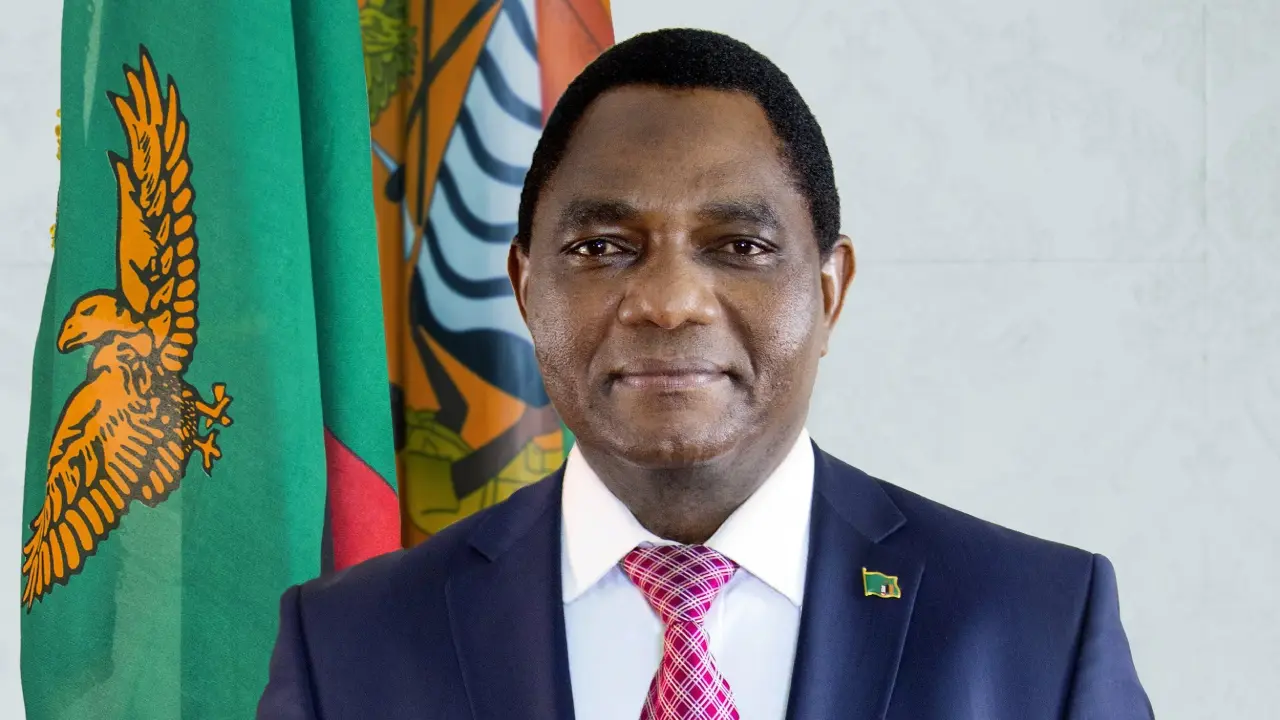

With 61.4% of the vote, Zambia’s president has secured a second term. The result validates his record of economic stabilisation, but leaves a harder question: can he turn copper, investment and debt relief into prosperity that Zambians can actually feel?
LUSAKA — Habemus president. Hakainde Hichilema has won a second five-year term as Zambia’s president, offering investors political continuity and voters a more demanding promise, that the recovery visible in the economic data will finally become visible in household incomes.
Electoral Commission of Zambia chairwoman Mwangala Zaloumis declared Hichilema the winner after results were consolidated from all 226 constituencies. The leader of the United Party for National Development, or UPND, won 2,965,326 votes, equivalent to 61.4% of valid ballots, against 1,856,217, or roughly 38%, for Brian Mundubile, his main challenger.
The margin exceeded 1.1 million votes, comfortably clearing the threshold required to avoid a runoff. It is a decisive victory. It is not a blank cheque.
What voters have given Hichilema is more valuable than another five years at State House in Lusaka: time to prove that the macroeconomic discipline of his first term can deliver microeconomic prosperity in his second, that will be considerably harder.
From candidate of change to President of continuity
Hichilema’s political history helps explain the significance of the result.
A businessman before becoming a politician, he ran repeatedly for the presidency and was once jailed on treason charges during Edgar Lungu’s administration. In August 2021, after several failed attempts, Hichilema defeated Lungu with nearly 59% of the vote, completing one of southern Africa’s most consequential peaceful transfers of power in recent years.
Five years later, Hichilema is no longer the opposition candidate promising to repair the system. He is the incumbent who must demonstrate that the repaired system works.
Voters appear to have given him the benefit of the doubt.
The Zambia that went to the polls in 2026 is different from the country Hichilema inherited. In November 2020, Zambia became the first African sovereign to default during the Covid-19 pandemic. By the end of 2022, its external debt stood at about $18.3 billion, with roughly $13.4 billion falling within the restructuring perimeter.
Hichilema’s administration spent much of its first term negotiating with official creditors, Eurobond holders, multilateral institutions and commercial lenders.
The result has been one of the largest sovereign-debt workouts undertaken under the Group of 20’s Common Framework.
By May 2026, the International Monetary Fund estimated that agreements covered about 94% of the debt included in the restructuring perimeter. Financial engineering, however, is only half the story.
The economy improved, everyday life did not always follow
The numbers give Hichilema plenty to campaign on.
Inflation, which during the crisis rapidly eroded wages and savings, fell to 6.8% in April 2026, returning to the Bank of Zambia’s 6%-8% target range. The primary fiscal surplus reached 3.1% of gross domestic product in 2025, according to the IMF. Yet Zambia remains vulnerable.
In May, the IMF cut its 2026 growth forecast to 4.3%, citing weaker mining output, the normalisation of agriculture after an exceptional 2025 harvest, energy constraints and a deteriorating external environment. Inflation could rise again to 8.5% by year-end, driven partly by fuel prices.
The gap between macroeconomic stabilisation and everyday economic experience became the real battleground of the election.
Hichilema could point to debt restructuring, reserves, inflation, investment and fiscal discipline. Mundubile talked about food prices, jobs and household incomes, both were describing the same economy, just from different altitudes.
Mundubile sought to turn that gap into a potent electoral argument: a recovery celebrated in Washington, London or financial markets means little if families in Lusaka, Kitwe, Ndola or Chingola cannot see it at the dinner table.
It was not enough to defeat Hichilema. But it may define his second term.
Copper is both the answer and the risk
No discussion about Zambia’s economic future gets very far without copper.
The metal accounts for roughly 70% of export earnings and more than 10% of GDP, making Zambia one of the African economies most exposed to, and potentially best placed to benefit from, the global race for minerals needed for power grids, electric vehicles, data centres and the energy transition.
Copper production increased 12% in 2024, from roughly 732,600 tonnes to 820,676 tonnes. The government has set a far more ambitious target: 3 million tonnes a year by 2031.
To get there, Lusaka is seeking to revive old assets while developing new ones.
Konkola Copper Mines and Mopani Copper Mines have returned to the centre of the country’s mining strategy. First Quantum Minerals’ Kansanshi S3 expansion is expected to lift processing capacity to about 55 million tonnes annually, while the Lumwana expansion is designed to raise average production to roughly 240,000 tonnes of copper a year over the mine’s life.
Estimates published before the election suggested that close to $10 billion in new mining investment had been attracted during Hichilema’s administration. This is where an electoral victory becomes an economic equation.
If Zambia can approach 3 million tonnes of annual copper output, Hichilema could preside over a structural transformation. If the country merely exports more ore without creating industrial supply chains, domestic suppliers, skilled jobs, processing capacity and efficiently managed tax revenues, it will have produced more copper without necessarily producing more development.
Washington, Beijing and the new geography of copper
There is also a geopolitical dimension, Zambia sits almost exactly where two competing infrastructure strategies meet.
China, which has financed roads, energy and mining projects in Zambia for decades, is involved in the revival of the Tanzania-Zambia Railway, or TAZARA, the historic route connecting the Copperbelt with the port of Dar es Salaam. The modernisation programme involves roughly $1.4 billion in Chinese support.
To the west lies the Lobito Corridor, backed by the United States, the European Union and other partners and intended to connect the mineral-producing regions of Zambia and the Democratic Republic of Congo with Angola’s Atlantic port of Lobito.
Geography therefore gives Lusaka something increasingly valuable, choice.
For Hichilema, the rational strategy need not be China or America. It is to use competition between the two to lower logistics costs, attract capital, diversify trade routes and strengthen Zambia’s bargaining power.
Copper has transformed a landlocked African country into an important piece of the new geopolitics of critical minerals.
The challenge is to ensure that Zambia does not remain merely the place where raw materials are extracted while most of the value is created elsewhere.
Democracy is an economic asset too
The size of Hichilema’s victory does not erase concerns raised during the election.
Counting was temporarily suspended following attacks on electoral officials and the theft of marked ballot papers. Eleven people, including opposition-linked figures, were detained on election night, adding to political tensions. Mundubile also complained of a security operation at his residence and challenged aspects of the electoral process.
International observers raised concerns over political freedoms and the uneven conditions surrounding the campaign, while Catholic leaders questioned the role of military personnel during the count. The government rejected allegations of repression.
That matters because one of Zambia’s most valuable competitive advantages is not buried underground, it lies in its institutions.
Since the restoration of multiparty politics in 1991, Zambia has built a reputation for relatively peaceful transfers of political power in a region where elections can still produce constitutional crises, violence or prolonged disputes.
Preserving that institutional capital may prove as valuable as opening another copper mine.
The election was about stabilisation, the second term will be about distribution
After the results were announced, Hichilema sought to address those who had voted against him, promising to govern for all Zambians.
Politically, that is sensible. Economically, the promise will need substance. The first term can be summarised in one word, stabilisation. The second will be judged by another, distribution.
Distribution does not mean abandoning fiscal discipline for indiscriminate spending. It means converting mining investment into domestic suppliers; copper into industry; railway corridors into agricultural and manufactured exports; economic growth into jobs; monetary stability into productive credit; and tax revenues into schools, hospitals, reliable electricity and infrastructure.
Hichilema has already shown that he can persuade creditors, now he must persuade households. He has demonstrated that he can attract investors to the Copperbelt.
Now he must show that a mine in Solwezi or Chingola can generate opportunity far beyond its gates.
And he has helped stabilise an economy that was in sovereign default only a few years ago.
Now he needs to make it grow fast enough for the recovery to stop being primarily a macroeconomic narrative and become a social reality.
That is why 2,965,326 votes represent both a victory and a demand for results.
Habemus president, certainly.
But the election has answered only the question of who will govern Zambia. The more consequential economic question for the next five years is different: Who will benefit from the Zambia Hichilema now intends to build?