Ghana President traces Sahel crisis to Libya’s collapse, warns of threat to coastal West Africa
- GhanaPolitics
- September 30, 2026
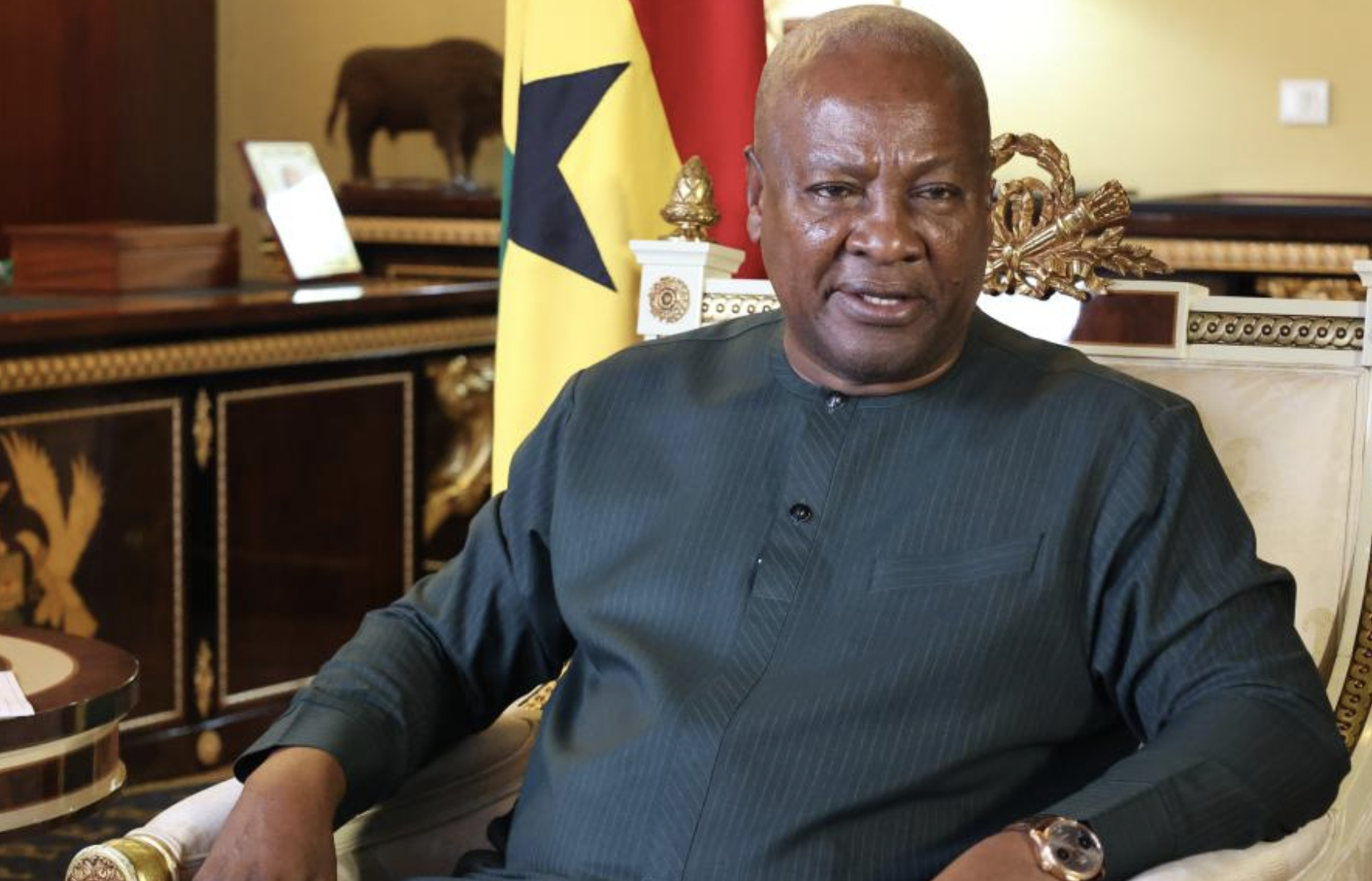

ACCRA — Ghanaian President John Dramani Mahama has argued that the roots of the Sahel’s current security crisis lie well before the military coups that have reshaped West Africa, tracing the chain of instability to the collapse of Libya following the 2011 overthrow of Muammar Gaddafi.
Mahama made the remarks during “A Conversation With President John Dramani Mahama of Ghana,” hosted by the Council on Foreign Relations (CFR) in New York on September 25.
The discussion focused on Ghana’s security environment, the growing threat of violent extremism from the Sahel and the strained relationship between the Economic Community of West African States (ECOWAS) and the Alliance of Sahel States (AES).
For AfricaHeadline, Mahama’s intervention offers a different framing of a crisis often reduced to military coups and political instability. His argument is that the coups were largely a consequence of a deeper security breakdown rather than the starting point of the Sahel’s destabilization.
“The destabilization of the Sahel started as a result of the actions of America and France when Gadhafi was taken out,” Mahama said at the CFR.
He argued that the collapse of Libya created a conduit for weapons and armed groups into the Sahel, turning the country into a gateway for militant networks moving into the region.
The history, however, is more complex than a single chain of events.
In Mali, Tuareg communities in the north had longstanding grievances over political and economic marginalization and demands for greater autonomy in an area known as Azawad.
Mahama argued that jihadist groups subsequently exploited those grievances, while weapons and fighters moving through Libya helped transform an existing insurgency into a broader regional security crisis.
The Sahel’s instability has since been driven by several overlapping factors, including weak state institutions, local conflicts, economic marginalization, cross-border trafficking and the expansion of jihadist organizations.
The collapse of Libya is therefore one important element in a wider regional crisis rather than an explanation that, by itself, accounts for every subsequent development.
The military coups in Mali, Burkina Faso and Niger came against that deteriorating security backdrop. Military leaders argued that civilian governments had failed to contain insurgencies and protect their populations and armed forces.
The coups then produced a second crisis, a political rupture between the three Sahelian states and ECOWAS.
The regional bloc imposed sanctions and demanded a return to constitutional rule. Mali, Burkina Faso and Niger subsequently deepened their cooperation through the Alliance of Sahel States and moved away from ECOWAS.
But political separation has not eliminated the economic and social ties linking the two blocs.
Mahama said Ghana had deliberately sought to rebuild channels of communication with the AES states, arguing that communities and ethnic groups cross national borders and that the landlocked Sahelian countries depend on coastal states for trade and access to international ports.
He also said Ghana’s relations with its northern neighbors have improved and that ECOWAS and the AES states are again engaged in dialogue. Ghana, he added, is willing to cooperate with the three Sahelian countries in combating terrorism rather than treating them solely through the prism of their political rupture with ECOWAS.
That approach is becoming increasingly important as militant violence moves closer to the Gulf of Guinea.
Ghana, Togo, Benin and Ivory Coast face the challenge of preventing the expansion of armed groups from the central Sahel into coastal West Africa. Mahama acknowledged that Ghana itself remains vulnerable and said the country could not rely indefinitely on geography or what he described as divine protection.
Accra has therefore increased surveillance and intelligence cooperation with neighboring countries. Mahama said Ghanaian and Burkinabe intelligence agencies exchange information on militant movements and threats.
But the security response comes with a financial cost. Resources that could otherwise be directed toward education, healthcare and development must increasingly be allocated to defense and surveillance.
There are nevertheless signs of diplomatic movement, Mahama pointed to renewed U.S. engagement with Mali, Niger and Burkina Faso and improving relations between Algeria and Mali as potentially important developments. He argued that the fight against terrorism cannot be conducted by individual countries or even by the region alone.
The broader lesson is that the Sahel crisis cannot be reduced to military coups.
The region’s instability has evolved through the interaction of external interventions, armed conflict, local grievances, weak institutions, economic pressures, trafficking networks and jihadist expansion. Addressing one factor without the others risks leaving the underlying vulnerabilities intact.
For coastal West Africa, the challenge is therefore not simply to stop militants from crossing a border. It is to prevent the political, economic and security conditions that allowed the Sahel crisis to deepen from taking root farther south.
That will require intelligence-sharing and military cooperation, but also stronger institutions, economic opportunity, effective governance and sustained regional diplomacy.
As Ghana prepares to assume the chairmanship of the African Union in 2027, Mahama is positioning regional integration and collective security as central elements of Ghana’s continental agenda.
For West Africa, the stakes extend beyond the future of the Sahel. The region is confronting a test of whether political divisions can be managed without allowing them to undermine cooperation against a security threat that recognizes neither borders nor institutional boundaries.