US sanctions Rwanda’s defence ministry and financial institution over alleged M23 support
- Uncategorized
- October 30, 2026

Washington accuses Kigali of deploying thousands of troops and providing weapons, logistical assistance and financial support to rebels in the eastern Democratic Republic of Congo. The sanctions increase pressure on President Paul Kagame and put the December 2025 peace agreement to the test.
LAGOS – The United States has imposed sanctions on Rwanda’s Ministry of Defence and the financial institution Zigama Credit and Savings Society over their alleged involvement in providing military, logistical and financial support to the March 23 Movement (M23), a rebel group operating in the eastern Democratic Republic of Congo (DR Congo).
Announced on 28 October 2026 by the US Treasury Department, through its Office of Foreign Assets Control (OFAC), the measures mark an escalation in Washington’s pressure on Kigali, targeting not only the country’s defence establishment but also a financial institution linked to Rwanda’s security services.
According to the US Treasury, Rwanda’s Ministry of Defence has overseen the deployment of thousands of troops from the Rwanda Defence Force into DR Congo’s North Kivu and South Kivu provinces, where they allegedly operate alongside M23 fighters. Washington also accuses Kigali of supplying weapons, ammunition, military equipment, logistical assistance and training to the rebel group.
The allegations extend to the financial infrastructure sustaining the conflict. The US Treasury says Zigama Credit and Savings Society facilitated payments for weapons and military equipment, financed travel and training activities, and processed transactions linked to M23 and its political wing, the Congo River Alliance (AFC), involving tens of millions of dollars.
The institution is also accused of facilitating the movement of gold from rebel-controlled areas of DR Congo into Rwanda, raising further questions about the trade in minerals and their integration into regional supply chains.
The sanctions freeze any assets and interests in property held by the designated entities that fall within US jurisdiction. They also generally prohibit US individuals and institutions from conducting transactions with the sanctioned parties, unless authorised or exempted. The measures could create additional compliance risks for third parties maintaining financial relationships with the designated entities.
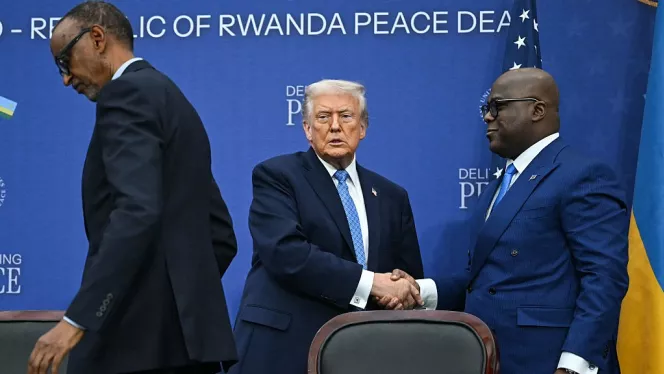
The announcement comes less than a year after the signing of the Washington Accords for Peace and Prosperity on 4 December 2025, by DR Congo’s President Félix Tshisekedi and Rwanda’s President Paul Kagame, under the mediation of US President Donald Trump.
The agreement established commitments to reduce military tensions, respect DR Congo’s sovereignty and territorial integrity, and create conditions for expanding trade and investment across the Great Lakes region. Its economic framework also envisaged greater transparency in strategic mineral supply chains.
However, developments on the ground remain far removed from the agreement’s stated objectives. In early 2025, M23 captured Goma and Bukavu, the provincial capitals of North Kivu and South Kivu respectively, consolidating its presence in strategically and economically important areas. Continued fighting and rebel control of mining regions have further undermined diplomatic efforts.
Disagreements between Washington, Kigali and Kinshasa
The Rwandan government has repeatedly rejected allegations that it supports armed groups and maintains that it remains committed to implementing the Washington Accords, provided that DR Congo also fulfils its obligations.
Government spokesperson Yolande Makolo told the Associated Press that Kinshasa had failed to meet its commitments concerning the neutralisation of the Democratic Forces for the Liberation of Rwanda (FDLR), an armed group operating in Congolese territory.
Kinshasa, meanwhile, welcomed the US decision and renewed its call for Kigali to honour its commitments, including the withdrawal of Rwandan forces from Congolese territory.
The opposing positions underline the continuing disagreement between the two governments over their respective security obligations under the agreement, while communities in eastern DR Congo remain exposed to violence, forced displacement and the exploitation of natural resources.
The wider impact of US pressure
Washington’s decision introduces another dimension to the conflict: the potential accountability of financial and institutional structures allegedly involved in sustaining military operations.
By targeting both the Ministry of Defence and a financial institution, the United States is seeking to put pressure not only on the military dimension of the conflict but also on the financial mechanisms that, according to its findings, help fund and sustain M23 operations.
The move also exposes a diplomatic contradiction. Washington, which promoted the peace accords as a means of stabilising the region and encouraging investment, is now using economic sanctions against one of the signatories to press for compliance with the commitments it made.
The challenge extends beyond bilateral relations between Washington and Kigali. Instability in eastern DR Congo threatens investment confidence, regional trade integration and transparency in supply chains for gold, coltan and other strategic minerals.
The future of the Washington Accords will depend on whether diplomatic commitments can be translated into verifiable action on the ground. As long as foreign military involvement, support for armed groups and competition for control of resource-rich territories persist, peace in the region will remain difficult to achieve.
More than a diplomatic declaration, the agreement now faces its most important test: whether it can secure Congolese sovereignty, reduce violence and establish the conditions for lasting stability and prosperity across the Great Lakes region.