Niger moves to reorganise transport, aviation security and university services
- NigerPolitics
- October 30, 2026

The Council of Ministers has approved plans for a state-backed rail company, a new body to coordinate airport security and regional university services. The communiqué also highlights road projects and efforts to promote locally made products.
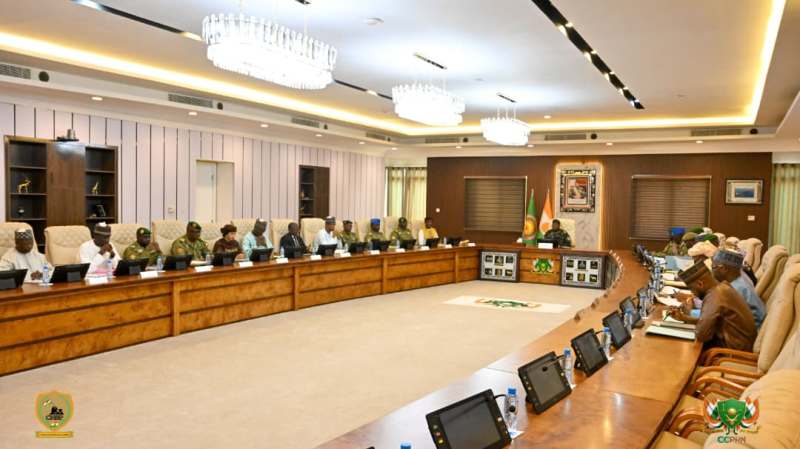
NIAMEY — Niger’s Council of Ministers approved a series of measures at its meeting on Thursday, 29 October, aimed at reorganising key sectors and creating new public bodies. The decisions include plans to establish the Nigerien Rail Transport Company (SNTR), a body to coordinate civil aviation security, and regional university services centres.
The measures point to an effort to expand the state’s role in transport, aviation, higher education and support for local production. The communiqué mainly sets out the proposed bodies and their responsibilities. It does not specify implementation timelines, costs, funding sources or targets for measuring their performance.
Rail and airport security
The SNTR is to be established as a mixed-economy company, with responsibility for managing rail traffic. The government says the initiative forms part of a strategy to develop rail transport across the Alliance of Sahel States (AES). The announcement signals an intention to expand rail services, but gives no details on proposed routes, required investment or when operations might begin.
In civil aviation, the Council approved plans to establish the Civil Aviation Security and Facilitation Coordination Body (OCSF). According to the communiqué, airport security measures are currently handled by several entities, including the Gendarmerie, National Police, Customs and other airport services, under the coordination of the National Civil Aviation Agency. The new body is intended to coordinate operational implementation, while the Agency retains its supervisory role.
The arrangement could clarify the division between oversight and operational responsibilities. Its effectiveness will depend on how clearly those roles are defined and how well the agencies work together. The Council also approved measures covering airport environmental issues, aviation security and the requirements for opening aerodromes to public air traffic.
New services for students
In higher education, the Council approved draft decrees to establish the Nigerien Scholarship Agency and Regional University Services Centres in each regional capital. The centres are expected to manage student services.
The government says the changes are intended to strengthen oversight, speed up decision-making and rationalise spending. Decentralising services could bring them closer to students outside the capital. The communiqué does not specify which services will be provided, what resources will be allocated or how provision will be kept consistent across regions.
Local production and infrastructure maintenance
The Council also approved a draft decree establishing the National “Consume Nigerien” Observatory. The body is expected to collect and analyse data on local consumption, assess public policies and private-sector initiatives, and recommend ways to promote goods and services produced in Niger. It will include representatives from government, the private sector and civil society.
The Observatory could help guide policies to promote domestic production using data. That will depend on regular data collection and on whether its recommendations lead to practical measures.
The Council approved the reorganisation of three bodies involved in road maintenance: the Delegated Road Maintenance Project Management Agency (AMODER), the Road Maintenance Fund (FER) and the Public Works Training Centre (CPTP). The draft decrees are intended to bring their founding and operating rules into line with legislation governing public institutions.
The meeting also heard updates on road projects, including works in the country’s north-east, bypass roads around Diori Hamani International Airport, the Arlit-Assamaka route near the Algerian border, and urgent repairs to the Niamey-Balleyara and Balleyara-Loga roads. The communiqué also refers to feasibility and technical studies for the Niamey-Téra section of the proposed Bamako-Ouagadougou-Niamey highway. It gives no overall cost or timetable for the projects.
Other decisions and announcements
In the financial sector, the Council approved a draft ordinance amending the measure that nationalised Niger-Transit (NITRA). The proposed changes would transfer technical oversight of the company to the finance minister and repeal transitional provisions in the original text.
The Council also heard that Niger had been nominated for an award recognising excellence in mining governance, and received a report on the first Abinci’Niger national food festival. According to figures presented by the government, the event drew more than 10,000 visitors, while exhibitors reported sales of 120 million CFA francs.
Taken together, the decisions combine new administrative structures with infrastructure projects and efforts to promote economic activity. Their impact will depend on implementation. Establishing public bodies and approving draft decrees creates an institutional framework, but does not by itself mean that the services, rail links or announced roadworks are already operational.