UN must change or risk irrelevance, Finland tells General Assembly
- AmericaPoliticsWorld
- September 27, 2025
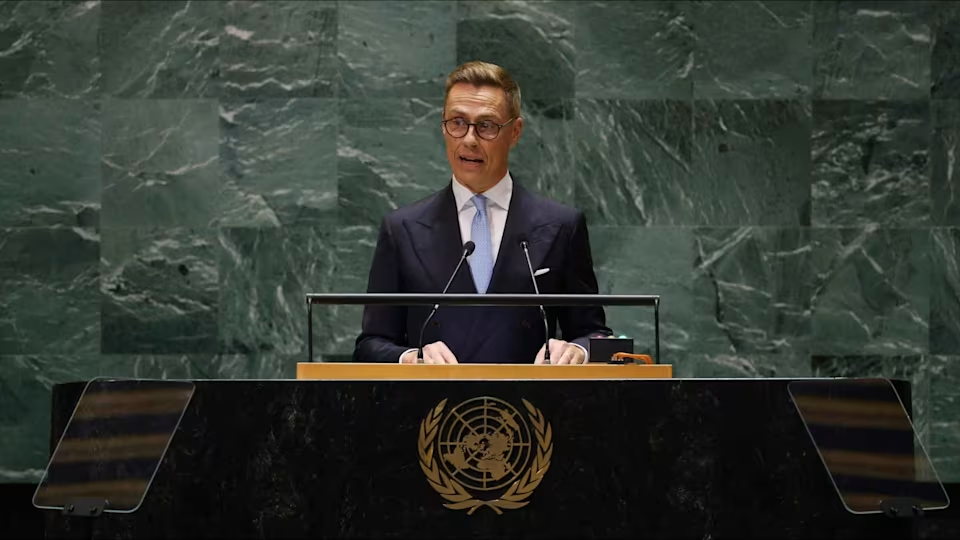

New York – Finland’s President used his address at the United Nations General Assembly to call for urgent institutional reform and a renewed commitment to multilateralism as the world enters an uncertain new era of global power realignment.

AfricaHeadline Reports Team
editorial@dw-demosnewstaion.online
The president underscored that foreign policy is built on three pillars, values, interests, and power. For smaller states like Finland, influence is not derived from military might but from principled cooperation and diplomacy. “Smart diplomacy is the weapon of small nations,” he said, stressing that upholding values is essential to preserving international stability.
According to the Finnish leader, the international order that emerged after the Cold War is now “effectively over.” The contours of the new order remain undefined and may take up to a decade to stabilize. “Every state, large or small, carries responsibility in shaping what comes next,” he noted.
The president warned of the risks of a global system dominated by shifting, transactional alliances driven solely by pragmatic interests. While acknowledging multipolarity as a reality, he argued that diplomacy must remain grounded in shared values and international law to prevent a return to destructive power politics.
One of the most pointed observations in the speech was the recognition of Africa, Asia, and Latin America as emerging centers of political, economic, and cultural influence. This shift, he argued, demands greater representation for these regions within international institutions.
Finland called for a comprehensive reform of the UN Security Council, including at least two new permanent seats for Africa and Asia, the abolition of the veto, and automatic suspension of voting rights for any member violating the UN Charter. Such measures, he argued, would restore credibility and effectiveness to the UN system.
The speech directly condemned Russia’s invasion of Ukraine and Israel’s actions in Gaza as grave breaches of sovereignty and international law. The president reaffirmed Finland’s support for a two-state solution in the Middle East, calling for an end to occupation and recognition of Palestinian statehood.
He also highlighted crises in Sudan, the Democratic Republic of Congo, Haiti, Myanmar, and Mali, insisting that the UN’s absence from active mediation has contributed to the spread of conflicts.
Defending freedom of the press, the Finnish leader warned that attacks on journalists undermine open societies and global stability. Protecting media workers, he said, is vital to preserving democracy worldwide.
Closing his address, the president reaffirmed Finland’s candidacy for a non-permanent seat on the UN Security Council for 2029–2030. “We want to be a principled yet pragmatic partner for peace,” he concluded, positioning Finland as a committed actor ready to contribute to global stability.