Dangote turns to Gulf crude as Nigeria’s supply strains test refining ambitions
- Economic
- July 2, 2026

Africa’s biggest refinery buys its first cargoes from the UAE, exposing the tension between Lagos’s industrial ambitions and the country’s chronic inability to feed them with domestic oil.
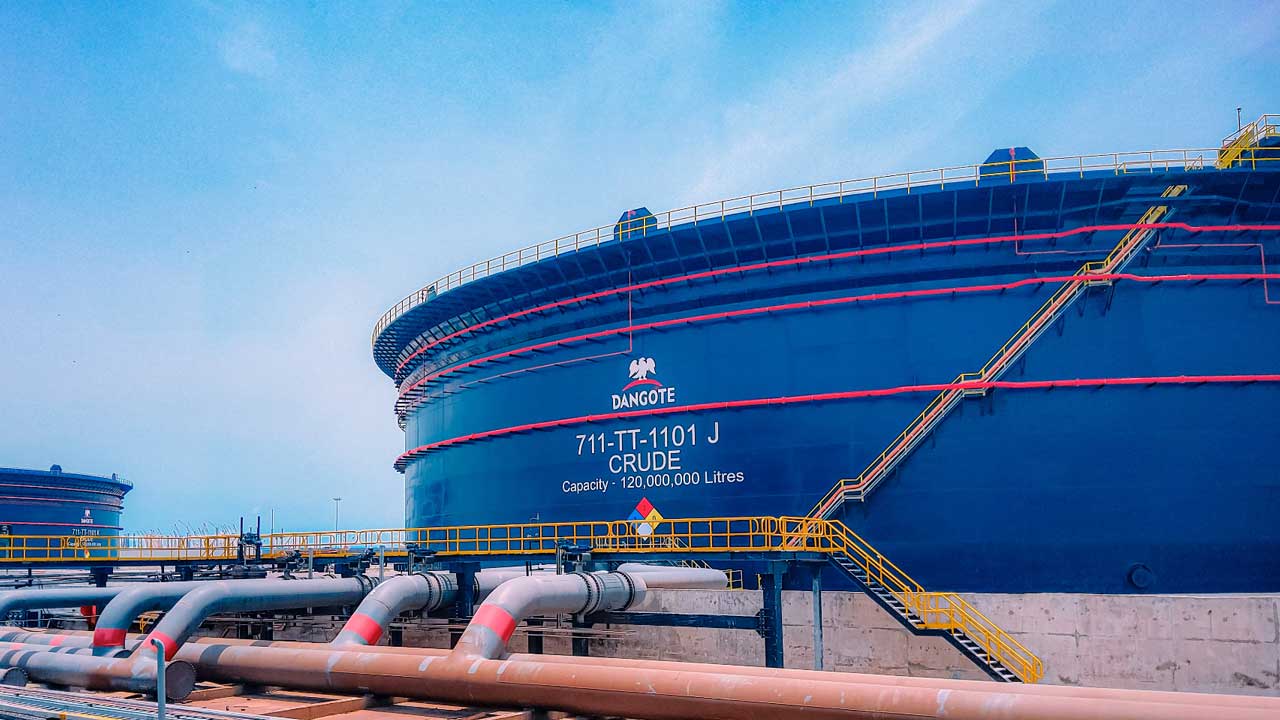
JOHANNESBURG – The Dangote Petroleum Refinery has begun importing crude from the United Arab Emirates, a first for Africa’s largest refining complex and a sign that Nigeria’s flagship industrial project is already being forced to look beyond domestic supply to sustain its rapid expansion.
The refinery, built by billionaire Aliko Dangote on the outskirts of Lagos, took in two cargoes of UAE crude this month, according to data cited by S&P Global Commodity Insights. The purchases mark the refinery’s first known imports from a Middle Eastern supplier and underscore a strategic shift for a facility that had, until now, leaned heavily on Nigerian barrels.
The move comes at a pivotal moment for the refinery, earlier this month, Dangote said the plant had reached 700,000 barrels per day of crude processing, a level that places it among the world’s largest single-train refining operations. The group now says it wants to double throughput to 1.4mn barrels a day within the next 30 months, a target that would put the facility in the top tier of global refiners and recast Nigeria as a far more consequential supplier of refined fuels to West Africa.
But the UAE imports highlight an uncomfortable reality at the heart of that ambition: Nigeria, Africa’s biggest crude producer, is still struggling to supply enough oil to feed its own most important downstream asset.
Until recently, Dangote had sourced most of its feedstock locally. S&P Global Commodity Insights estimates that 70 per cent of the refinery’s crude intake in 2025 came from Nigeria, while 24 per cent was sourced from the United States. The entry of Gulf barrels into that mix suggests the refinery is moving more decisively towards a diversified supply model, one designed to protect throughput, optimise crude blends and reduce exposure to domestic bottlenecks.
That shift has become increasingly difficult to avoid, the Nigerian National Petroleum Company (NNPC) had committed to supplying the refinery with 13 to 15 cargoes of Nigerian crude a month, an arrangement intended to anchor the project to local production and help the country reduce its long-standing dependence on imported fuel. Yet Nigeria’s upstream sector remains constrained by lower-than-potential output, theft, pipeline vandalism, underinvestment and recurring logistical disruptions. For a refinery of Dangote’s scale, those disruptions are more than an inconvenience; they are a direct threat to utilisation rates, margins and export plans.
In that sense, the UAE purchases are less a tactical trade than an industrial necessity. Large refineries are built on consistency: they need predictable feedstock, optionality across grades and the ability to switch origins when domestic supply becomes unreliable or uneconomic. Dangote’s decision to tap Middle Eastern crude suggests the refinery is being run with that logic in mind, not as a purely national project, but as a commercial refining platform that will source barrels wherever they best support scale and profitability.
The timing is notable. Gulf crude flows have regained momentum after an interim easing of tensions between the US and Iran helped restore traffic through the Strait of Hormuz, one of the world’s most strategically sensitive oil chokepoints. With regional supply routes less constrained and more cargoes available, producers in the Gulf have once again become competitive sellers into non-Asian markets. For Dangote, that opens an additional pool of supply at a moment when every extra barrel matters.
The implications go beyond procurement, the refinery was conceived as the centrepiece of Nigeria’s effort to fix one of the country’s deepest economic contradictions: despite being one of the continent’s largest oil producers, it has spent decades importing much of the petrol, diesel and aviation fuel it consumes. A fully functioning Dangote complex promised to change that equation by cutting fuel imports, reducing pressure on foreign exchange reserves, easing strain on the naira and allowing Nigeria to retain more value from its hydrocarbon chain at home.
That promise remains intact, but it is becoming more complicated, if Dangote can refine locally but must increasingly import crude to do so, Nigeria will still capture more value than it did under the old model of exporting raw crude and importing finished products. Yet the political symbolism of “energy independence” becomes harder to sustain when the country’s most important refinery cannot be reliably supplied by Nigerian oil.
There is also a regional dimension, fuel demand across West and Central Africa remains structurally strong, while many state-owned or ageing refineries across the continent operate below capacity or suffer chronic maintenance problems. Dangote’s scale gives it a potential edge as a regional hub for gasoline, diesel, jet fuel and petrochemical products. If it can secure stable crude supply, whether from Nigeria, the US or the Gulf, it could reshape fuel trade flows across the region and displace a portion of imports from Europe and Asia.
That is why the refinery’s supply strategy matters as much as its engineering, the success of Dangote will not be determined solely by nameplate capacity or commissioning milestones, but by whether it can run at high utilisation with a feedstock slate that is both commercially viable and logistically secure. The arrival of UAE crude suggests management is not waiting for Nigeria’s upstream sector to solve its own problems before scaling the plant further.
For Nigeria, the optics are more mixed. Dangote’s rise is a genuine industrial achievement, one that could alter the economics of fuel supply in Africa’s largest economy. But it also throws into sharper relief the weaknesses of the country’s oil sector: a producer with abundant reserves, but persistent difficulty translating that abundance into reliable domestic supply. The refinery has proved that Nigeria can build refining capacity at global scale. The next question is whether the country can produce and deliver enough crude to keep that machine running on its own terms.