Algeria pushes Banks toward private credit as state financing strains system
- Uncategorized
- August 29, 2026
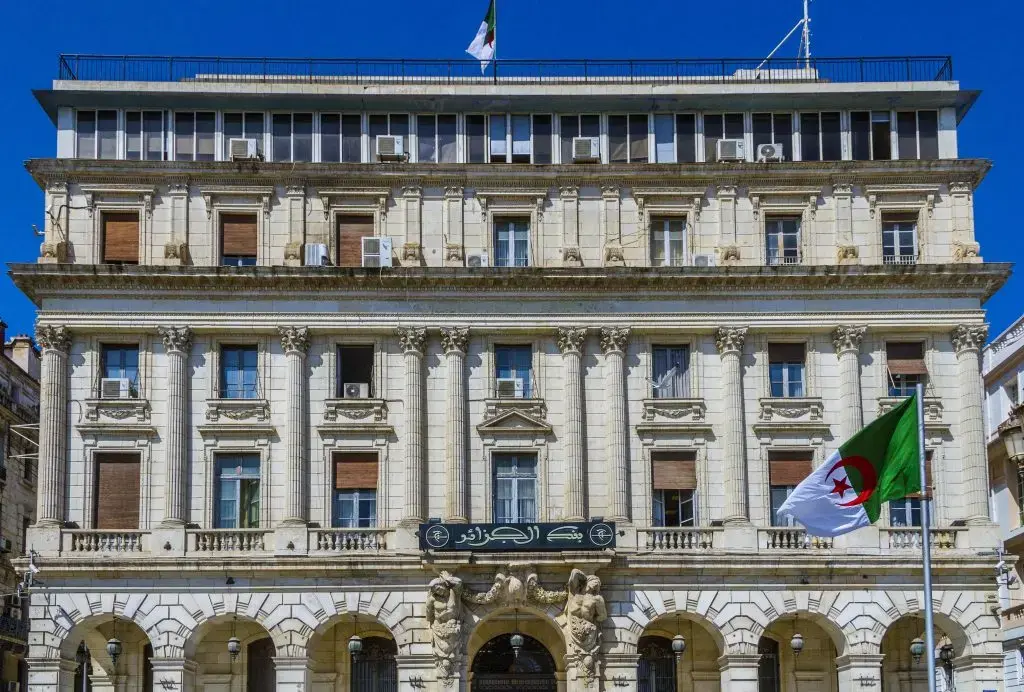

Central bank expands export finance and digital banking as IMF warns that deep links between the government, state companies and public lenders risk crowding out private investment
ALGIERS — Algeria is stepping up efforts to channel more bank financing toward private businesses and exporters as large government borrowing needs test a financial system already heavily exposed to the state.
The Bank of Algeria has introduced measures aimed at expanding export finance, financial inclusion and digital payments, while keeping its policy rate at 2.5% in July. Longer-term refinancing operations reached 702.6 billion dinars ($5.4 billion) that month, while fine-tuning operations totaled 410.6 billion dinars, according to central-bank data.
The push comes as the International Monetary Fund warns that Algeria’s close links between the government, state-owned enterprises and public banks pose an increasing macro-financial risk. The IMF estimates economic growth at 3.8% in 2026, after 3.9% last year, but says large fiscal financing requirements are increasing pressure on the domestic financial system.
Algeria’s budget deficit narrowed to 10.5% of gross domestic product in 2025, helped partly by one-off dividends from state companies and the central bank, while public debt climbed to 52.1% of GDP. Monetary conditions also eased as central-bank financing of the government increased.
That combination is at the heart of Algeria’s banking challenge. The IMF says Algerian lenders are among the most exposed to the public sector compared with peers, with exposure rising over time. Large fiscal deficits and the close sovereign-SOE-public bank nexus risk absorbing resources that could otherwise finance private companies.
Private credit push
The Bank of Algeria is trying to broaden the other side of banks’ balance sheets.
An Aug. 10 instruction established a framework allowing banks to finance export operations, complementing measures to speed up export domiciliation and improve access to banking products. The central bank has also urged lenders to expand consumer credit, financial inclusion and digital services.
Those measures build on Governor Mohammed Lamine Lebbou’s June call for commercial banks to diversify products, improve access to financial services and support domestic production while preserving financial stability.
The central bank is simultaneously managing substantial liquidity operations. In July, seven-day refinancing amounted to 5.7 billion dinars, compared with 702.6 billion dinars of longer-term refinancing and 410.6 billion dinars of fine-tuning operations. The required-reserve ratio stood at just 1% for the June 15-July 14 maintenance period.
The IMF says better liquidity management is needed to bring interbank rates closer to the policy rate and strengthen monetary-policy transmission. It also wants Algeria to reduce the sovereign-SOE-public bank nexus and avoid continued monetary financing of government deficits.
For Algeria, the question is increasingly less about whether its banks have liquidity than where that money ultimately goes.
The success of the latest reforms will depend on whether public lenders can expand financing for exporters, manufacturers and other private businesses fast enough to support diversification without government and state-company borrowing absorbing an increasing share of their balance sheets.
That could determine whether Algeria’s banking modernization becomes mainly a technological upgrade — or helps shift capital from the state-dominated financial system toward the private-sector-led growth the IMF says the country needs.