How China beat the West in the global automotive industry
- Business and Networking
- June 17, 2026
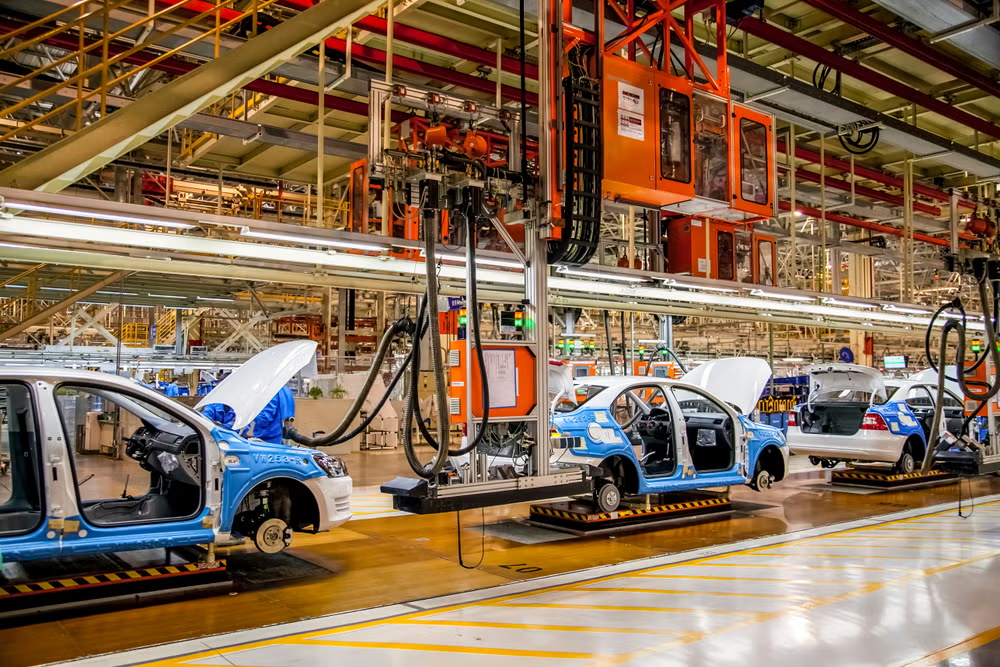

A two-decade industrial strategy has turned China into the World’s largest car producer, EV leader and emerging automotive superpower
LAGOS — Twenty years ago, China was largely absent from the list of global automotive powers.
Today, it produces more vehicles than the United States, Japan, Germany and South Korea combined. It has become the world’s largest automotive market, the largest producer of electric vehicles (EVs), the largest battery manufacturer and, more recently, the world’s largest automobile exporter.
The transformation is reshaping one of the world’s most important industries and challenging the dominance of manufacturers that have defined global automotive excellence for more than a century.
For Germany in particular, the implications are profound, Volkswagen, Mercedes-Benz, BMW and Porsche built their global reputations on engineering excellence, premium branding and mastery of internal combustion engines. Yet as the industry transitions toward electrification, software and artificial intelligence, many of those historical advantages have become less decisive.
The result is a historic shift in industrial leadership that increasingly favors China.
The numbers behind China’s rise
The scale of China’s automotive transformation is unprecedented.
China now produces more than 31 million vehicles annually, accounting for roughly one-third of global vehicle production.
| Country | Annual Vehicle Production |
|---|---|
| China | 31+ million |
| United States | ~10 million |
| Japan | ~9 million |
| India | ~6 million |
| Germany | ~4 million |
China also became the world’s largest automobile exporter, shipping more than 5 million vehicles annually, overtaking Japan and significantly expanding its presence across Europe, Latin America, Southeast Asia, the Middle East and Africa.
Its domestic market remains equally important. More than 30 million vehicles are sold annually in China, making it by far the largest automotive market in the world.
For global manufacturers, success in China is no longer optional—it is essential.
Beijing’s US$200 Billion automotive strategy
China’s success was not accidental.
It was the result of one of the most ambitious industrial strategies of the modern era.
Beginning in the late 2000s, Beijing identified electric mobility as a strategic sector capable of disrupting the global automotive hierarchy.
Unlike traditional vehicles, electric cars depend less on engine technology—an area where Western manufacturers held a century-long advantage—and more on batteries, software, semiconductors and digital ecosystems.
Through the “Made in China 2025” strategy and related industrial policies, Chinese authorities provided an estimated US$200 billion in subsidies, tax incentives, research funding, industrial financing and infrastructure investments to accelerate EV adoption.
These measures included consumer subsidies, preferential financing, charging infrastructure, battery development and strategic investments across global mineral supply chains.
The result was the creation of an ecosystem capable of competing globally.
The battery empire
The true foundation of China’s automotive dominance lies not in vehicle assembly but in batteries. Today, China controls approximately:
75% of global lithium-ion battery manufacturing capacity
70% of global lithium processing
70% of global cobalt refining
Significant portions of global nickel and graphite processing. Chinese battery giant CATL has become the world’s largest EV battery manufacturer, while BYD has evolved from a battery producer into one of the world’s most successful electric vehicle companies.
Control over batteries provides China with a strategic advantage similar to Germany’s historic leadership in engine manufacturing.
In the age of electric mobility, batteries have become the new engine.
Germany’s strategic miscalculation
While China was investing heavily in future technologies, Germany remained focused on preserving its existing strengths.
German automakers believed that internal combustion engines would remain dominant for much longer.
The transition to electric mobility was therefore approached cautiously.
Governments were equally hesitant. Charging infrastructure expanded slowly, regulatory pressure remained limited and manufacturers continued investing billions into combustion-engine technologies.
The consequences are increasingly visible. Volkswagen has faced mounting competitive pressure in China, while Porsche has struggled to balance its traditional sports-car identity with the transition toward electrification.
Mercedes-Benz and BMW continue to generate profits but face growing competition from Chinese brands that often offer superior software, connectivity and autonomous-driving features at lower prices.
The challenge extends beyond electric vehicles. It is increasingly a software war.
The shift from cars to computers on wheels
Modern vehicles are becoming software-defined products.
Consumers increasingly evaluate vehicles based on autonomous driving capabilities, artificial intelligence integration, connectivity, digital entertainment systems and over-the-air software updates.
Chinese manufacturers built their products around these priorities from the outset.
Companies such as BYD, NIO, Xpeng and Li Auto operate more like technology companies than traditional automakers.
Many Western manufacturers, by contrast, still rely on business models designed for the mechanical era.
Recognizing this gap, German firms have increasingly sought partnerships with Chinese technology leaders. Mercedes-Benz partnered with autonomous-driving company Momenta, while Volkswagen invested heavily in Xpeng to accelerate software development.
These partnerships underscore a new reality: some of Europe’s largest automakers are now looking to China for technological expertise.
Why Europe and America are worried
The rise of Chinese automakers is no longer merely a commercial issue, it has become a geopolitical concern.
The automotive industry supports more than 800,000 jobs in Germany alone and millions more across Europe and North America.
As Chinese EVs enter Western markets, policymakers fear a repeat of the industrial shifts that transformed sectors such as consumer electronics, solar panels and telecommunications equipment.
The European Union has responded by imposing additional tariffs on Chinese electric vehicles, arguing that state subsidies create unfair competitive advantages.
The United States has adopted even more aggressive measures, significantly increasing tariffs on Chinese EV imports.
Yet many analysts believe tariffs may slow, but not stop, China’s expansion. The country’s scale, supply-chain integration and technological advantages remain formidable.
China’s automotive industry
China’s automotive industry benefits from unparalleled scale. It operates within the world’s largest vehicle market, enjoys leadership in electric vehicle production and controls much of the global battery supply chain. Government support, industrial policy, integrated manufacturing ecosystems and rapid innovation cycles have enabled Chinese manufacturers to move faster than many Western competitors.
Despite its success, China’s automotive sector remains dependent on continued export growth and access to foreign markets. Many Chinese brands still lack the premium prestige enjoyed by German luxury manufacturers, while intensifying domestic competition is placing pressure on profitability. Geopolitical tensions and trade restrictions also expose the industry to significant external risks.
The next phase of growth is likely to come from emerging markets across Africa, Latin America and Southeast Asia. The rise of autonomous vehicles, AI-powered mobility services, battery storage systems and smart-city infrastructure offers additional opportunities for expansion and technological leadership.
China faces growing protectionism from Western governments, rising tariffs, trade disputes and increasing geopolitical tensions. Overcapacity risks within the domestic automotive sector could also create financial pressures if export growth slows significantly.
Western automotive industry
Despite mounting competitive pressures, Western automakers continue to possess significant structural advantages. Companies such as Volkswagen, Mercedes-Benz, BMW, Porsche, Ford and General Motors have built some of the world’s most valuable and recognizable brands over more than a century. Their reputations for engineering excellence, safety, quality and reliability remain powerful assets, particularly in premium and luxury vehicle segments where brand perception continues to influence purchasing decisions.
The industry also benefits from extensive global distribution networks, advanced manufacturing capabilities and highly developed after-sales service ecosystems. These strengths provide Western manufacturers with a level of customer loyalty and market presence that newer competitors often struggle to replicate. In addition, decades of investment in research, engineering and production expertise continue to support innovation across multiple vehicle categories.
Many of the same factors that contributed to Western automotive success have also become sources of vulnerability. For years, manufacturers remained heavily dependent on internal combustion engine technologies, delaying large-scale commitments to electric mobility while Chinese competitors accelerated investments in batteries, software and digital platforms.
This legacy dependence created structural challenges. Existing factories, supply chains and business models were optimized for traditional vehicles, making the transition to electrification costly and complex. At the same time, Western manufacturers face significantly higher labour and production costs than many Chinese competitors.
Perhaps the most critical weakness is the industry’s slower adaptation to software-driven mobility. Modern vehicles increasingly function as connected digital platforms, yet many traditional manufacturers continue to lag behind technology-focused competitors in areas such as artificial intelligence, autonomous driving, connectivity and over-the-air software updates. Longer development cycles have further reduced their ability to respond rapidly to changing consumer preferences.
The global transition toward electric mobility presents substantial opportunities for Western manufacturers willing to adapt. Premium electric vehicle segments continue to grow, allowing established brands to leverage their reputations while introducing high-performance EVs capable of maintaining attractive profit margins.
The emergence of software-defined vehicles also creates new revenue opportunities. Future growth is expected to come not only from vehicle sales but also from software subscriptions, connected services, autonomous driving features and digital ecosystems. Strategic partnerships with technology companies can help accelerate innovation and close capability gaps in key areas such as artificial intelligence, battery technology and advanced driver-assistance systems.
In addition, growing regulatory support for sustainable transportation and increasing consumer demand for low-emission mobility solutions provide opportunities to build broader ecosystems that integrate electric vehicles, renewable energy, battery storage and smart infrastructure.
The most immediate threat to Western automakers comes from the rapid rise of Chinese competitors. Companies such as BYD, NIO, Xpeng, Geely and SAIC are expanding globally with technologically advanced vehicles that often combine competitive pricing with superior digital features and battery performance.
Western manufacturers are simultaneously losing market share in China, the world’s largest automotive market and a key source of profitability for many European brands. Chinese consumers increasingly prioritize software, connectivity and intelligent driving systems—areas where domestic manufacturers have established strong competitive positions.
Geopolitical tensions, trade disputes and rising protectionist measures add further uncertainty. Tariffs, export restrictions and industrial policy interventions could disrupt global supply chains and increase costs throughout the industry. Meanwhile, increasingly stringent environmental regulations are forcing manufacturers to accelerate investments in electrification and emissions reduction technologies.
Finally, the transition toward electric and software-defined mobility is putting pressure on profit margins. Companies must invest billions of dollars in battery technology, software platforms, artificial intelligence and factory modernization while facing intensifying competition and growing pricing pressure. Successfully navigating this transition may determine which manufacturers remain global leaders and which become casualties of the industry’s most significant transformation in more than a century.
Why Africa matters
Africa may become one of the most important battlegrounds in the next phase of automotive competition. The continent possesses many of the minerals required for electric mobility.
| Mineral | Major African producers |
|---|---|
| Cobalt | DRC |
| Copper | Zambia, DRC |
| Lithium | Zimbabwe, Namibia |
| Manganese | South Africa, Gabon |
The Democratic Republic of Congo alone produces approximately 70% of global cobalt output, a critical component in battery production.
Meanwhile, Africa’s population is projected to reach 2.5 billion people by 2050, making it one of the world’s fastest-growing consumer markets.
Countries such as Morocco, South Africa and Egypt have already emerged as automotive manufacturing hubs.
Others, including Angola, could leverage their energy resources, strategic ports and industrial zones to attract investment in battery processing, EV assembly and automotive supply chains.
Angola and the EV Supply chain Opportunity
Angola may be one of the lesser-discussed beneficiaries of the global automotive transition, but its strategic position is becoming increasingly relevant.
As electric vehicle manufacturers seek to diversify supply chains away from traditional production centres, Africa is attracting growing attention as both a source of critical minerals and a future manufacturing base. Angola’s geographic location, Atlantic ports, growing energy infrastructure and proximity to the copper and cobalt belts of the Democratic Republic of Congo and Zambia position the country as a potential logistics and industrial hub.
The development of the Lobito Corridor has further strengthened Angola’s strategic importance. The railway and port network connecting the Atlantic Ocean to Central Africa’s mineral-rich regions is increasingly viewed by investors and policymakers as one of the most significant infrastructure projects on the continent.
If combined with industrial zones, renewable energy investments and targeted manufacturing incentives, Angola could attract investments in battery materials processing, electric vehicle assembly and automotive component manufacturing.
Rather than remaining solely a supplier of raw materials, the country has an opportunity to participate in higher-value segments of the emerging electric mobility economy.
The new global automotive order
The automotive industry is undergoing the most profound transformation since the invention of the internal combustion engine.
China’s rise was not the result of lower labour costs alone. It was the outcome of long-term industrial planning, massive public investment, technological innovation and strategic control of critical supply chains.
The industry is no longer defined primarily by engine performance, manufacturing heritage or mechanical engineering. It is increasingly shaped by batteries, software, artificial intelligence and access to critical minerals.
China recognized this shift earlier than most Western competitors and invested accordingly.
The result is one of the most significant transfers of industrial leadership in modern economic history—comparable to America’s post-war manufacturing dominance or Japan’s automotive ascent in the 1980s.
The question facing Europe and the United States is no longer whether China has become an automotive superpower.
The question is whether they can adapt quickly enough to prevent that leadership from becoming permanent.
For Africa, the challenge is different. The continent must decide whether it will remain a supplier of the minerals powering the electric revolution or emerge as an active participant in the industries that will define the future of global mobility.
In the race for the future of transportation, China has taken an early lead. The rest of the world is now trying to catch up.