Justice under scrutiny in Côte d’Ivoire
- Uncategorized
- July 21, 2026

The release of six opposition activists does little to dispel doubts surrounding the country’s electoral cycle
LAGOS – The release of six activists from the Parti Démocratique de Côte d’Ivoire–Rassemblement Démocratique Africain (PDCI-RDA) after nine months in detention is welcome news for them and their families. It does not, however, resolve the broader questions raised by an electoral cycle marked by the exclusion of President Alassane Ouattara’s principal rivals, bans on opposition demonstrations and the detention of hundreds of government critics.
The six activists were freed on July 20, 2026, following a hearing before the Anti-Terrorism Chamber of the Abidjan Court of First Instance. Defence lawyer Ange Rodrigue Dadjé announced the decision on social media. Initial reports, however, offered little explanation of the legal basis for their release, leaving it unclear whether the court had granted provisional release, dismissed the charges or adopted another procedural measure.
That distinction matters. In a state governed by the rule of law, justice is measured not only by when someone is imprisoned or released, but by the legal reasoning behind those decisions. Without a clear explanation of the charges, the evidence supporting them and the grounds for release, it is impossible to determine whether the judiciary corrected an abuse, acknowledged insufficient evidence or merely modified a procedural arrangement.
An election without its strongest challengers
The arrests took place during one of Côte d’Ivoire’s most politically charged electoral periods. The October 25, 2025 presidential election proceeded without Tidjane Thiam and Laurent Gbagbo, arguably the country’s two most influential opposition figures.
Thiam, the former Credit Suisse chief executive and leader of the PDCI-RDA, was removed from the electoral roll in April after an Abidjan court ruled that he had automatically forfeited Ivorian nationality by voluntarily acquiring French citizenship. Although he renounced his French nationality in March 2025 and received official confirmation of his Ivorian citizenship in August, the Constitutional Council ruled on September 8 that the late regularisation did not restore his eligibility. His supporters argued that electoral law had been applied with excessive formalism and, they alleged, at a politically convenient moment.
Gbagbo remained barred from contesting the presidency because of a 20-year sentence handed down by Ivorian courts in the so-called BCEAO robbery case. His acquittal by the International Criminal Court did not overturn that domestic conviction.
The two exclusions rested on different legal grounds but produced the same political outcome: both removed the opposition’s most formidable challengers from the ballot. A joint observation mission by the African Union and ECOWAS noted that the decisions reinforced perceptions of electoral bias.
Ouattara was subsequently declared the winner with 89.77% of the vote on a turnout of just 50.1%, securing a fourth presidential term. The Constitutional Council maintains that the 2016 Constitution reset presidential term limits, while the opposition argues that such an interpretation effectively nullifies the constitutional two-term limit. Precisely because this legal dispute remains unresolved, such a one-sided electoral outcome requires careful scrutiny rather than automatic conclusions, either of unquestionable legitimacy or outright fraud.
Crackdown during the electoral period
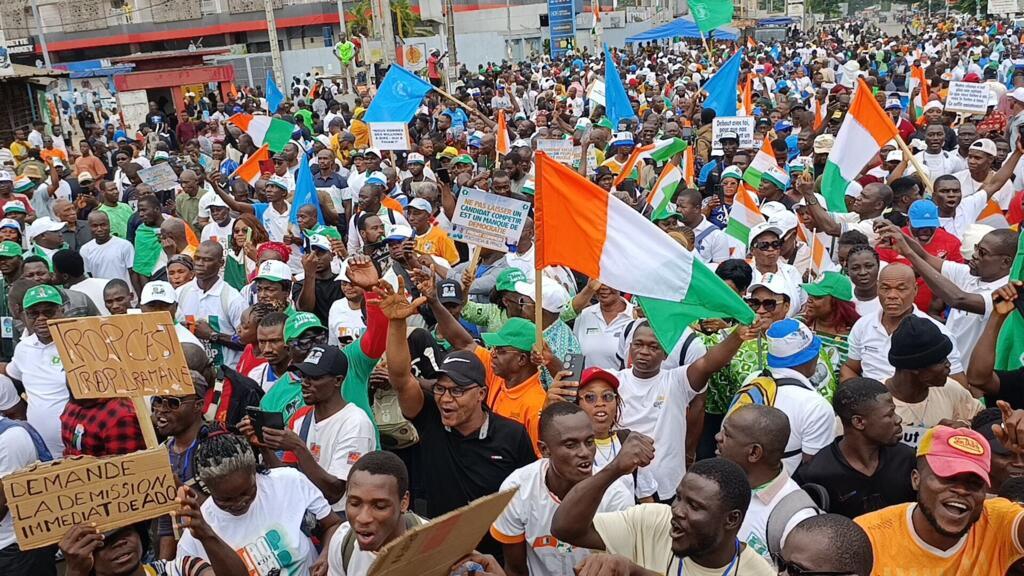
The campaign was also characterised by restrictions on public protest. In October 2025, authorities prohibited demonstrations organised against the exclusion of opposition leaders. According to the Interior Ministry, more than 700 people were arrested nationwide during the unrest, including at least 237 in Abidjan alone during protests on October 11. Twenty-six demonstrators were sentenced to three years in prison on October 16, followed days later by another 32 receiving identical sentences. Hundreds of additional cases remained pending before the courts.
Human rights organisations, including Amnesty International, accused the authorities of arbitrary arrests and unlawful restrictions on the right to peaceful assembly. In subsequent reports, they documented detainees who remained imprisoned without formal charges. Côte d’Ivoire’s National Human Rights Council (CNDH) recorded six deaths linked to opposition protests between October 11 and October 21 across several regions.
These figures do not, in themselves, prove that every arrest was politically motivated. They do, however, make it difficult to examine the release of the six activists independently of the wider repressive environment in which they were detained.
The chronology inevitably raises questions. The arrests occurred as the opposition sought to mobilise before the presidential vote. The releases came nine months later, after the election result had long been settled and the governing party had consolidated its parliamentary dominance.
In the December 27, 2025 legislative elections, the ruling Rassemblement des Houphouëtistes pour la Démocratie et la Paix (RHDP) secured 197 of the National Assembly’s 255 seats on turnout of only 35%. The PDCI-RDA saw its representation fall from 66 to 32 seats, while Laurent Gbagbo’s PPA-CI boycotted the poll altogether. The outcome further concentrated political power in the hands of the presidential camp.
The sequence alone cannot establish that the detentions were orchestrated to sideline the opposition. It does, however, justify a question that the authorities have yet to answer: why was it necessary to keep these activists behind bars for nine months, and what changed legally to justify their release?
Stability is not the same as pluralism
Côte d’Ivoire stands apart from several neighbouring states now governed by military juntas. It retains regular elections, civilian institutions and one of West Africa’s most dynamic economies. That stability carries genuine value in a region shaken by coups and armed conflict.
Yet comparisons with military rule cannot become the sole benchmark for democratic performance. A country does not need to experience a coup for judicial independence, political pluralism or opposition rights to weaken. Democratic erosion often occurs through formally legal mechanisms: disputed exclusions, sweeping protest bans, prolonged detention and opaque judicial procedures. Turnout of just 50% in the presidential election and 35% in the legislative vote, the lowest levels in years, suggests that many voters may already have reached their own conclusions.
The release of the six activists should therefore be welcomed, but it should not be mistaken for an answer to the underlying concerns. The authorities still need to explain the charges, the legal basis for the detentions and the judicial status of each individual released. They must also ensure that all remaining cases linked to the election protests fully respect due process and are adjudicated by genuinely independent courts.
Justice is measured not simply by opening a prison gate. It is measured by demonstrating that no one was deprived of liberty for political convenience. Until that explanation is provided, the release of the six activists will remain an important humanitarian development, but an incomplete institutional answer.