Ghana exits IMF bailout as debt-distress risk eases to ‘moderate’
- EconomicGhana
- July 30, 2026

Fund’s board approves final $371m tranche of three-year rescue programme, four days after a mid-year budget review showed growth and debt ratios beating target
ACCRA – The International Monetary Fund’s executive board completed the sixth and final review of Ghana’s $3bn rescue programme on July 27th, approving a last disbursement of $371m and concluding, for the first time in 13 years, that the country’s risk of debt distress had eased from “high” to “moderate”.
| $371m
Final IMF disbursement |
High → Moderate
Debt-distress risk |
6.4%
Real GDP growth (Q1 2026) |
5.3%
Inflation (Jun. 2026) |
| 45.0%
Debt/GDP (Jun. 2026) |
GH¢15.6bn
Sinking fund balance |
GH¢111bn
2027-28 debt wall |
1.5% of GDP
Primary surplus (2026 target) |
The decision closes out a 39-month Extended Credit Facility approved in May 2023, when Ghana was defaulting on most of its external debt, inflation had passed 50% and the cedi was in free fall. It lands four days after Cassiel Ato Forson, the finance minister, told parliament in a mid-year budget review that the economy had outrun almost every assumption built into this year’s budget.
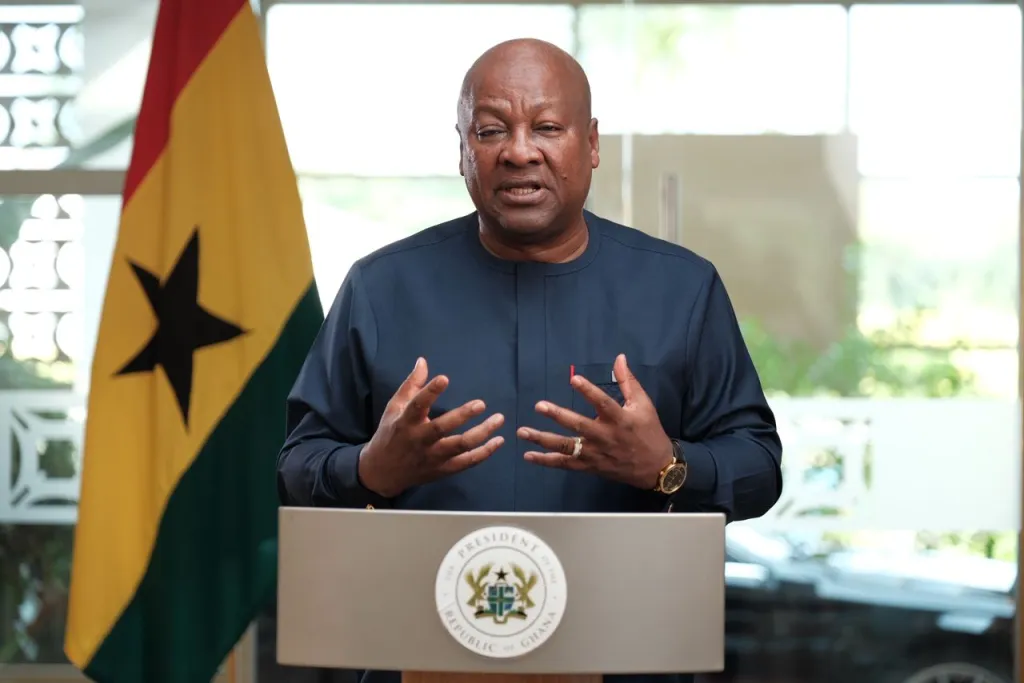
“It is my hope that this will be the very last time we will ever go for a bailout from the IMF,” President John Mahama said as the review concluded, a sentiment his finance minister put more bluntly still, telling MPs that Ghana had moved from IMF “supplicant” to “partner” and would not need another rescue “in the foreseeable future.”
The Fund’s own language was more measured. Ghana’s programme performance had been “broadly satisfactory,” it said in a statement, citing sharply lower inflation, reserves that have nearly doubled since 2025, and a primary balance that has swung into surplus. Completing the review, it added, “allows for an immediate and final disbursement of about $371 million, bringing Ghana’s total disbursements under the arrangement to about $3 billion”, and hands the country a lighter-touch, 36-month Policy Coordination Instrument to anchor reforms once the loan itself expires.
The board’s approval was not entirely clean. It also had to grant a waiver for a minor, temporary breach of one performance criterion, an overshoot in the central bank’s claims on government linked to cost-sharing arrangements under Ghana’s gold-purchase programme, which it attributed to one-off factors rather than a loosening of discipline.
A budget that outran its own targets
The mid-year review that preceded the IMF’s decision supplied the numbers behind the story. Real GDP grew 6.4% in the first quarter, against a budget assumption of 4.8%; non-oil growth reached 6.3%. Inflation fell to 5.3% in June, down from 13.7% a year earlier and comfortably inside the central bank’s target band of 8%, plus or minus two percentage points. Debt fell to 45% of GDP by June, down from 61.8% at the end of 2024, a threshold the government had pledged, under the IMF programme, to reach only by 2028.
“These are not mere statistics. They represent higher incomes, stronger businesses, greater opportunities and an economy with an enhanced capacity to invest in its people.”
— Cassiel Ato Forson, finance minister
Execution, not just headline growth, backs up some of that framing. By the end of June the government had spent GH¢143.7bn, or 47.5% of the GH¢302.5bn budgeted for the year, an ordinary mid-year run rate, not the spending freeze opposition MPs allege. Wages, including pension contributions, took the largest share at GH¢48.8bn; domestic interest payments absorbed a further GH¢21.5bn. Revenue came in just shy of target, at 7.8% of GDP against a goal of 7.9%, leaving a first-half primary surplus of 0.9% of GDP, which the ministry says keeps the government on track for its full-year target of 1.5%.
The debt wall still ahead
Ghana’s next real test is not this year’s numbers but 2027 and 2028, when GH¢111bn of restructured domestic debt falls due — GH¢58bn and GH¢53bn respectively, with the first big Domestic Debt Exchange Programme maturity landing in February 2027. The Treasury has built a sinking fund of GH¢15.6bn, financed by 7% of non-oil tax revenue and bond proceeds, and aims to reach GH¢30bn by year-end.
A GH¢2.7bn seven-year cedi bond sold in April, the government’s first long-dated domestic issuance since the 2022 default, was pitched as proof that investors are again willing to lend to Accra at longer tenors. Eurobond holders, meanwhile, have received $2.1bn in principal and interest since January 2025. “We’re not going back to haircuts,” Mr Ato Forson has told reporters, seeking to reassure both domestic and external bondholders that debt-service commitments will be honoured on schedule even as spending resumes.
Algorithms at the border, court orders on the fund
Some of the fiscal improvement traces to enforcement rather than growth. An artificial-intelligence system called Publican AI, fully deployed since March, cross-checks import declarations against international pricing data; the government says it has reviewed roughly 500,000 declarations, flagged 24% for further scrutiny, and lifted assessed customs values by more than $300m-400m, a 17.5% jump on what importers originally declared. Monthly customs receipts have risen from about GH¢4bn in 2025 to GH¢5.3bn-5.5bn this year. A parallel pilot to tax non-resident digital service providers, launched in April, is expected to add GH¢2.3bn a year once fully operational, a modest dent in the roughly 60% of potential VAT revenue the ministry says still goes uncollected.
Not every institutional story this year has run the government’s way. After floods killed dozens of people in Accra on June 29th, President Mahama ordered the finance ministry to seek parliamentary approval for GH¢350m in emergency relief from the constitutionally protected Contingency Fund, Ghana’s only statutory disaster-response mechanism. Officials then discovered the fund’s account at the central bank had been frozen by a court garnishee order, confirmed in an Attorney-General’s letter dated July 1st. Mr Ato Forson called it troubling that “the only emergency fund we have” was blocked, and has asked parliament to legislate which state accounts can and cannot be garnisheed; the Attorney-General has separately moved to have the order set aside. The parliamentary minority contends the government sidestepped the freeze unlawfully by paying out the money through an unauthorised account regardless, an allegation that, should it reach a courtroom, could test how far the executive may go in defying a civil judgment in the name of emergency relief.
Not everyone is convinced
The opposition New Patriotic Party’s minority caucus has been consistently unimpressed. Its leader, Alexander Afenyo-Markin, dismissed the budget statement as “full of empty rhetoric”; a former minister, Amin Adam, called it “empty, hopeless, jobless and growthless.” Their central charge is that 2025’s fiscal improvement, a primary surplus of 2.6% of GDP, came from a 13.8% compression in spending rather than a resolution of the 4.7% revenue shortfall, and that a GH¢15.63bn loss at the Bank of Ghana in 2025 remains, in their words, a “fiscal time bomb.”
Independent analysts are more measured but not uncritical. Wilson Dele of DataBank flagged that the 2026 budget contains no allocation for subsidies, arguing “there should be some allocation, significant allocation for subsidies” to cushion future shocks. Godfred Bokpin, an economics professor, has pressed the government for a clearer roadmap on sustaining its gains once IMF oversight eases to the lighter PCI arrangement, telling reporters that investors need more clarity on the country’s post-programme strategy. Richmond Frimpong of FLF Africa called the central bank’s decision to hold interest rates pragmatic given imported-inflation risks, but said fiscal discipline now needs to be paired with deliberate spending on productive sectors such as industry and manufacturing, rather than continued restraint alone.
Ghana’s exit from the IMF programme is, on the Fund’s own numbers, a genuine turnaround from the depths of 2022. But the coming eighteen months, a GH¢111bn debt wall, a Policy Coordination Instrument with lighter enforcement teeth than a lending programme, and a legal system still capable of freezing the state’s own emergency account mid-crisis, will show whether the discipline behind this year’s numbers is durable, or whether, as in 2022, it depended on conditions that will not hold once the Fund stops watching quite so closely.