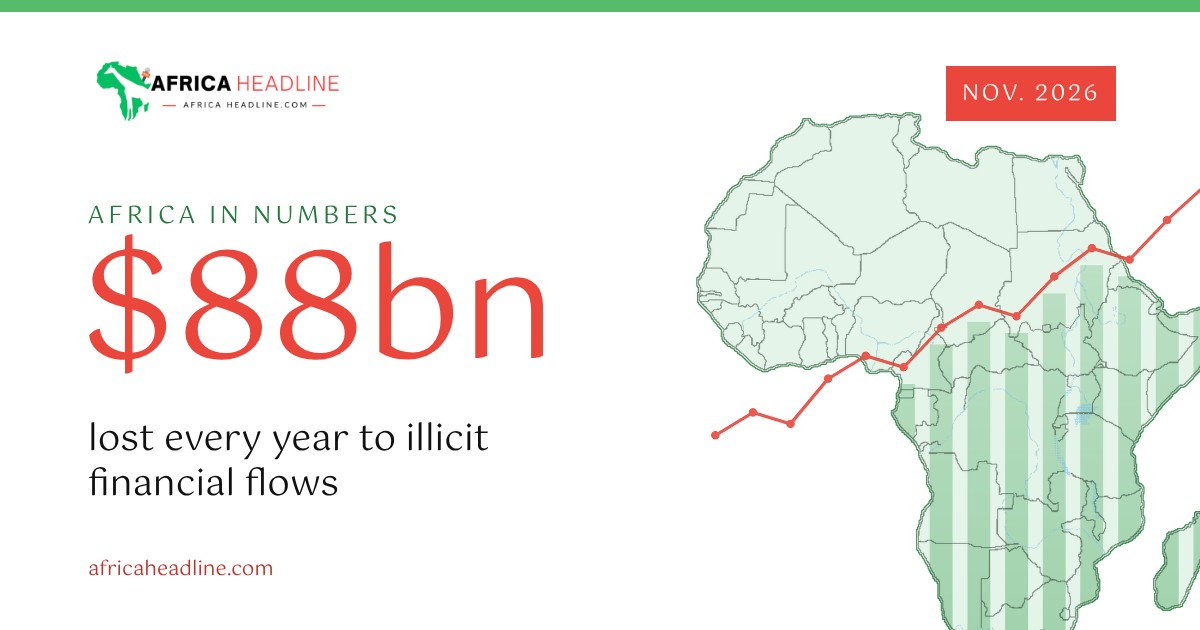
Africa loses $88bn a year to illicit financial flows
- Economic OutlookFeaturedMagazine
- November 21, 2026

AfricaHeadline report ranks all 54 countries on the continent and finds illegal outflows exceed foreign investment
Johannesburg – AfricaHeadline Media Group has published “Africa in Numbers: The cost of corruption and illicit financial flows”. The report estimates that about $88bn a year leaves the continent through tax evasion, money laundering and corruption, or $241mn a day.
The study is available in Portuguese, English and French, as a PDF and in an online edition. It compares all 54 African countries using 11 primary international sources, including Transparency International, the Basel Institute on Governance, the Financial Action Task Force, the Mo Ibrahim Foundation, the IMF and Unctad. It covers the past 12 months of governance, drawing on indicators published between November 2025 and November 2026.
AfricaHeadline Africa em Numeros Corrupcao
AfricaHeadlineA frica in Numbers Corruption
AfricaHeadline Afrique en Chiffres Corruption
Illicit outflows are 27 per cent larger than the foreign direct investment Africa received in 2025, which totalled $69.5bn. They are also 3.6 times bilateral aid to sub-Saharan Africa, which fell to $24.5bn.
On the 2025 Corruption Perceptions Index, Africa averages 32 points, 10 below the global average. Forty of the 54 countries score below 40. Only four score above 50: Seychelles, Cabo Verde, Botswana and Rwanda. Central Africa is the most exposed region, with an average of 24.6, and 17 countries slipped over the past year.
None of the 10 largest economies, which together account for about 70 per cent of African GDP, reaches 50 points.
The report also records progress. Eight African countries left the FATF grey list between June 2025 and June 2026, and the anti-corruption measure in the Ibrahim Index has been recovering since 2020.
It stresses that responsibility is shared: the world’s 10 largest enablers of financial secrecy are outside Africa, led by the US and Switzerland.
“Mobilising domestic resources is the lowest-cost route to development finance: it adds no debt and depends on no one else,” the editorial note says. According to the study, recovering a quarter of illicit flows would match almost all bilateral aid to the region.
AfricaHeadline will repeat the exercise every year.