Senegal: Faye-Sonko split ignites battle for the future of power in Dakar
- PoliticsSenegal
- November 19, 2026
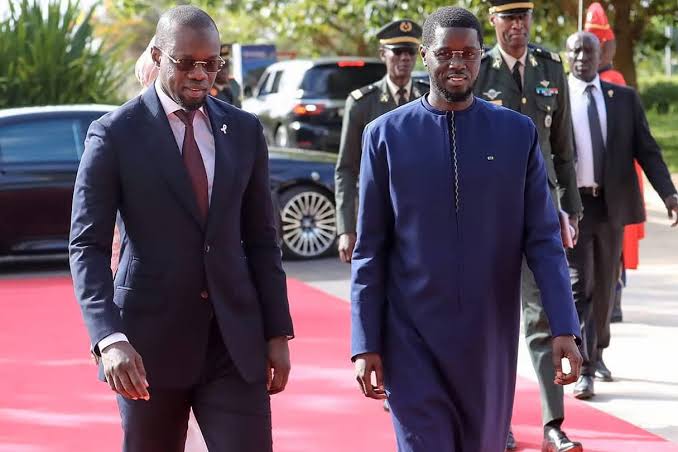

The removal of President Bassirou Diomaye Faye and 31 other members from the ruling Pastef party ends 16 years of political collaboration, exposing one of West Africa’s most prominent democracies to growing institutional, economic and geopolitical uncertainty.
JOHANNESBURG — Senegal has entered a period of profound political uncertainty after the party that brought President Bassirou Diomaye Faye to power formally removed him from its ranks, transforming a once-powerful political alliance into a struggle between two competing centres of authority.
On Tuesday, 17 November, Pastef’s National Council announced the removal of 32 members, including the president and six ministers who remained in government following Ousmane Sonko’s dismissal as prime minister in May.
The party invoked Article 6 of its statutes, which provides for the automatic loss of membership upon joining another political formation.
Three days earlier, Sonko, now president of the National Assembly, had declared his political separation from Faye definitive.
The announcement marks the collapse of one of Africa’s most closely watched experiments in political renewal.
From political brotherhood to institutional rivalry
In March 2024, Faye and Sonko embodied the aspirations of a generation demanding economic sovereignty, institutional transparency, social justice and a reassessment of Senegal’s relationship with former colonial powers.
Barred from contesting the presidential election, Sonko transferred his political capital to Faye, who secured 54.28% of the vote in the first round.
Sonko’s subsequent appointment as prime minister created an unusual power-sharing arrangement. Faye possessed constitutional authority, while Sonko retained considerable influence over the party’s leadership and grassroots supporters.
The inherent tensions became increasingly difficult to reconcile.
Faye dismissed Sonko in May 2026 and launched his own political party, Kiiraay, on 25 July, laying the foundations for an independent electoral platform.
Who really controls Senegal?
Senegal’s emerging political landscape is defined by an imbalance between presidential authority and parliamentary power.
Pastef secured 130 of the National Assembly’s 165 seats in November 2024, giving it a commanding 78.8% parliamentary majority.
Faye controls the executive, but Sonko’s parliamentary strength provides considerable leverage over legislation, economic reforms and budgetary decisions.
Article 87 of Senegal’s constitution allows the president to dissolve parliament after the first two years of its term, subject to constitutional procedures.
However, early legislative elections could strengthen Sonko’s position rather than resolve the crisis.
An economy caught in the crossfire
The political rupture comes at a particularly vulnerable moment for Senegal’s public finances.
The discovery of previously undisclosed financial liabilities, estimated at approximately $13bn, has undermined investor confidence and complicated negotiations with international creditors.
A proposed $2.2bn International Monetary Fund programme remains crucial to restoring financial stability.
Prolonged political confrontation could delay public investment, increase borrowing costs and undermine economic reforms.
For Senegal’s predominantly young population, already facing employment and socioeconomic pressures, the consequences could extend well beyond the political establishment.
Why the world is watching Dakar
Senegal’s stability carries considerable geopolitical significance.
Against a backdrop of military coups, jihadist expansion and the withdrawal of Mali, Burkina Faso and Niger from the Economic Community of West African States, Dakar remains an important regional diplomatic and security partner.
Its Atlantic coastline, constitutional tradition and emerging energy industry reinforce its strategic relevance.
The Sangomar oilfield and the Greater Tortue Ahmeyim gas project, developed jointly with Mauritania, have strengthened international interest in the country.
France, the United States, China, Turkey, the European Union and Gulf states all have economic or strategic interests in Senegal.
There is, however, no established evidence of foreign involvement in the Faye-Sonko split.
Four scenarios towards 2029
Senegal’s political trajectory could follow four broad paths:
Institutional compromise: renewed dialogue restores governability and financial stability.
Presidential consolidation: Faye builds Kiiraay into a competitive national political force.
Parliamentary dominance: Sonko strengthens Pastef’s electoral and legislative influence.
Prolonged confrontation: institutional paralysis fuels economic uncertainty and social polarisation.
Religious leaders, youth movements, trade unions and the Senegalese diaspora could significantly influence these outcomes.
Democracy’s defining test
Senegal’s crisis is no longer simply about the political survival of two former allies. It concerns the resilience of democratic institutions in a region increasingly vulnerable to constitutional breakdown.
Having demonstrated that political power could be won democratically, Faye and Sonko must now demonstrate that it can also be contested without endangering democracy itself.