Angola’s $38 billion challenge: Can Massano’s economic reforms push it past Morocco into Africa’s top five?
- AngolaEconomic Outlook
- November 15, 2026

AFRICAHEADLINE | ECONOMIC INTELLIGENCE
After moving ahead of Kenya in 2026 nominal GDP estimates, Angola faces a tougher test against Morocco. Stronger non-oil growth, industrial investment and currency stability could reshape Africa’s economic rankings by 2031, but closing the gap will require more than a rebound in oil revenues.
JOHANNESBURG — Angola’s ambition to join Africa’s five largest economies is becoming a more credible long-term prospect as accelerating non-oil growth and an investment-led reform agenda strengthen the country’s economic outlook. But overtaking Morocco, whose economy is approximately $38.3 billion larger, will require sustained productivity gains, stronger exports and greater currency stability than Angola has historically achieved.
Angola’s nominal gross domestic product is estimated at $157.3 billion in 2026, compared with Morocco’s $195.6 billion and Kenya’s $151.2 billion, using the October 2026 IMF World Economic Outlook figures as the reference for this analysis.
The estimates place Angola sixth among African economies, ahead of Kenya by $6.1 billion but behind Morocco by almost a quarter of Angola’s own economic output.
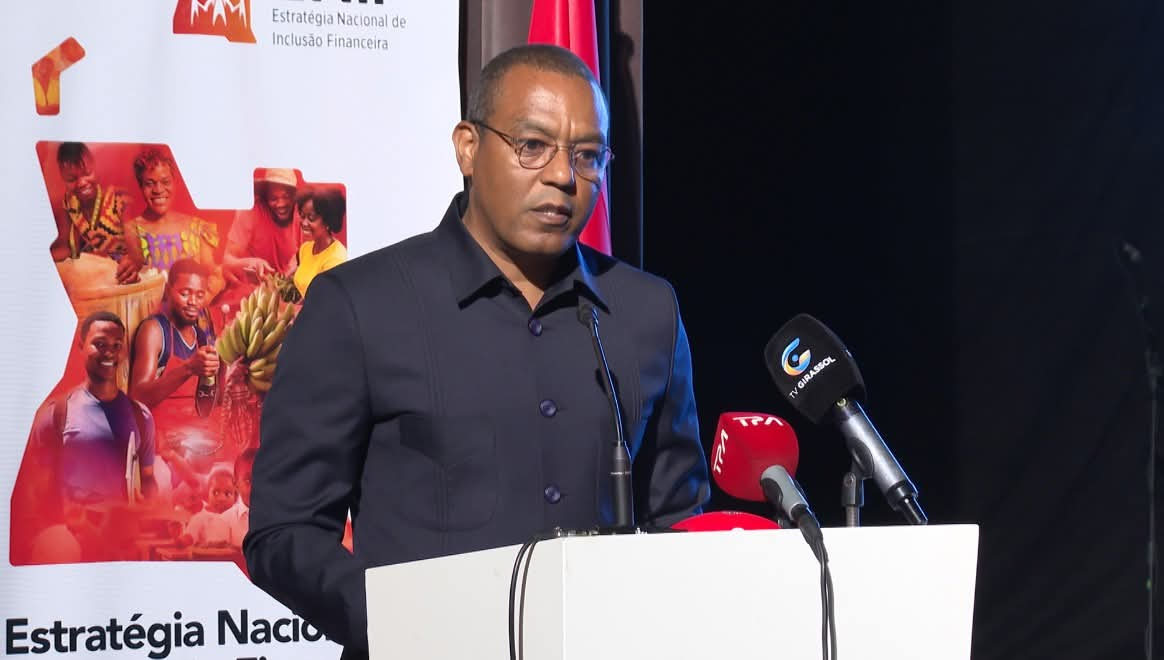
For José de Lima Massano, Angola’s Minister of State for Economic Coordination, the challenge is to turn the country’s non-oil recovery into a broader economic transformation, supported by fiscal discipline, productive investment, financial-sector reform and the expansion of domestic manufacturing.
The policy direction is consistent with the government’s efforts to reduce dependence on crude oil and create a more diversified economic base. Yet Morocco’s established manufacturing sector, export networks and relatively diversified foreign-exchange earnings mean Angola will need to outperform its North African rival for several years before the gap can close.
Angola’s non-oil expansion changes the growth equation
The latest figures point to a strengthening recovery in Angola’s productive economy.
Gross domestic product expanded 5.32% year on year in the first quarter of 2026, before accelerating to 8.74% in the second quarter. Non-oil output grew 6.22% and 9.24%, respectively, according to figures reported by Angola’s National Statistics Institute.
The second-quarter performance was highlighted by Massano at the Africa Financial Summit in Luanda on November 3, where he argued for a greater mobilisation of financial resources to support productive investment, diversification and job creation.
The growth figures suggest that transport, telecommunications, agriculture, manufacturing and services are playing a more significant role in Angola’s expansion. But the country remains vulnerable to oil-price volatility, while a strong quarterly performance does not necessarily translate into sustained annual growth.
The IMF’s October 2026 database projects real GDP growth of 4.4% for Angola this year, with average inflation of 10.6%, a current-account surplus of 2.8% of GDP and gross public debt equivalent to 51.5% of output.
These figures offer a more favourable outlook than the IMF’s earlier assessment in May, when the Fund projected growth of just 2.3% for 2026 and warned that declining oil production was weakening Angola’s fiscal and external positions.
The upward revision illustrates the economy’s improving prospects, although the IMF cautioned again in September that favourable external conditions could slow the pace of necessary structural reforms.
The economic timeline: from recovery to potential convergence
2023 — A new phase of economic coordination
José de Lima Massano takes office as Minister of State for Economic Coordination in June, following his tenure as governor of the National Bank of Angola. Fiscal discipline, domestic production and private investment become central elements of the economic policy framework.
2024–2025 — Recovery and macroeconomic adjustment
Angola records real GDP growth of approximately 5% in 2024, followed by 3.1% in 2025. The IMF reports non-oil growth of 5.2% in 2025, despite a 5.2% contraction in the oil sector.
May 2026 — IMF identifies reform priorities
The Fund calls for stronger fiscal consolidation, improved access to credit, greater exchange-rate flexibility, banking-sector reform and better conditions for private investment.
September 2026 — Growth outlook improves
The IMF’s post-financing assessment identifies stronger non-oil activity, easing inflation and improved access to international capital markets, while warning about oil dependence and fiscal risks.
November 3–4, 2026 — Massano makes the case for productive finance
At AFIS in Luanda, the minister calls for African financial institutions to channel more capital into agriculture, manufacturing, infrastructure and small businesses.
2027–2029 — Proposed investment acceleration
Under the AfricaHeadline analytical scenario, this would be the period for expanding industrial capacity, strengthening domestic supply chains, improving energy reliability and increasing non-oil exports.
2030–2031 — Potential GDP convergence
Under an accelerated nominal dollar growth scenario, Angola could narrow or eliminate the gap with Morocco. This is an illustrative outcome, not an official government target or IMF forecast.
The financial mathematics behind overtaking Morocco
The critical variable is not simply how quickly Angola grows in real terms, but how rapidly its nominal GDP expands when expressed in US dollars.
Exchange-rate movements, domestic prices and real output growth all influence that calculation.
Starting with Angola’s estimated $157.3 billion economy and Morocco’s $195.6 billion, the following simulation assumes Morocco’s nominal GDP grows by 5% annually.
| Target year | Minimum annual nominal dollar growth required for Angola |
|---|---|
| 2030 | Above 11.0% |
| 2031 | Above 9.7% |
| 2035 | Above 7.6% |
AfricaHeadline calculations using compound growth. Thresholds are rounded and assume constant Moroccan growth of 5% annually.
Under a 10% annual growth scenario for Angola, the country would overtake Morocco in 2031.
Angola versus Morocco: nominal GDP convergence
US$ billions, illustrative scenario
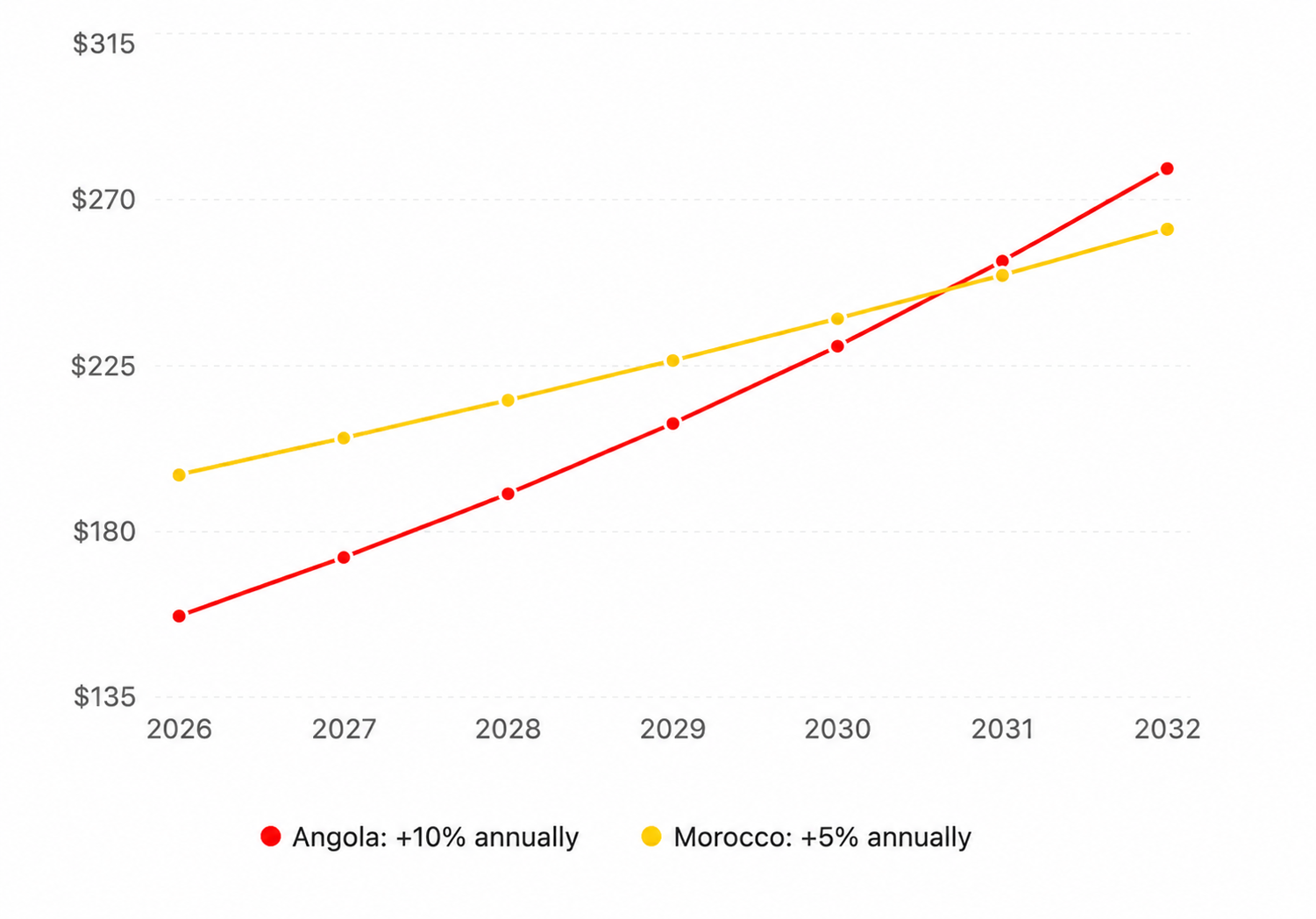
Angola, 2031
$253.3bn
Morocco, 2031
$249.6bn
Illustrative constant-growth scenario. Angola would be approximately $3.7 billion ahead in 2031.
There is, however, a significant qualification. The IMF’s March 2026 country assessment projected Morocco’s nominal GDP at about $284 billion by 2031, up from $194 billion in 2026, a substantially faster trajectory than the 5% annual growth assumption used above.
Although that forecast predates the October figures used for the article’s starting point, it demonstrates why the 2031 overtaking scenario should be regarded as an ambitious possibility rather than a central forecast.
If Morocco follows a faster nominal dollar growth path, Angola would need a correspondingly stronger performance.
Massano’s strategy: turning financial strength into productive growth
The most important element of Angola’s economic transformation may be its ability to mobilise capital more effectively.
Speaking at AFIS 2026, Massano argued that Africa’s financial institutions had become increasingly profitable without delivering sufficient credit to the productive economy.
“We have increasingly profitable financial institutions on the continent, but credit to the private sector remains limited in many of our economies,” Massano said, according to the government’s official account.
The minister noted that African banking revenues exceeded $100 billion in 2024, while agriculture, manufacturing and small and medium-sized enterprises continued to face financing constraints.
His remarks reflected a broader concern: Africa has accumulated significant financial capacity, but much of that capital has yet to translate into industrial development, infrastructure and employment.
For Angola, the challenge is particularly important because investment levels remain relatively low.
The IMF’s May 2026 assessment estimated gross investment at 11.4% of GDP in 2026, with private investment at 7.6%. Those figures compare with national savings of approximately 13% of GDP.
The figures suggest considerable scope to improve the mobilisation of domestic savings and attract long-term foreign capital.
A five-year investment programme worth an illustrative $40 billion could support industrial expansion, energy infrastructure, agriculture, logistics and digital services.
| Investment priority | Illustrative allocation, 2027–2031 |
|---|---|
| Manufacturing and industrial processing | $12bn |
| Energy and infrastructure | $10bn |
| Agriculture and agro-processing | $8bn |
| Logistics and transport | $6bn |
| Digital economy and services | $4bn |
| Total | $40bn |
Such a programme would require an average of $8 billion annually, equivalent to approximately 5.1% of Angola’s estimated 2026 GDP.
It is not an announced government commitment. Rather, it illustrates the scale of capital mobilisation that could complement existing investment and accelerate the country’s structural transformation.
The financial architecture could combine foreign direct investment, development-finance guarantees, corporate bonds, public-private partnerships and domestic institutional investment.
The key would be ensuring that projects generate sustainable returns and do not create excessive sovereign liabilities.
Morocco’s industrial lead remains Angola’s biggest challenge
Morocco’s competitive advantage is rooted in an industrial and export base developed over several decades.
The country has established internationally connected manufacturing industries, particularly automotive assembly, aerospace components, chemicals and phosphate-based products.
The IMF identifies automobiles and phosphate derivatives among Morocco’s principal exports, while France and Spain accounted for 43% of its total trade in 2024.
The Moroccan economy also benefits from tourism, logistics infrastructure and relatively diversified foreign-exchange earnings.
Angola has a different set of strengths. Its petroleum industry generates substantial export revenue, while agricultural land, minerals, energy resources and Atlantic transport infrastructure provide opportunities for industrial development.
But the two countries’ export structures illustrate the scale of Angola’s diversification challenge.
The IMF’s May assessment projected Angola’s goods exports at 24% of GDP in 2026, with oil and gas alone accounting for 22.4 percentage points. On that basis, hydrocarbons would represent approximately 93% of goods-export value.
This concentration makes Angola more vulnerable to fluctuations in oil prices and production volumes.
Morocco, by contrast, benefits from a broader manufacturing base and established export relationships.
The comparison is not entirely unfavourable to Angola. The country’s substantial energy resources and agricultural potential could provide a platform for domestic industrialisation, particularly in fertilisers, food processing, petrochemicals and construction materials.
The critical question is whether Angola can convert those resources into competitive products rather than remain predominantly an exporter of raw materials.
The Lobito Corridor offers a route to regional industrialisation
The Lobito Corridor could become one of Angola’s most consequential economic assets over the next decade.
Connecting Angola’s Atlantic coast with the mineral-producing regions of the Democratic Republic of Congo and Zambia, the corridor has the potential to strengthen the country’s role in regional trade and international logistics.
The opportunity extends beyond transporting copper, cobalt and other minerals.
Industrial processing, warehousing, freight services, agricultural exports and logistics-related manufacturing could generate additional economic activity along the route.
For Angola, the strongest economic outcome would be a corridor that supports domestic production and industrial clusters rather than functioning exclusively as a transit route for commodities.
This would require reliable electricity, competitive freight costs, efficient customs procedures and investment in local businesses.
Massano has also emphasised regional financial integration as an important element of Africa’s development strategy.
Speaking at AFIS, he highlighted the potential of the Pan-African Payment and Settlement System and the interconnection of African capital markets to lower cross-border transaction costs and strengthen continental commerce.
These initiatives could complement physical infrastructure by reducing the financial barriers to regional trade.
Inflation, public debt and currency stability will shape the outcome
Angola’s ability to overtake Morocco will depend heavily on macroeconomic stability.
The IMF’s October 2026 database forecasts average inflation of 10.6% this year, compared with a substantially higher rate in 2025. It also projects a current-account surplus of $4.46 billion, equivalent to 2.8% of GDP.
The improvement in inflation is encouraging for businesses and households, particularly if it contributes to lower borrowing costs and more predictable investment decisions.
Yet fiscal constraints remain.
Angola: selected 2026 macroeconomic indicators
| Indicator | IMF estimate |
| Nominal GDP | $157.3bn |
| Real GDP growth | 4.4% |
| Average inflation | 10.6% |
| Current-account balance | +2.8% of GDP |
| Fiscal balance | −4.7% of GDP |
| Gross public debt | 51.5% of GDP |
| GDP per capita | Approximately $3,880 |
Currency stability will be particularly important.
A depreciation of the kwanza reduces the dollar value of Angola’s nominal GDP, even when domestic output expands. Conversely, an appreciation can increase the dollar measure without necessarily improving productivity or living standards.
For example, real growth of 6%, a 5% increase in the GDP deflator and a 1% depreciation would produce nominal dollar GDP growth of approximately 10.2%.
That would be broadly consistent with the accelerated convergence scenario. But maintaining such conditions would require stronger exports, sustained investment and credible monetary and fiscal policies.
The IMF has recommended greater exchange-rate flexibility, prudent debt management, stronger banking supervision and structural reforms to attract investment.
What investors should watch between 2027 and 2031
The economic outlook can be assessed against a series of measurable milestones.
| Period | Key economic test |
|---|---|
| 2027 | Sustained non-oil growth, inflation reduction and stronger private-sector credit |
| 2028 | Higher industrial investment, reliable energy supply and export diversification |
| 2029 | Greater manufacturing output and stronger logistics revenues |
| 2030 | Faster productivity growth and improved nominal dollar GDP performance |
| 2031 | Assessment of whether Angola has narrowed or eliminated the gap with Morocco |
These are analytical milestones rather than official targets.
For investors, five indicators will be particularly important: non-oil real GDP growth, the exchange rate, private investment as a share of GDP, non-oil export earnings and the public debt trajectory.
A sustained improvement across those measures would provide stronger evidence of economic convergence than headline GDP growth alone.
The most significant test will be whether Angola can increase its productive capacity without relying excessively on oil-price gains or debt-financed public expenditure.
A more diversified Angola could reshape Africa’s economic rankings
Angola’s rise above Kenya in the 2026 nominal GDP estimates demonstrates how the relative size of African economies can change as growth, prices and exchange rates evolve.
The prospect of overtaking Morocco is more demanding because the North African economy has a more diversified export structure and an established industrial base.
Nevertheless, Angola enters the next phase with important advantages: a substantial natural-resource base, expanding non-oil activity, opportunities for regional logistics integration and a government economic strategy focused on attracting productive investment.
Massano’s emphasis on financial-sector efficiency and the mobilisation of capital could become particularly consequential if it leads to measurable improvements in industrial investment, business financing and export capacity.
At AFIS 2026, the minister argued that Africa’s development would depend not only on economic policies but also on the ability of its financial institutions to mobilise savings and support competitive businesses.
For Angola, the proposition is straightforward: financial stability must become a foundation for higher productivity, rather than an end in itself.
The 2031 overtaking scenario remains ambitious and conditional. Morocco’s own growth trajectory means Angola would need to deliver a sustained improvement in investment, competitiveness and nominal dollar output beyond the IMF’s baseline expectations.
But the country’s recent non-oil performance offers a basis for cautious optimism.
The more significant economic achievement would not simply be Angola’s entry into Africa’s top five by nominal GDP. It would be the emergence of a more competitive, diversified economy capable of generating higher household incomes, formal employment and sustainable export growth.
If that transformation takes hold, Angola’s position in Africa’s economic rankings could become a consequence of deeper structural progress rather than the primary measure of success.