Illicit capital flight outstrips foreign investment in Africa
- Business and NetworkingZimbabwe
- November 21, 2026


The $88bn that leaves the continent each year is more than 3.6 times bilateral aid to sub-Saharan Africa, at a time when external finance is shrinking
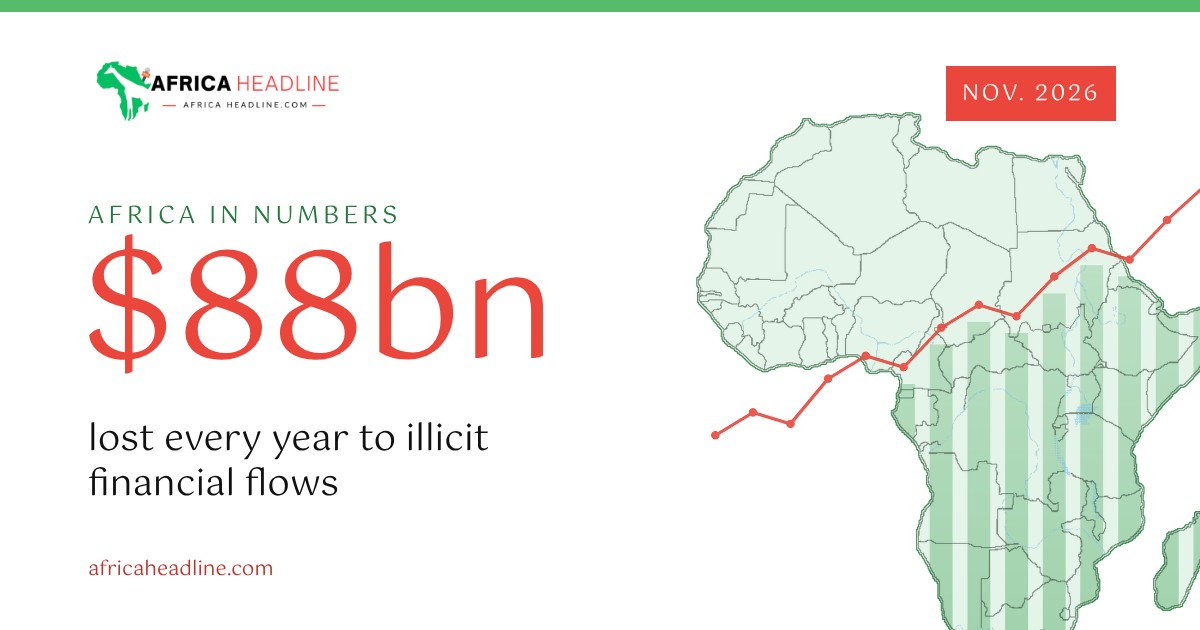
LAGOS — Africa loses more money through illicit channels than it receives in foreign investment. About $88bn leaves the continent each year through tax evasion, money laundering and corruption, according to “Africa in Numbers: The cost of corruption and illicit financial flows”, a report published by AfricaHeadline Media Group. That is $241mn a day, or close to $10mn an hour.
The figure, an African Union estimate, compares poorly with external sources of finance. Foreign direct investment into Africa was $69.5bn in 2025, 26 per cent lower than the previous year. Illicit outflows exceed it by 27 per cent. They are 3.6 times bilateral aid to sub-Saharan Africa, which stands at $24.5bn. Only diaspora remittances, at $124.2bn, are larger than what leaves illegally.
The trend has worsened. In 2015 the AU put these outflows at $50bn a year, an increase of 76 per cent in a decade. Unctad estimates that illicit financial flows amount to 3.7 per cent of African GDP.
A public finance problem
The report treats corruption as a matter of macroeconomic stability rather than only of governance ethics. Its argument is that every diverted dollar reduces the fiscal space for education, health and infrastructure, at a time when the alternatives are drying up.
The past 12 months have tightened the arithmetic. Official development assistance suffered its sharpest contraction on record, foreign investment fell and African debt exceeds $1.16tn. Against this backdrop, AfricaHeadline describes the $88bn as “the largest pool of domestic resources yet to be mobilised”. Mobilising it, the editorial note argues, “adds no debt and depends on no one else”.
Structural, not episodic
The indicators suggest the problem is widespread. Africa’s average score on Transparency International’s Corruption Perceptions Index (CPI) is 32 out of 100, 10 points below the global average. Forty of the 54 countries score below 40, and none of the continent’s 10 largest economies reaches 50.
Perceived corruption and financial risk move together. Across the 48 countries with data on both indices, the correlation between the CPI and the money-laundering risk measured by the Basel AML Index is −0.74. Correlation does not prove causation, but it shows that where public integrity fails, financial reputation tends to fail too. Central Africa is the most exposed region: it has the lowest CPI average, at 24.6, and six of the 10 African countries at highest risk of money laundering.
Shared responsibility
The report does not lay all the blame on African governments. Part of the outflow comes from profit shifting by multinationals and export under-invoicing, routed to financial centres outside the continent. The world’s 10 largest enablers of financial secrecy are outside Africa, led by the US and Switzerland. Stemming the outflow therefore also requires transparency in destination countries.
There are signs of progress, but they are fragile. Eight African countries left the Financial Action Task Force grey list between June 2025 and June 2026. The anti-corruption component of the Ibrahim Index of African Governance has been recovering since 2020. Even so, 17 countries slipped on the CPI over the past year.
One caveat on method: illicit flows include tax evasion, illicit commercial practices and crime, not only corruption. They do not measure corruption in isolation, but they are the best available gauge of its financial cost. Corruption is the main enabler: without captured licences, customs and contracts, most of these flows would not leave.
For governments, investors and development partners, the conclusion is that no external source of capital on offer can make up for what the continent lets slip across its own borders.