How Angola is turning lower inflation into sustainable economic growth
- Business and Networking
- July 10, 2026

From stabilization to transformation
After nearly two years of steady disinflation, Angola is approaching a macroeconomic turning point. Falling inflation is more than a monetary achievement; it signals improving policy credibility, stronger structural reforms and a growing capacity of the real economy to sustain broader-based growth.
JOHANNESBURG – For much of the past decade, inflation was one of Angola’s most persistent economic constraints. Currency volatility, heavy dependence on imports and repeated oil-price shocks eroded household purchasing power, raised business costs and discouraged long-term investment, that landscape is beginning to change.
Annual inflation slowed to 10.11% in June 2026, marking the 23rd consecutive month of disinflation and the lowest reading in more than a decade. The pace of improvement has been striking. Inflation stood near 31% in June 2024, eased to 19.73% a year later and is now approaching single digits.
The significance extends well beyond one economic indicator.
Few African economies have reduced inflation by more than 20 percentage points in two years without resorting to widespread price controls or unsustainable fiscal interventions. Angola’s experience increasingly reflects a broader macroeconomic adjustment driven by disciplined policy and gradual structural change.
Stability is becoming a competitive advantage
For years, Angola’s overriding policy objective was macroeconomic stabilization, today, the debate has shifted.
The challenge is no longer simply bringing inflation down. It is using that stability to generate higher investment, stronger productivity, greater private-sector confidence and sustained improvements in living standards.
Inflation is one of the clearest barometers of economic confidence. When prices become more predictable, companies invest with greater certainty, households regain purchasing power, banks price risk more efficiently and foreign investors gain confidence in the policy environment.
That transition is now becoming increasingly visible in Angola.
Disinflation reflects more than monetary policy
It would be misleading to attribute the decline in inflation solely to tighter monetary policy, the improvement reflects several reinforcing factors.
The National Bank of Angola has maintained a disciplined monetary stance, strengthening policy credibility and helping anchor inflation expectations.
Fiscal consolidation, greater exchange-rate stability, stronger tax administration and improved coordination between fiscal and monetary authorities have also contributed to restoring macroeconomic stability, yet one structural driver deserves particular attention, he real economy is beginning to play a much larger role.
Economic Diversification Is Starting to Influence Inflation
For decades, Angola’s inflation dynamics were largely imported, whenever the kwanza weakened, higher import prices quickly fed through to food, medicine, industrial equipment and consumer goods.
That transmission mechanism still exists, its influence, however, is gradually diminishing.
Growth in commercial agriculture, food processing, manufacturing, logistics, transportation, telecommunications and business services is reducing Angola’s structural dependence on imported goods, recent national accounts highlight this transition.
Real GDP expanded 5.32% year-on-year in the first quarter of 2026, led by 6.22% growth in the non-oil economy. Information and Communication expanded 27.63%, Transport and Storage grew 16.12%, Agriculture and Fisheries rose 8.73%, while Electricity and Water increased 8.15%.
The broader message is more important than any individual figure, economic growth is increasingly being generated outside the oil sector, that shift is also reshaping Angola’s inflation profile.
Producing more means importing less inflation
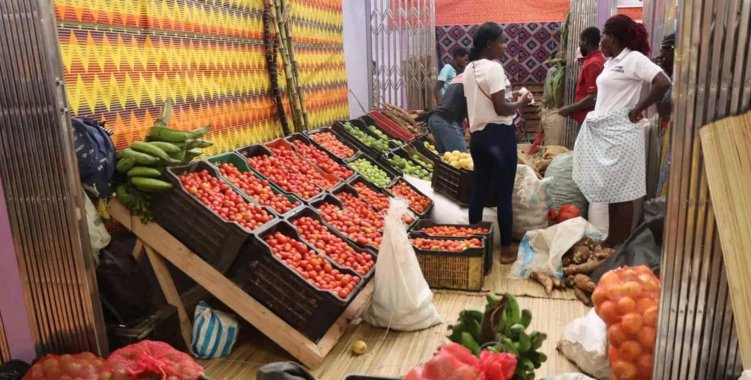
Domestic production remains one of the most effective long-term inflation anchors. Every additional tonne of maize produced locally reduces import dependence. Every litre of milk processed domestically lowers exposure to exchange-rate fluctuations. Every new manufacturing plant shortens supply chains. Every agricultural investment expands domestic supply.
From a macroeconomic perspective, stronger domestic production reduces the transmission of global price shocks into local consumer prices.
Economic diversification has therefore become more than an industrial strategy, it is increasingly functioning as an anti-inflation strategy.
Lower Inflation Improves Angola’s Investment Story
Financial markets reward predictability.
Persistently high inflation raises sovereign borrowing costs, discourages foreign direct investment and increases country-risk premiums, the reverse is equally true.
A sustained decline in inflation strengthens investor confidence, gradually lowers the cost of capital and improves perceptions among international lenders and development finance institutions.
For investors considering agriculture, manufacturing, logistics, mining, renewable energy, tourism and the digital economy, a more predictable macroeconomic environment significantly enhances Angola’s investment case.
Macroeconomic stability is becoming part of the country’s competitive advantage.
Households are beginning to benefit
The improvement should not be overstated, an inflation rate of around 10% remains elevated by international standards, and households continue to absorb the cumulative effects of several years of higher prices.
Real income recovery will depend on sustained economic growth, stronger productivity, formal job creation and rising wages, nevertheless, lower inflation provides the foundation for that recovery, without price stability, inclusive growth is difficult to achieve.
The next challenge lies ceyond the central bank
Monetary policy has largely achieved its immediate objective, the next phase depends on the real economy.
Accelerating industrialization, expanding agricultural output, improving transport infrastructure, lowering logistics costs, strengthening human capital and raising business productivity will determine whether Angola can sustain its current trajectory.
These reforms will ultimately shape the country’s long-term growth potential.
Risks remain, but the economy is better positioned
Challenges have not disappeared, a sharp decline in global oil prices could weaken fiscal revenues and place renewed pressure on the exchange rate.
Geopolitical tensions, supply-chain disruptions or climate-related shocks could also push food and energy prices higher, the key difference today is that Angola is becoming more resilient.
A more diversified economy is inherently better equipped to absorb external shocks.
As agriculture, manufacturing, logistics, energy and digital industries account for a larger share of economic activity, Angola’s vulnerability to external inflationary pressures should continue to decline.
A new economic narrative is emerging
Economic history shows that defeating inflation is only the first stage of development.
The countries that achieve lasting prosperity are those that transform monetary stability into investment, productivity gains, innovation and rising living standards.
Angola is beginning to build those foundations.
The sustained decline in inflation, combined with robust non-oil growth, expanding domestic production and stronger macroeconomic management, suggests the country may be entering a new phase of its economic cycle.
The real achievement is not simply reducing inflation from around 31% to 10.11% in two years.
It is creating the conditions for a more diversified, resilient and competitive economy.
If structural reforms continue and investment increasingly flows into productive sectors, the recent decline in inflation may ultimately be remembered not merely as a monetary policy success, but as the beginning of a broader economic transformation, one in which Angola is defined less by the volatility of commodity cycles and more by the strength of its institutions, the expansion of its productive economy and its growing capacity to generate sustainable, private-sector-led growth.