Rwanda’s strategic gains in the DRC conflict
- Democratic Republic of the Congo (DRC)PoliticsRwanda
- January 29, 2025

A pragmatic analysis
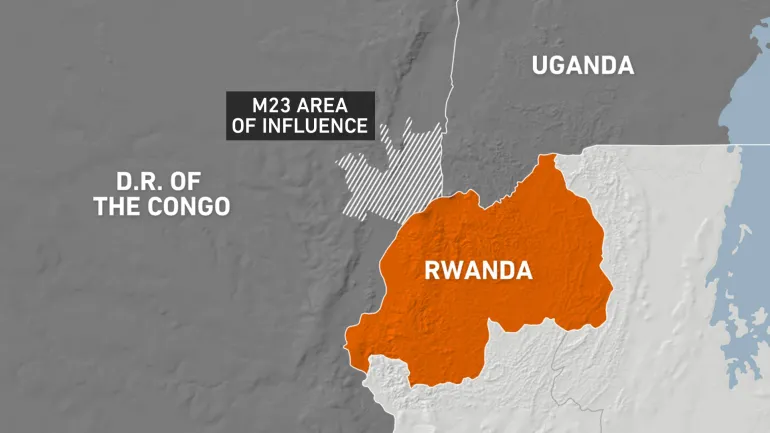
Lagos, Nigeria – The involvement of Rwanda in the ongoing conflict in the Democratic Republic of the Congo (DRC) has been the subject of intense geopolitical debate, with Kigali consistently denying allegations of supporting the March 23 Movement (M23). However, Rwanda’s influence in eastern DRC is undeniable and serves multiple strategic interests—economic, security-related, and geopolitical.

AfricaHeadline Reports Team
editorial@dw-demosnewstaion.online
Given Rwanda’s limited natural resources and small territorial size, its engagement in the conflict, whether direct or indirect, provides tangible benefits that reinforce its regional position.
Control over strategic minerals
Eastern DRC is home to some of the world’s most valuable mineral reserves, including coltan, gold, diamonds, and cobalt—key resources in the global tech supply chain.
Reports from the United Nations and human rights organisations suggest that Rwanda has benefited from illicit mineral trade networks, with resources smuggled out of DRC being processed and exported via Kigali. This trade has bolstered Rwanda’s economy, positioning it as a crucial player in the global mineral market despite its lack of domestic reserves.
The presence of M23 rebels in eastern DRC has further undermined Kinshasa’s control over these resources, creating an environment where alternative trade routes and illicit extraction networks can flourish. Even if Rwanda is not directly involved, the instability in the region ensures that the DRC government remains unable to fully assert its sovereignty over its own mineral wealth.
Ethnic and National defence interests
Rwanda’s involvement in eastern DRC is also driven by security concerns, particularly in relation to ethnic tensions and the legacy of the 1994 genocide.
The M23, a predominantly Tutsi rebel group, claims to be fighting for the rights of the Tutsi minority in DRC, which it alleges faces discrimination and violence from both Congolese security forces and rival armed groups, particularly the Democratic Forces for the Liberation of Rwanda (FDLR).
The FDLR, composed in part of former Hutu militias involved in the genocide, remains a long-standing security threat to Kigali.
By maintaining a strong presence—either directly or through rebel proxies—in eastern DRC, Rwanda ensures that hostile groups such as the FDLR do not gain a foothold near its borders. The conflict also prevents these groups from reorganising and launching attacks against Rwandan territory, reinforcing Kigali’s long-standing policy of pre-emptive regional security.
Expanding Diplomatic and Military reach
Despite its small size, Rwanda has positioned itself as a key regional player in Central and East Africa, leveraging its military strength and diplomatic engagement. Its involvement in DRC, whether overt or covert, enhances its influence in regional peace negotiations and conflict mediation.
Rwanda’s modernised army, which has participated in peacekeeping missions across Africa, is perceived as one of the most disciplined and capable forces in the region, strengthening its status as a security provider.
At the same time, Kigali enjoys significant diplomatic backing from Western allies, particularly the United States and the United Kingdom, who see Rwanda as a stabilising force in an otherwise volatile region.
This strategic alignment has provided the country with financial and military support, helping to reinforce its regional role, even as it faces periodic scrutiny over its involvement in eastern DRC.
Trade and Cross-Border commerce
Trade between Rwanda and eastern DRC remains a significant economic factor. Cities like Goma serve as crucial commercial hubs for Rwandan goods, and instability in the region weakens Kinshasa’s ability to regulate cross-border trade effectively.
The ongoing conflict creates conditions that allow Rwandan businesses and traders to capitalise on economic activity in the region, securing key market advantages over their Congolese counterparts.
Moreover, Kigali has invested in infrastructure that strengthens its economic ties with eastern DRC, making the region increasingly reliant on Rwanda for imports and logistical support. Continued instability further entrenches this economic dependency, limiting Kinshasa’s ability to exert full control over its own economic corridors.
A Calculated Strategy with Risks
Rwanda’s engagement in the DRC conflict is not merely about backing rebels—it reflects a broader strategy that balances economic ambition, security imperatives, and regional diplomacy.
While Kigali officially denies involvement with M23, the geopolitical landscape suggests that the ongoing instability aligns with its strategic interests, allowing it to maintain influence over key mineral reserves, protect its borders from hostile groups, and solidify its regional standing.
However, this approach is not without risks. Growing diplomatic pressure, increased scrutiny from international organisations, and the possibility of escalating military confrontations could challenge Rwanda’s long-term position. If Kinshasa strengthens its military capabilities or secures greater regional support, the cost of continued engagement in eastern DRC could outweigh the benefits.
Ultimately, a resolution to the crisis will require more than military intervention or diplomatic statements—it will demand a comprehensive regional strategy that acknowledges both the sovereignty of DRC and the legitimate security concerns of its neighbours, including Rwanda.
such a framework is established, Kigali will continue to navigate this complex conflict, weighing its risks and rewards in a region where instability has long been the status quo.