China deepens South African manufacturing push as trade gives way to factories
- Uncategorized
- July 20, 2026

From solar power and mining equipment to automobiles, Chinese companies are shifting towards local production. Pretoria sees an opportunity for jobs and technology transfer, but labour and regulatory risks remain.
JOHANNESBURG — For decades, the economic relationship between China and South Africa followed a familiar pattern: South African minerals flowed to Chinese factories, while finished goods travelled in the opposite direction. That model is beginning to change.
| Indicator | Key Figures |
|---|---|
| Chinese investment focus | Solar energy, mining equipment,
automotive manufacturing, SMEs |
| Flagship energy project | Redstone Concentrated Solar Power Plant |
| Project developer | Sepco III (PowerChina) |
| Jobs created (Redstone) | 2,500+ |
| Local jobs created | ~650 |
| Youth unemployment (Northern Cape) | ~40% |
| Major mining investment | Expansion of Sany heavy mining equipment operations |
| Automotive investment | Chery plans vehicle production in South Africa |
| Strategic objective | Local manufacturing,
assembly and supplier development |
| Target sectors | Renewable energy, mining machinery,
automotive, industrial manufacturing, solar technology |
| Policy incentives | Local-content rules,
industrial localisation and tariff support |
| Key opportunities | Job creation, technology transfer,
supplier development, exports |
| Main risks | Labour disputes, regulatory complexity,
electricity shortages, logistics costs |
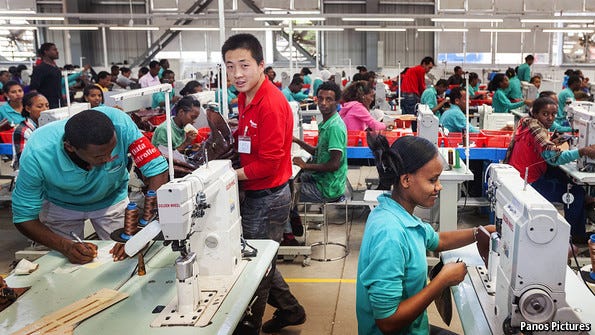
Chinese companies are expanding beyond trade into manufacturing, energy, heavy machinery and automotive production, signalling a broader shift in Beijing’s economic engagement with Africa’s most industrialised economy. For Pretoria, the transition offers an opportunity to attract investment, create jobs and strengthen industrial capacity at a time of sluggish growth and persistently high unemployment. It also raises difficult questions over local content, labour standards and whether foreign investment can translate into lasting industrial development.
In the Northern Cape, the Redstone concentrated solar power project has become one of the clearest symbols of this new phase. Built by Sepco III, a subsidiary of China’s state-owned PowerChina, the plant demonstrates Beijing’s ability to combine engineering expertise, project finance and construction capabilities under the Belt and Road framework.
China deepens South African manufacturing push as trade gives way to factories, by the numbersKey Investments
- Redstone Solar Thermal Project (Northern Cape)
- Built by Sepco III, a subsidiary of PowerChina.
- More than 2,500 construction jobs.
- Around 650 local workers employed.
- Includes workforce training and community engagement programmes.
- Mining Equipment
- Sany is expanding beyond equipment exports into after-sales services and potential local industrial capacity.
- Supports South Africa’s mining industry while aligning with localisation policies.
- Automotive Manufacturing
- Chery intends to establish vehicle production in South Africa.
- Investment is expected to generate employment and strengthen regional exports under the African Continental Free Trade Area (AfCFTA).
- Small and Medium Enterprises
- Chinese entrepreneurs are increasingly investing in solar energy, electrical solutions and industrial services.
- Johannesburg’s “China malls” are evolving from import centres into broader commercial and industrial business hubs.
According to project information, construction created more than 2,500 jobs, including around 650 filled by local residents in a province where youth unemployment remains close to 40%. Training programmes and community grievance mechanisms were introduced to address the language and cultural challenges that often accompany large foreign-backed infrastructure projects.
The experience also illustrates one of the central tensions in the relationship. South African policymakers increasingly argue that infrastructure alone is insufficient; projects must generate skilled employment, strengthen domestic suppliers and facilitate technology transfer. For investors, meanwhile, compliance with labour regulations, environmental standards and community expectations has become as important as engineering execution in determining whether projects proceed without costly delays.
A similar evolution is unfolding in mining. China remains a major buyer of South African raw materials, particularly chrome concentrate used in stainless-steel production. Yet Chinese manufacturers of heavy equipment, including Sany, are increasingly seeking to establish sales networks, after-sales services and eventually industrial operations within southern Africa.
For mining companies, the attraction lies in competitive pricing and operational efficiency. For Pretoria, however, the strategic question is how much of that value chain can be relocated domestically. South Africa’s industrial policy increasingly favours productive investment over the simple importation of finished goods, using localisation requirements and tariff incentives to encourage assembly and manufacturing.
The automotive sector may become the most significant test of that strategy. Chinese carmaker Chery, one of China’s largest vehicle exporters, has announced plans to establish production in South Africa alongside commitments to create local employment. The investment could reinforce one of the country’s most important export industries, although its long-term impact will depend on production scale, supplier localisation and access to regional African markets.
The expansion comes as slowing domestic demand in China and rising trade tensions with the United States and Europe encourage manufacturers to diversify production bases and seek new growth markets. South Africa offers comparatively advanced infrastructure, sophisticated financial institutions and preferential access to the wider African market through continental trade arrangements. Against those advantages stand persistent electricity shortages, expensive logistics and a complex regulatory environment.
The shift extends beyond large state-owned enterprises. Johannesburg’s Chinese commercial centres, once known primarily for importing low-cost consumer goods, have gradually evolved into broader business ecosystems. A new generation of Chinese entrepreneurs—many internationally educated and operating across multiple markets—is connecting Asian manufacturers with African customers, particularly in solar energy and technologies designed to address South Africa’s electricity shortages.
These smaller businesses may prove as economically significant as headline infrastructure projects. They deepen distribution networks, expand commercial relationships and build local market knowledge that large multinational investors often require years to develop. They also place greater pressure on regulators to enforce tax compliance, licensing requirements, consumer protection, immigration rules and labour legislation.
The deepening relationship carries political sensitivities. Trade unions and local communities continue to demand assurances that South African workers will not be displaced and that wages and workplace safety standards will be upheld. Domestic manufacturers warn against unfair competition from subsidised imports, while Chinese investors seek greater regulatory certainty, stronger intellectual property protection and more efficient dispute-resolution mechanisms.
Ultimately, the success of this new phase will be measured less by investment announcements than by what remains on South African soil: operating factories, competitive local suppliers, skilled workers and reliable sources of energy. If that transition materialises, China may come to be viewed not merely as South Africa’s largest trading partner, but as a more deeply embedded participant in the country’s industrial transformation.
For Pretoria, that presents both opportunity and risk. Chinese capital could help fill investment gaps that neither the state nor many Western investors have been willing or able to address. Without consistent regulation, robust oversight and effective industrial policy, however, the next chapter of the relationship could replicate old dependencies in a different form.
The bottom line
China’s engagement in South Africa is moving from trade to production. Rather than exporting finished goods alone, Chinese companies are increasingly building factories, assembling vehicles, manufacturing equipment and investing in renewable energy, positioning South Africa as both an industrial base and a gateway to African markets. The long-term success of this strategy will depend on how effectively investment generates local jobs, technology transfer and domestic supply chains while addressing regulatory, labour and infrastructure challenges.