Nigeria enters 2026 with inflation easing and debt demanding its price
- Economic OutlookFeatured
- July 13, 2026
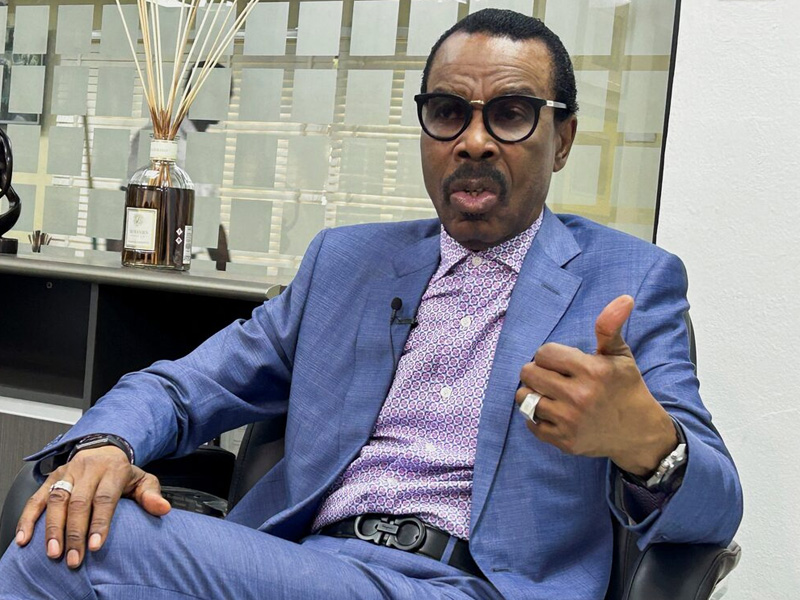

Currency and fiscal reforms have begun to stabilise key indicators in Africa’s largest economy, but Bismarck Rewane warns that growth without broader income distribution, reliable electricity and fiscal discipline risks deepening insecurity.
ABUJA — Nigeria enters 2026 with a combination that would have seemed unlikely only a few years ago: inflation is slowing, foreign reserves have strengthened, the trade balance has returned to surplus and the naira appears closer to finding a sustainable market value. Beneath those encouraging trends, however, lies an equally extraordinary liability: federal public debt could reach ₦180tn.
That is the central tension in the economic assessment presented by economist Bismarck Rewane. He estimates that gross domestic product expanded by 3.9 per cent in 2025 and forecasts growth of 4.2 per cent in 2026, comfortably above the five-year average of just 2.03 per cent. It represents progress, but not yet transformation.
With GDP estimated at roughly $250bn in 2025, Nigeria remains a long way from its official ambition of becoming a $1tn economy by 2030. According to Rewane, achieving that target within the decade would require annual growth of around 15 per cent, almost four times the current trajectory. For now, the arithmetic does not support the ambition.
The clearest evidence of stabilisation is visible in the external accounts. After recording average deficits over the previous five years, the trade balance posted a $13.13bn surplus in 2024. Rewane projects a surplus of $7.3bn in 2025 and $10bn in 2026. Foreign reserves are estimated to have risen to $45bn in 2025, although they could ease again this year.
The exchange rate tells a similar story. Following a sharp depreciation that pushed the official average to about ₦1,590 per US dollar in 2024, Rewane estimates an average of ₦1,490 in 2025 and ₦1,560 in 2026. More significant than the precise level is the narrowing gap between the official and parallel markets, suggesting that the country’s long-standing currency fragmentation is beginning to recede.
The adjustment, however, has carried a heavy social cost. Per capita income, which averaged $2,728 over the five-year comparison period, fell to $824 in 2024 and around $806 in 2025. The projected recovery to $1,360 in 2026 would mark an improvement, but it would still leave living standards well below previous levels.
Inflation captures that contradiction. After peaking at 33 per cent before the consumer price basket was rebased, headline inflation fell to 21.02 per cent following the statistical revision. Rewane expects it to decline further to 12.7 per cent in 2026. Lower inflation matters, but slower price increases do not automatically restore the purchasing power households have already lost.
The sharp increase in federal revenue also warrants caution. Government receipts are projected to rise from ₦9.44tn in 2024 to ₦12tn in 2025 and ₦18tn in 2026. In nominal terms, the increase is striking. Adjusted for inflation and currency depreciation, however, the improvement is considerably less impressive. Rewane argues that dividing nominal values by roughly four provides a simple, albeit imperfect, illustration of the erosion in real terms.
Debt is where optimism meets its greatest constraint. Federal government debt, compared with a historical benchmark of ₦12tn, is estimated to have reached ₦166tn in 2025 and could climb to ₦180tn in 2026. External debt may also rise from $45bn in 2024 to $50bn this year. The critical question is not merely how much Abuja borrows, but what the economy receives in return.
“Those who borrow eventually meet sorrow,” Rewane remarked, reviving an old proverb about the true cost of debt. The real test is whether borrowing finances productive infrastructure capable of generating future income, or merely shifts the burden onto future budgets.
The productive sectors present a mixed picture. Petroleum refining expanded by 19 per cent in 2025, driven by the Dangote Refinery and modular refining capacity. Increased domestic supply has helped reduce fuel shortages and ease pressure on pump prices. A proposed 15 per cent import tariff on refined petroleum products would strengthen domestic refiners, although it could also raise costs for consumers if competition remains limited.
Crude oil production, meanwhile, remains stuck at around 1.5m barrels a day. OPEC production limits, pipeline vandalism, oil theft and underinvestment continue to prevent the country from fully monetising its resource base. In the power sector, repeated grid failures remain one of the most persistent obstacles to investment and industrial expansion.
There are, nevertheless, pockets of strength. Surging global cocoa prices have benefited producers across the south-west. On the Nigerian Exchange, market capitalisation has increased from ₦21tn in 2020 to ₦99tn in 2025, while aggregate corporate profits have risen from ₦1.5tn to ₦9.4tn. Domestic investors traded four times more capital than foreign participants, reducing dependence on international portfolio flows and demonstrating that local savings have remained resilient despite the currency’s depreciation.
A future listing of the Dangote Refinery could reinforce that trend. Rewane also identified companies including MTN, Okomu Oil, Guinness, Transcorp Power and Dangote Cement as businesses worth monitoring in the domestic market, alongside selected global technology and healthcare companies. It is a watchlist rather than an investment recommendation.
The international backdrop adds another layer of uncertainty. Bulgaria became the eurozone’s 21st member on January 1, 2026. In the United States, the federal elections scheduled for November 3 will be midterm congressional elections rather than a presidential contest. Any shift in Washington’s political balance could still influence trade policy, interest rates and capital flows into emerging markets.
For Nigeria, however, domestic politics may present the more immediate challenge. The approach of the 2027 elections is likely to increase spending pressures and test fiscal discipline. New tax legislation may broaden government revenues, but it will also reshape incentives for a private sector already grappling with high borrowing costs, expensive energy and subdued consumer demand.
Rewane reduces the dilemma to a simple proposition: productivity without fairness and inclusion ultimately fuels insecurity. Nigeria’s richest regions in oil, gold, lithium and other minerals frequently overlap with areas affected by violence, smuggling and weak state presence. Growth that fails to distribute its benefits may improve headline GDP while simultaneously weakening the country’s social foundations.
Nigeria accounts for roughly 2 per cent of the world’s population but only 0.2 per cent of global output. Closing that gap will require more than exchange-rate stability or lower inflation. It will require reliable electricity, institutions capable of sustaining reform, debt converted into productive assets and public revenues translated into visible improvements in citizens’ daily lives.
The balance sheet for 2025 suggests that Nigeria has moved beyond the most painful phase of its economic adjustment. The greater challenge for 2026 is to convert macroeconomic stability into tangible prosperity.
As Rewane concluded, “What you see is what you get, but what you don’t see is what catches you.” In Nigeria’s case, the hidden risk may be the widening gap between improving economic statistics and the everyday experience of its people.