Al-Sisi Bets on manufacturing to reshape Egypt’s $436 billion economy
- EconomicEgypt
- November 24, 2026

Egypt aims to raise manufacturing’s share of GDP to 20%, expand private-sector participation and establish itself as an industrial export hub linking Africa, Europe and the Middle East.
CAIRO — Egypt is shifting its economic strategy towards manufacturing and exports as President Abdel Fattah al-Sisi seeks to reduce import dependence, diversify foreign currency earnings and create jobs through an expansion of domestic industrial capacity.
The strategy marks a new phase in the economic programme launched in 2014, when the government prioritised investment in energy, roads, railways and ports. The focus is now on leveraging that infrastructure to improve productivity, attract private capital and integrate Egypt into global supply chains.
Manufacturing Drives Economic Recovery
Egypt’s nominal gross domestic product reached $436.5 billion in the 2025/26 fiscal year, up from $359.9 billion a year earlier. Real economic growth accelerated from 2.4% in 2023/24 to 4.4% in 2024/25 and 5.1% in 2025/26.
Non-oil manufacturing expanded by 9.1%, contributing 1.14 percentage points to overall economic growth, while private investment increased by 11.6%. Average annual inflation declined from 20.9% to 13.2%.
The figures point to a recovery in productive activity, although public debt, equivalent to approximately 90% of GDP, continues to constrain the government’s fiscal flexibility.
A $100 Billion Export Ambition
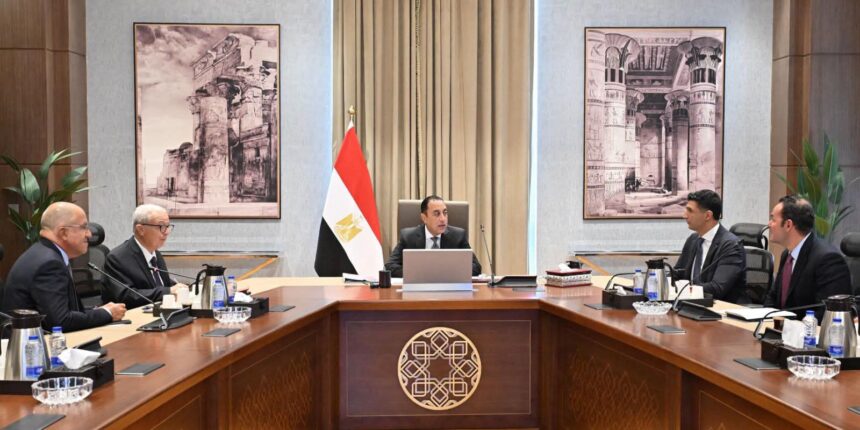
On July 6, 2026, Al-Sisi met Prime Minister Mostafa Madbouly and Industry Minister Khaled Hashem in Cairo to review the implementation of Egypt’s National Industrialisation Strategy for 2026–2030.
The programme targets $100 billion in annual non-oil exports by 2030, with seven priority industries: automotive manufacturing, pharmaceuticals, food processing, textiles, garments, electronics, and electrical and engineering equipment.
Al-Sisi called for greater private-sector participation and the removal of administrative barriers to industrial investment.
The government also plans to revive idle factories, develop domestic suppliers, expand access to industrial land and strengthen small and medium-sized enterprises.
Financing Egypt’s Industrial Expansion
Egypt’s 2025/26 economic development plan envisaged EGP252.8 billion ($5.1 billion) in manufacturing investment, compared with EGP99.5 billion in actual investment in 2023/24.
Private businesses were expected to account for more than 83% of planned investment, reflecting the government’s efforts to shift the balance of industrial development towards private capital.
The reforms build on Investment Law No. 72 of 2017, amended in 2023, which provides tax and customs incentives, including a 2% customs duty on certain machinery and equipment required to establish industrial projects.
Eligible projects may also qualify for financial incentives equivalent to between 35% and 55% of corporate income tax paid.
Egypt’s so-called Golden Licence allows qualifying investors to secure the necessary project approvals through a single administrative authorisation, reducing regulatory complexity and implementation delays.
Global Manufacturers Expand Production
Foreign investment is increasingly translating into new manufacturing capacity.
On November 19, 2026, Madbouly inaugurated the second phase of Chinese appliance manufacturer Haier’s industrial complex in 10th of Ramadan City. The additional $70 million investment brings the company’s total commitment to the complex to $185 million.
The new facility has an initial annual production capacity of 500,000 refrigerators and freezers, with potential expansion to one million units. It is expected to create 1,000 jobs and serve export markets across more than 30 countries.
In June 2025, Germany’s Bosch inaugurated a manufacturing facility in the same industrial city, with an annual production capacity of 350,000 cookers, half of which are intended for export, and approximately 1,000 employees.
Domestic component sourcing, initially estimated at around 50%, is expected to reach 70% within two years.
Investments by Haier, Bosch and Turkey’s Beko illustrate Egypt’s efforts to attract international manufacturers while developing domestic industrial supply chains.
Egypt’s Economic Transformation in Numbers
Egypt’s $436.5 billion economy is showing signs of a structural shift towards manufacturing, private investment and export-oriented growth. Real GDP expanded by 5.1% in the 2025/26 fiscal year, supported by a 9.1% increase in non-oil manufacturing, 19.3% growth in telecommunications and a 23.3% recovery in Suez Canal activity. Private investment rose by 11.6%, while average annual inflation declined to 13.2%, signalling an improvement in macroeconomic conditions.
With planned manufacturing investment of $5.1 billion, the government is seeking to translate economic stabilisation into greater industrial capacity and international competitiveness. Its targets of $100 billion in annual non-oil exports and a 20% manufacturing share of GDP by 2030 underscore Cairo’s ambition to diversify foreign currency earnings, reduce import dependence and strengthen its position in global supply chains.
Achieving these objectives, however, will require sustained productivity gains, affordable industrial financing and deeper private-sector participation, particularly as public debt remains a constraint on fiscal flexibility.
An Industrial Gateway Between Three Continents
Egypt’s geographical position, preferential trade arrangements with the European Union, membership of the Common Market for Eastern and Southern Africa (COMESA) and participation in the African Continental Free Trade Area provide manufacturers with access to multiple international markets.
The Suez Canal Economic Zone is central to that strategy, combining industrial production, port infrastructure and logistics services along one of the world’s most important maritime trade corridors.
Egypt is seeking to compete with established manufacturing centres such as Morocco, South Africa and Turkey, particularly in automotive production, textiles, electronics and electrical equipment.
The sustainability of its industrial expansion will also depend on exchange-rate stability, workforce development and the government’s ability to ensure a level playing field between state-owned and private enterprises.
Al-Sisi’s industrial policy represents an attempt to reshape the composition of Egypt’s external revenues and reduce its exposure to foreign financing.
By converting infrastructure investment into manufacturing capacity, and manufacturing capacity into export earnings, Cairo is seeking to strengthen its foreign currency position, increase domestic value added and establish a more resilient economic model anchored in production, productivity and international competitiveness.