Dangote’s $5bn IPO tests Africa’s appetite for funding its own energy future
- AlgeriaAngolaBusiness and NetworkingNigeria
- August 6, 2026
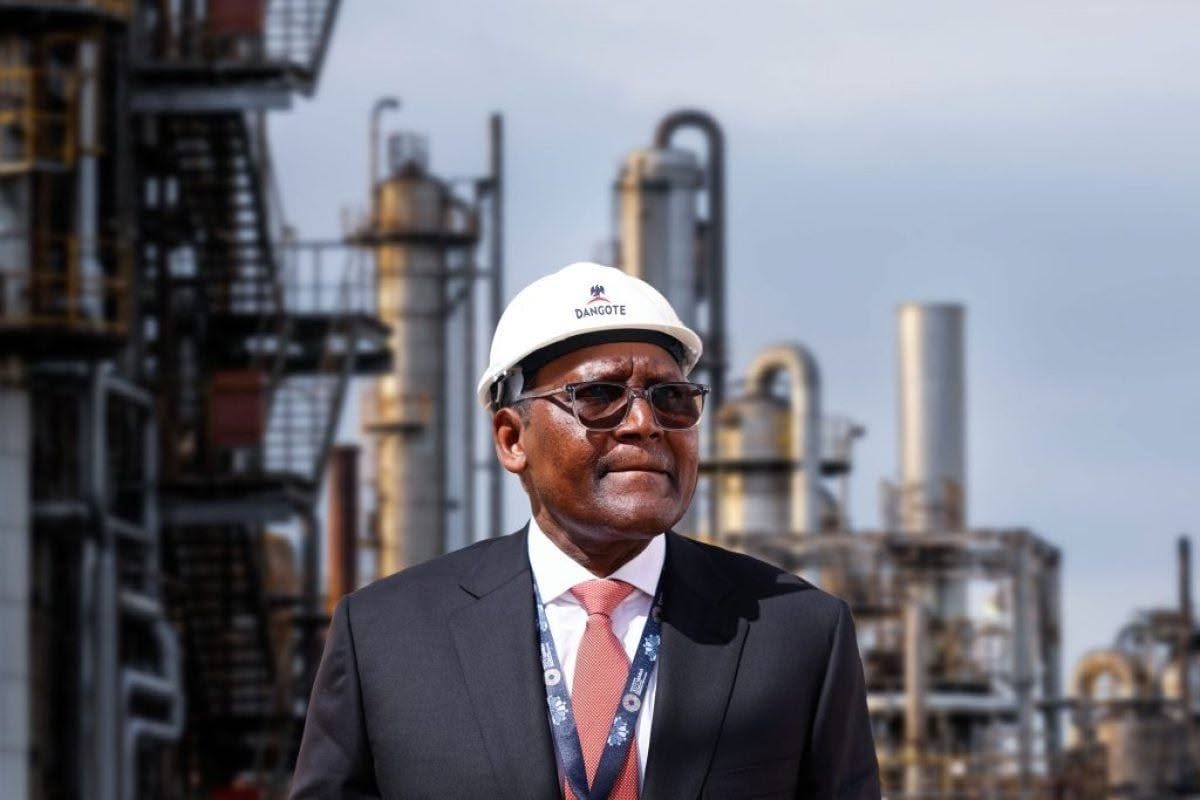

The continent’s largest refinery is seeking to raise $5bn in Lagos and is considering a subsequent Johannesburg listing. The deal would shift part of its expansion risk to shareholders, while Algeria opens its fields to investors without opening Sonatrach, and Angola relies on debt ahead of any Sonangol flotation.
MARKETS ANALYSIS
LAGOS — The Johannesburg Stock Exchange confirmed on August 5 that it had held talks with the Dangote Group over a possible listing of Africa’s largest refinery that would follow a planned IPO in Lagos seeking to raise about $5bn. The transaction, targeted for October, remains subject to approval by Nigeria’s Securities and Exchange Commission and the publication of a prospectus. If it reaches its fundraising target, it would be the largest IPO ever completed on the continent.
The JSE told Reuters there was a “strong intention” to pursue a South African listing at a later date. No public application, approval or timetable for a second admission yet exists. What has been confirmed is an intention, not a transaction.
In gross terms, the targeted proceeds would exceed by $200mn the $4.8bn Sonangol is seeking to finance the next phase of the Lobito refinery, before offering fees and any cost revisions. The sum is also equivalent to roughly twice Sonangol’s annual ebitda and just over 8 per cent of Sonatrach’s roughly $60bn development programme.
The comparison lays bare three models, Dangote is sharing risk with shareholders; Algeria is keeping Sonatrach in state hands while opening projects to partners; and Angola is turning to debt while delaying the sale of a stake of as much as 30 per cent in Sonangol.
The central question extends well beyond one refinery: can Africa mobilise its own savings, stock exchanges and pension funds to finance oil infrastructure, or will it remain dependent on state balance sheets, foreign banks and export-linked lending? A pipeline now under construction between Warri and Algeria’s Hassi R’Mel hub, the long-dormant Trans-Saharan Gas Pipeline, suggests that Nigerian and Algerian state capital are, at the same time, starting to converge physically even as their corporate financing models diverge.
What to know
Dangote aims to raise about $5bn on the Nigerian Exchange Limited in October, subject to regulatory approval.
A $2.5bn private placement, reported as representing close to 6 per cent of the equity, implied a valuation of about $40bn. The company has not disclosed the final percentage sold or its new shareholder register.
In an all-primary offering, investors would own 11.1 per cent at a $40bn pre-money valuation, or 12.5 per cent at a $40bn post-money valuation.
PenCom has granted a one-off waiver allowing pension fund managers to invest, suspending the usual profitability and dividend-track-record criteria while leaving their fiduciary duties intact.
NNPC had consolidated a 7.25 per cent holding before the private placement after failing to complete its originally agreed purchase of 20 per cent. Its precise current stake has not been disclosed.
Sonatrach has a 2026–30 plan reported at about $60bn, with no IPO announced; it also controls the 198,000 b/d Augusta refinery in Sicily. Sonangol secured $2.65bn in bank financing in June and is seeking about $4.8bn for Lobito, having already invested roughly $1.4bn of its own funds.
Three companies, three ways to finance energy
| Metric | Dangote Refinery | Sonatrach | Sonangol |
|---|---|---|---|
| Scope | Refining and petrochemicals | Integrated oil, gas, LNG and refining group | Integrated group undergoing restructuring |
| Ownership | Private; Aliko Dangote is the controlling shareholder and NNPC owns just over 7 per cent, subject to possible dilution | 100 per cent state-owned | 100 per cent state-owned |
| Capital strategy | Targeted $5bn IPO | Self-funding and project-level risk sharing | Debt now; possible sale of a stake of up to 30 per cent, with no firm date |
| Recent transactions | $2.5bn equity raise; $4bn refinancing facility | Agreements with Midad ($5.4bn), Eni ($1.35bn) and Sinopec ($850mn) | $750mn of five-year debt at 10 per cent; $2.65bn bank financing |
| Physical refining capacity | 650,000 barrels a day at one complex | About 671,000 b/d at six plants in Algeria, plus 198,000 b/d at Augusta in Italy (~869,000 b/d combined) | 65,000 b/d in Luanda; 30,000 b/d in Cabinda’s first phase |
| Economic interest | Final structure undisclosed | Controls Algerian capacity outright and Augusta via a wholly owned subsidiary | Controls Luanda; owns 10 per cent of Cabinda versus Gemcorp’s 90 per cent |
| Expansion | Target of 1.4mn b/d | Upstream prioritisation and downstream modernisation | Lobito: 200,000 b/d; Cabinda’s second phase: an additional 30,000 b/d |
| Latest financial reference | Indicative valuation of about $40bn in 2026 | $45bn in export revenues and about $6bn in profit in 2024 | $9.15bn in revenue, $2.63bn in ebitda and $946mn in net profit, per Sonangol E.P.’s audited 2025 consolidated accounts (up from a preliminary $750mn figure presented in February, before audit) |
| Principal risk | Valuation, crude supply, regulation and concentration | Reserve replacement, domestic demand and fiscal dependence | Falling production, debt, subsidies, receivables from the state and execution |
The reporting periods and accounting perimeters differ. Dangote’s 2026 valuation is not directly comparable with Sonatrach’s consolidated 2024 results or Sonangol’s 2025 results.
A $5bn IPO does not mean a $5bn company
The $5bn is the target fundraising, not the valuation. A $2.5bn placement, described as representing close to 6 per cent, put the equity value near $40bn. If it consisted entirely of new shares and 6 per cent were exact, the calculation would imply a pre-money valuation of about $39.2bn and a post-money valuation of $41.7bn. In an entirely secondary sale, the implied reference would be about $41.7bn. The company confirmed the capital raised but did not disclose the final structure; it also did not respond to Reuters’ request for comment on the terms of the IPO.
If $40bn is the pre-money value and the entire offer is primary, the post-money valuation will be $45bn and new investors will own 11.1 per cent: $5bn divided by $45bn. If $40bn is post-money, they will own 12.5 per cent. If existing shares are sold, the free float could be larger, but less money would flow into the refinery.
The prospectus will have to clarify how much of the equity is new, who is selling, how shareholders will be diluted and whether the proceeds will fund expansion, working capital or debt. It will also need to distinguish equity value from enterprise value, which includes net debt.
The valuation remains demanding. The refinery cost about $20bn. On August 4, Tüpraş, which has similar capacity, was worth $12bn; HF Sinclair, with 678,000 b/d, was valued at $16bn. Those peers test the premium being sought.
On nameplate capacity, $40bn equates to about $61,500 for each barrel of daily capacity at Dangote, compared with $18,500 at Tüpraş and $23,600 at HF Sinclair. The calculation is indicative only: it does not adjust for debt, complexity, asset configuration, petrochemicals, margins or location.
At 1.4mn b/d, the ratio would fall to $28,600. That would not automatically make the shares cheap: it divides today’s equity value by capacity that has yet to be built and ignores the additional investment required. Buyers would be paying simultaneously for the current operation and the execution promised for 2028.
The number the market still does not know
The biggest problem with the valuation is not the $40bn numerator. It is the absence of a publicly available denominator.
Dangote has yet to publish full accounts from which investors can calculate revenue, ebitda, net debt, cash flow, borrowing costs or return on capital. Audited data on margins, crude costs, utilisation, working capital and related-party transactions are also lacking.
The balance sheet has already undergone a significant reorganisation. In March, the refinery secured a five-year, $4bn senior syndicated facility, of which Afreximbank underwrote $2.5bn. Its stated purpose was to consolidate and refinance existing obligations; the transaction should not be counted as $4bn of net new capital. The prospectus will need to disclose how much of that debt remains outstanding and at what cost.
Capacity measures physical scale, not economic value. Without those figures, it is impossible to know whether $40bn represents six, 10 or 20 times recurring earnings.
The prospectus will need to distinguish structural advantages, a domestic market, a modern configuration and petrochemicals, from margins boosted by disruption in the Middle East. The refinery has yet to operate through a full cycle.
Danladi Verheijen, managing partner at Lagos-based Verod Capital Management, said the significance of the deal “goes beyond the transaction itself” and could strengthen the market’s foundations for long-term investors. The comment, published by Bloomberg and reproduced by Rigzone, reflects the offering’s market-wide significance. That potential does not remove the need for an appropriate price, sound governance and comparable disclosure.
An offering too large for the exchange to treat as routine
The $5bn represents about 4.3 per cent of the Nigerian exchange’s roughly $116bn market capitalisation on August 4. The full $40bn value would amount to about 34 per cent of the market before the refinery’s admission and roughly 26 per cent of an enlarged aggregate market capitalisation after listing. Its actual index weight would be lower and would depend on free float, issuer caps and eligibility rules.
There is also a free-float problem. In the all-primary scenarios, the 11.1 per cent or 12.5 per cent free float would fall below the 20 per cent normally required on the NGX’s Main Board. Exceptions exist, Dangote Cement had a free float of about 12.7 per cent, but the deal would need to combine new issuance with a secondary sale or secure a specific waiver.
Regulators have already broadened the potential buyer pool. In May, the National Pension Commission granted a one-off waiver allowing pension fund managers to invest in the IPO, suspending customary criteria such as a track record of profitability and dividends. PenCom described the measure as “exceptional, one-off and strictly specific,” while retaining fund managers’ risk controls and fiduciary duties. The decision opens the offering to a significant pool of long-term domestic savings.
The waiver broadens demand but also allows industrial risk into retirement portfolios. The prospectus, portfolio limits and the independence of fund managers will matter as much as initial demand.
The asset has redrawn trade flows; crude still constrains the ambition
Lekki reached its 650,000 b/d nameplate capacity in early 2026 and ran above 700,000 b/d during a test in June. That result does not prove a permanently sustainable run rate.
Exports rose from 168,000 b/d in February to 353,000 b/d in April, before retreating to 285,000 b/d in May; about half of April’s volumes went to other African markets. The refinery is already reshaping Atlantic fuel flows.
Import substitution remains uneven. Domestic refineries supplied 77.9 per cent of petrol in the first half, but their share fell from 87.6 per cent in May to 64.2 per cent in June, when imports jumped 207 per cent. A share close to 80 per cent is an average, not a guarantee.
The harder constraint lies upstream of the refinery. Nigeria produced 1.56mn b/d of crude in June, excluding condensates. Dangote’s nameplate capacity is equivalent to about 42 per cent of that total; an expansion to 1.4mn b/d would require almost 90 per cent of current output if it relied solely on Nigerian barrels. June marked the highest level in 74 months.
The refinery has said it needs 13 to 15 cargoes a month, but NNPC made seven available for May, up from five in previous months. The shortfall forced it to buy overseas, incurring freight costs and possible premiums. Predictable access to crude remains a material vulnerability.
An IPO does not create reserves or repair pipelines. Abuja will have to raise production or choose between foreign currency from crude exports and domestic refining margins.
Regulatory risk is equally tangible. Dangote has challenged in court import licences granted to traders and NNPC, arguing that they undermine local production. NNPC countered that restricting imports could create a monopoly, threaten supply and increase price volatility. The case exposes the tension between industrialisation and competition.
A refinery that displaces imports has economic value, one whose margins depend on permanent protection also derives value from regulation. Investors will need to model both.
NNPC: a minority stake acquired before the premium
In 2021, NNPC agreed to acquire 20 per cent for $2.76bn, implying a valuation of $13.8bn. It paid $1bn and ultimately acquired 7.25 per cent after failing to complete the financing. Its precise holding following the private placement has not been disclosed. NNPC’s accounts document the original structure.
At the indicative $40bn valuation, 7.25 per cent would in theory be worth $2.9bn; the 20 per cent originally agreed would be worth $8bn. That calculation is an inference, not a realisable return: the valuation is provisional, the stake may have been diluted and the original agreement included supply obligations.
The precise conclusion is that NNPC did not complete the purchase of a larger minority stake when the implied valuation was substantially lower. A 20 per cent holding would not automatically have given it control, and there is no basis for characterising the stake it did not acquire as conferring economic control.
Dangote said in an interview published in May that he had rejected a subsequent attempt by NNPC to buy more shares, arguing instead for broader ownership through the market. He did not say when the proposal was made or announce a formal allocation for retail investors.
The state-owned company remains indispensable as shareholder, crude supplier, importer and refiner. Port Harcourt, Warri and Kaduna have combined capacity of 445,000 b/d, but remained without regular operations. Dangote is 46 per cent larger than that combined state-owned capacity.
The structural conflict remains. NNPC benefits from Dangote’s profits as a shareholder, competes through imports and its own assets, supplies the feedstock and depends on export revenues. Its equity interest is small; its influence over the system is not.
Johannesburg offers the market depth Lagos still lacks
The Lagos–Johannesburg sequence combines domestic legitimacy with regional liquidity. The NGX offers regulatory proximity and access to Nigerian investors. The JSE, with a market capitalisation of about $1.5tn in mid-2026, offers greater institutional depth, larger pension funds and longstanding experience with mining and energy companies.
A $40bn Dangote Refinery would be transformative in Lagos but not dominant in Johannesburg, improving price discovery and access to capital.
For now, a dual listing is not part of the formally announced structure. Kenya could mobilise as much as $500mn, according to one person familiar with the plans, while exchanges in Egypt, Ghana and Rwanda have been in contact with the advisers. The initial solution could involve depositary receipts or locally listed instruments tracking NGX shares, rather than five simultaneous admissions.
The option of dollar dividends could reduce conversion and repatriation risk, but remains an aspiration. And a listing does not move fuel: energy integration requires terminals, ships and contracts.
Sonatrach opens its projects, not the company
Algeria is pursuing the opposite strategy. Sonatrach remains wholly state-owned and has not announced an IPO. Its 2026–30 corporate plan was reported at about $60bn, with 75 per cent of development investment earmarked for exploration and production, about $45bn if that share applies to the entire envelope. The programme includes about 1,450 new wells and more than 6,300 interventions at existing wells.
The plan overlaps with the $60bn national programme for 2025–29; they are not two independent $60bn commitments. The corporate plan averages about $12bn a year; the upstream component would be roughly $9bn annually if the 75 per cent indication covers the full envelope.
Sonatrach has substantial internal funding capacity: in 2024 it reported about $45bn in export revenue, $6bn in profit and $6bn in investment. Its scale stems from an integrated chain spanning fields, pipelines, LNG, refining and exports.
That chain extends beyond Algeria’s borders. Since 2018, Sonatrach has owned the 198,000 b/d Augusta refinery in Sicily, acquired from ExxonMobil’s Esso Italiana and now producing ethanol-blended petrol under EU fuel rules, a wholly owned downstream foothold inside the European Union that neither Dangote nor Sonangol can match. Counting Augusta alongside its six domestic plants, Sonatrach controls close to 869,000 b/d of refining capacity, more than Dangote’s current nameplate output.
Private capital enters at field level, not at the corporate level: Midad will fully finance a $5.4bn contract; Eni has committed $1.35bn; and Sinopec $850mn. Algeria is sharing geological risk without privatising its national champion. The model preserves sovereign control but forgoes daily market scrutiny of capital efficiency.
The clearest sign that Algiers and Abuja are, nonetheless, edging toward a shared infrastructure future is the Trans-Saharan Gas Pipeline. In June 2026, energy ministers from Algeria, Nigeria and Niger formally launched construction of the Algerian section of the 4,128km line linking Warri to the Hassi R’Mel hub, with planned capacity of 30bn cubic metres a year, revived after a diplomatic reconciliation between Algiers and Niamey in February 2026. No final investment decision or full financing package has been secured, and Niger’s roughly 720km section is not due to begin construction until early 2027. But the project illustrates that NNPC and Sonatrach, for all their different corporate financing philosophies, may end up sharing physical infrastructure that neither could build alone.
Sonangol: debt before equity, and execution before valuation
Angola is seeking a middle course. Sonangol still intends to sell as much as 30 per cent, initially on BODIVA and potentially in other markets, but 2027 is no longer a firm date. Management has again ruled out a transaction in 2026 without offering a new timetable.
The 2025 numbers themselves came in two versions. Preliminary results presented by chairman Gaspar Martins in February, marking the company’s 50th anniversary, pointed to a net profit of about $750mn. The final consolidated accounts of Sonangol E.P., certified by auditor EY in March, showed revenue of $9.15bn (down 12.4 per cent year on year), ebitda of $2.63bn (down 23.9 per cent) and net profit of $946mn. EY also flagged Kz6.55tn in receivables from the state and public entities, about $7.2bn, most without a repayment plan. The boundary between public policy and commercial performance remains blurred.
Sonangol placed $750mn of five-year debt at 10 per cent, equivalent to $75mn in annual interest, or roughly 8 per cent of its 2025 net profit. In June it secured $2.65bn for operations and investment. The terms were not disclosed; it cannot be assumed that the entire amount represents incremental net debt.
The balance sheet faces a declining production base. Angola produced 1.04mn b/d in June, down from about 1.64mn in 2017 and close to 2mn at its 2008 peak. Angola’s departure from Opec in 2024 removed a quota constraint, not the geological maturity of its fields.
Downstream, Luanda has capacity of 65,000 b/d and Cabinda has added 30,000 b/d, though Sonangol owns just 10 per cent of the latter, alongside Gemcorp’s 90 per cent. In April, Angola was still importing about 88,000 b/d of refined products. That volume was numerically equivalent to more than 90 per cent of the two plants’ combined nominal crude-processing capacity, although the measures are not directly comparable: one is finished products and the other potential feedstock input.
Lobito is the decisive test. Designed to process 200,000 b/d, the project is expected to cost between $6.2bn and $6.6bn. Sonangol has already invested more than $1.4bn of its own funds, including nearly $330mn on long-lead equipment, mostly on road and water infrastructure for the first phase, and is seeking roughly $4.8bn from Chinese and European lenders to close the gap. The financing sought is almost equal to Dangote’s planned IPO.
The timetables refer to different milestones. Physical completion stood at about 23 per cent in early 2026, with priority units targeting initial production in late 2027, while full completion is not expected before 2029. “First fuel in 2027” therefore does not mean the full 200,000 b/d will be available that year.
The difference is one of timing: Dangote is seeking $5bn after the asset has begun operating; Sonangol is seeking almost the same amount before Lobito generates cash. A ring-fenced vehicle, with its own accounts and contracts, could raise equity on BODIVA and issue JSE-linked instruments, transferring risk without privatising the whole of Sonangol.
The prospectus will show who bears the risk
The models do not set an efficient private sector against an inefficient state. Dangote benefits from public decisions; Sonatrach shares risk with partners while extending its own reach into Europe; Sonangol retains ownership but pays creditors before prospective shareholders.
In Nigeria, risk is shifting progressively to investors and pension funds. In Algeria, it is shared at field level while the parent company remains closed, even as Algiers and Abuja quietly link their pipeline networks. In Angola, it remains largely on Sonangol’s balance sheet, with creditors and, indirectly, the state.
None of the three models is cost-free. Equity capital demands transparency, minority-shareholder rights and dilution. Production-sharing contracts give partners a share of the field economics. Debt carries an interest bill even when oil prices or production fall.
The prospectus will need to disclose net debt, cash, crude contracts, related-party transactions, use of proceeds, expansion costs, dividends and regulatory sensitivity.
The global outlook makes that discipline more urgent. The International Energy Agency estimates that 4.2mn b/d of new refining capacity could come on stream by 2030, partly offset by 1.6mn b/d of closures. Net capacity could grow faster than global demand.
Afreximbank estimated in 2025 that Africa’s reliance on imported refined products cost about $30bn a year. The opportunity lies between a continent that needs more fuel and a world that may need less; petrochemicals will be essential to extending the life of these assets.
If Dangote raises $5bn in Lagos and draws liquidity from Johannesburg and other markets, it could set a precedent for ports, mines, railways, pipelines and data centres: domestic ownership combined with regional savings. If the valuation does not withstand scrutiny, crude supply remains erratic or margins depend on excessive protection, it will be a warning about the cost of turning an industrial champion into a financial asset.
Oil power has not left African capitals. It is increasingly being shared with exchanges, partners and creditors. Governments still control reserves, licences and taxes. Markets are beginning to determine what assets are worth, what capital costs and who absorbs the loss when execution fails.
Africa already has the oil. The test is whether it can build balance sheets, markets and institutions on the same scale as its reserves, and submit the capital it raises to the same discipline.
_
- * This analysis draws on public reporting from Reuters, Bloomberg and other sources cited throughout, with original calculations and framing by africaheadline.
** Sources: Reuters, Bloomberg, Rigzone, Vanguard Nigeria, NUPRC, Afreximbank, NNPC, Sonatrach, Sonangol (audited 2025 consolidated accounts), ANPG, JSE, IEA (“Oil 2025”), APS Algeria, Ecofin Agency, Zawya.
*** Data and market values are as of August 6 2026. Calculations identified as estimates are based on public information and may change when the prospectus is published.