Nigeria’s state oil company and central bank strike deal to boost energy financing
- EconomicNigeria
- November 19, 2026

Agreement between NNPC and CBN aims to increase oil output by 67 per cent, strengthen foreign exchange inflows and bolster investor confidence
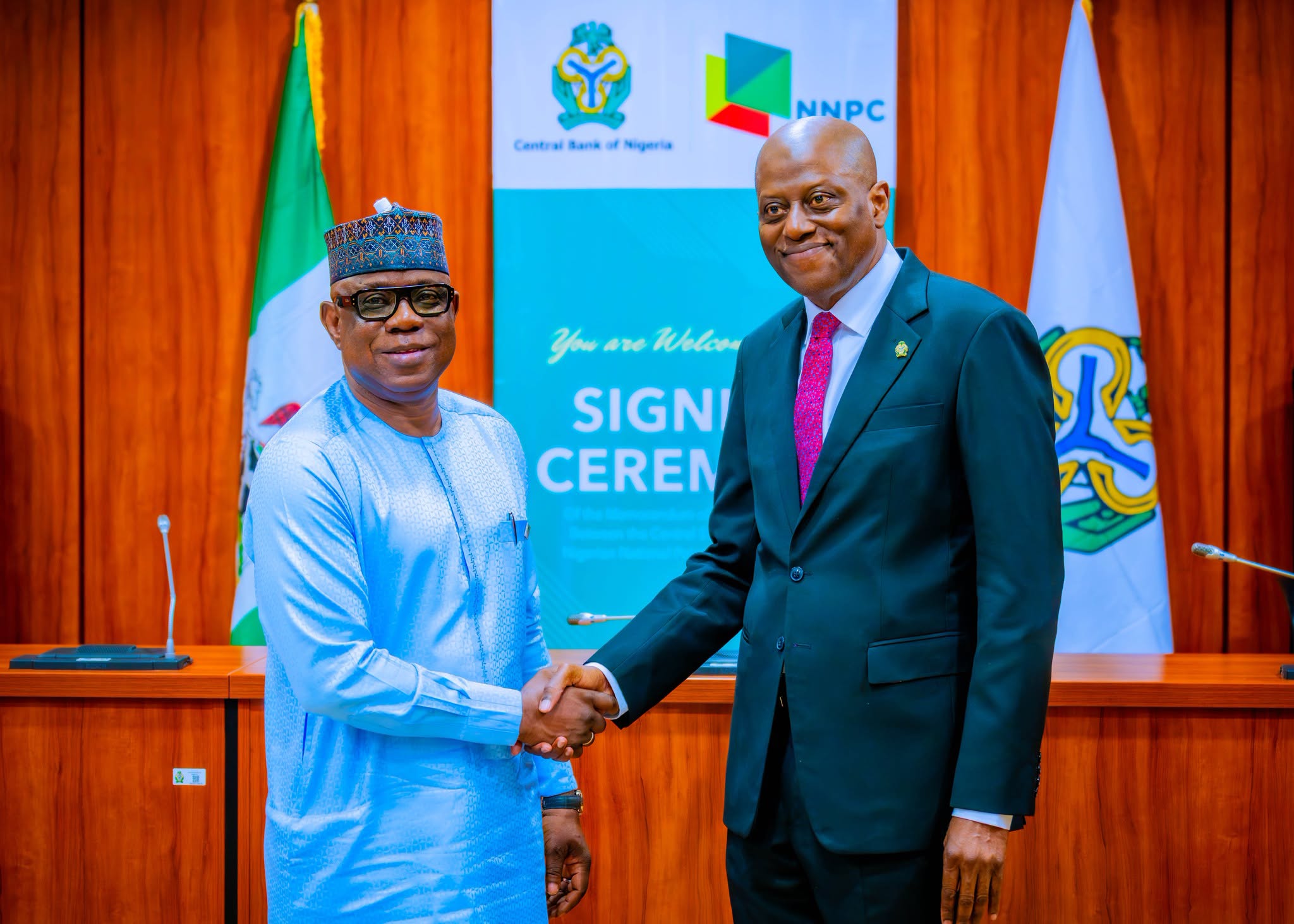
LAGOS — Nigeria’s state-owned energy company, NNPC Limited, and the Central Bank of Nigeria have signed a strategic agreement designed to improve foreign exchange inflows, strengthen financial discipline and mobilise investment to increase national oil production from 1.8mn to 3mn barrels a day.
The memorandum of understanding, signed on November 18 at the central bank’s headquarters in Abuja, marks a significant step towards closer co-ordination between Nigeria’s monetary and energy authorities since President Bola Tinubu launched sweeping economic reforms in May 2023.
NNPC chief executive Bashir Bayo Ojulari and central bank governor Olayemi Cardoso are seeking to establish a financial framework that would enable the energy group to raise capital against its assets and balance sheet while improving dollar liquidity across Africa’s most populous economy.
Oil as an anchor for monetary stability
The agreement comes as Nigeria seeks to rebuild its foreign exchange buffers, stabilise the naira and reduce its vulnerability to external shocks.
Emem Usoro, deputy governor of the central bank, said during the signing ceremony that gross foreign reserves had surpassed $55bn, supported by higher oil production and diaspora remittances.
The accumulation of reserves represents an important development for an economy that has endured successive currency depreciations, dollar shortages and persistent inflationary pressures since June 2023.
According to the World Bank, Nigeria’s gross international reserves increased from $32.9bn at the end of 2023 to $40.9bn in December 2024. The latest figure represents an increase of more than 67 per cent compared with 2023, subject to consistent accounting definitions.
More predictable export revenues could ease pressure on the foreign exchange market, lower import financing costs and strengthen international investor confidence.
A $30bn opportunity
Adedapo Segun, NNPC’s chief financial officer, said the agreement would help mobilise the investment required to increase national oil production by 1.2mn barrels a day.
Nigeria produced 622.14mn barrels of crude oil and condensates in 2025, equivalent to approximately 1.7mn barrels a day, according to the country’s upstream petroleum regulator.
Reaching the 3mn-barrel target would lift annual production to nearly 1.1bn barrels, approximately 76 per cent above 2025 levels.
At an illustrative oil price of $70 a barrel, the planned incremental production of 1.2mn barrels a day would generate an additional $30.7bn in annual gross production value, before operating costs, capital expenditure and contractual obligations.
Achieving that target will require substantial investment in the Niger Delta, the rehabilitation of mature oilfields and deepwater exploration in the Gulf of Guinea, alongside measures to tackle crude theft and infrastructure disruptions.
Nigeria’s natural gas ambitions
The agreement also seeks to facilitate financing for the development of Nigeria’s extensive natural gas reserves, an increasingly important component of the country’s long-term energy strategy.
As of January 1, 2026, Nigeria held 37.01bn barrels of crude oil and condensate reserves, compared with 37.28bn barrels a year earlier.
By contrast, natural gas reserves increased by 2.21 per cent to 215.19tn cubic feet, equivalent to an estimated 85 years of production at the rates assessed by the regulator.
Developing these resources could expand liquefied natural gas exports from Bonny Island in Rivers State, improve domestic electricity generation and provide feedstock for Nigeria’s petrochemical industry.
A test of institutional credibility
Since taking charge of NNPC in April 2025, Ojulari has faced the challenge of strengthening the company’s liquidity, improving asset profitability and laying the groundwork for a potential stock market listing.
The partnership envisages joint oversight mechanisms, technological integration and performance monitoring, with operational responsibilities involving NNPC treasurer John Etukudo.
Neither institution, however, has disclosed an overall financing commitment or a definitive timetable for achieving the production target.
Investors will also scrutinise whether closer institutional ties can deliver greater financial transparency without compromising central bank independence or exposing monetary policy to the commercial risks of the state-owned energy group.
For Nigeria, the challenge is no longer simply to extract more hydrocarbons. It is to convert its considerable energy wealth into productive capital, stronger public finances and lasting monetary stability.
The agreement could mark an important step in that direction. Its credibility, however, will ultimately depend on execution rather than ambition.