Egypt’s world cup paradox, Africa’s most successful football nation still searching for Its first FIFA World Cup victory
- Sports
- June 7, 2026
 Save as PDF
How the continent’s most decorated team became the only major African side never to win a World Cup match
CAIRO — Throughout nearly a century of African participation in the FIFA World Cup, the continent has produced some of football’s most memorable stories. Cameroon stunned the world by reaching the quarter-finals in 1990. Senegal shocked defending champions France in 2002. Ghana came within a penalty kick of a historic semi-final in 2010. Morocco rewrote history in 2022 by becoming the first African nation to reach the World Cup semi-finals.
Yet one statistic continues to defy logic. Egypt, the most successful national team in African football history, remains without a single victory at the FIFA World Cup.
With a record seven Africa Cup of Nations (AFCON) titles, a football culture stretching back more than a century, and generations of elite talent, the Pharaohs stand as one of the continent’s greatest football powers. However, despite four World Cup appearances, Egypt has never won a match on football’s biggest stage.
The contrast represents one of the most remarkable paradoxes in international football: Africa’s most decorated team has never managed to secure the achievement that many less successful nations accomplished decades ago.
The pioneer of African football
Egypt’s World Cup story began long before most African nations gained independence.
At the 1934 FIFA World Cup in Italy, Egypt became the first African and Arab nation ever to participate in the tournament. The historic debut marked Africa’s arrival on the global football stage and demonstrated the continent’s growing potential in the sport.
Facing Hungary in the first round, Egypt suffered a 4-2 defeat. Nevertheless, forward Abdelrahman Fawzi made history by scoring Africa’s first-ever World Cup goals, establishing a milestone that would inspire generations of African footballers.
The achievement positioned Egypt as a pioneer of African football. Yet what appeared to be the beginning of a sustained international presence quickly turned into decades of absence.
Following the 1934 tournament, Egypt would wait 56 years before returning to the World Cup.
Decades of continental success, limited global presence
While Egypt established itself as one of Africa’s football powerhouses, qualification for the World Cup remained elusive.
Throughout the second half of the twentieth century, nations such as Cameroon, Algeria, Morocco and Nigeria emerged as regular World Cup participants, building international experience and global recognition.
Egypt, meanwhile, enjoyed significant success within Africa but repeatedly fell short in World Cup qualifying campaigns.
The long absence limited the country’s exposure to elite international competition and prevented the development of a continuous World Cup tradition comparable to that of other leading African football nations.
Italy 1990, Progress without victory
Egypt’s return to the World Cup came at Italia ’90, one of the most competitive tournaments of its era.
Drawn against England, the Netherlands and Ireland, the Pharaohs exceeded expectations in several matches.
A 1-1 draw against the Netherlands, then European champions, demonstrated Egypt’s ability to compete with elite opposition. A goalless draw against Ireland followed, raising hopes of a historic breakthrough.
However, a narrow 1-0 defeat to England ended Egypt’s campaign.
Although the team remained unbeaten in two of its three matches, the elusive first World Cup victory remained out of reach.
The golden generation that never reached the World Cup
Perhaps the most remarkable chapter of Egypt’s football history occurred between 2006 and 2010.
Led by legendary figures including Mohamed Aboutrika, Ahmed Hassan and Essam El-Hadary, Egypt dominated African football as few teams ever have.
The Pharaohs won three consecutive AFCON titles: 2006 (Egypt) | 2008 (Ghana) | 2010 (Angola)
No African nation has matched this achievement in the modern era. Yet despite dominating continental football, this golden generation never qualified for a World Cup.
For many analysts, this remains one of the greatest underachievements in international football history. A team capable of conquering Africa repeatedly failed to reach the sport’s biggest tournament.
The Salah era and the return to the global stage
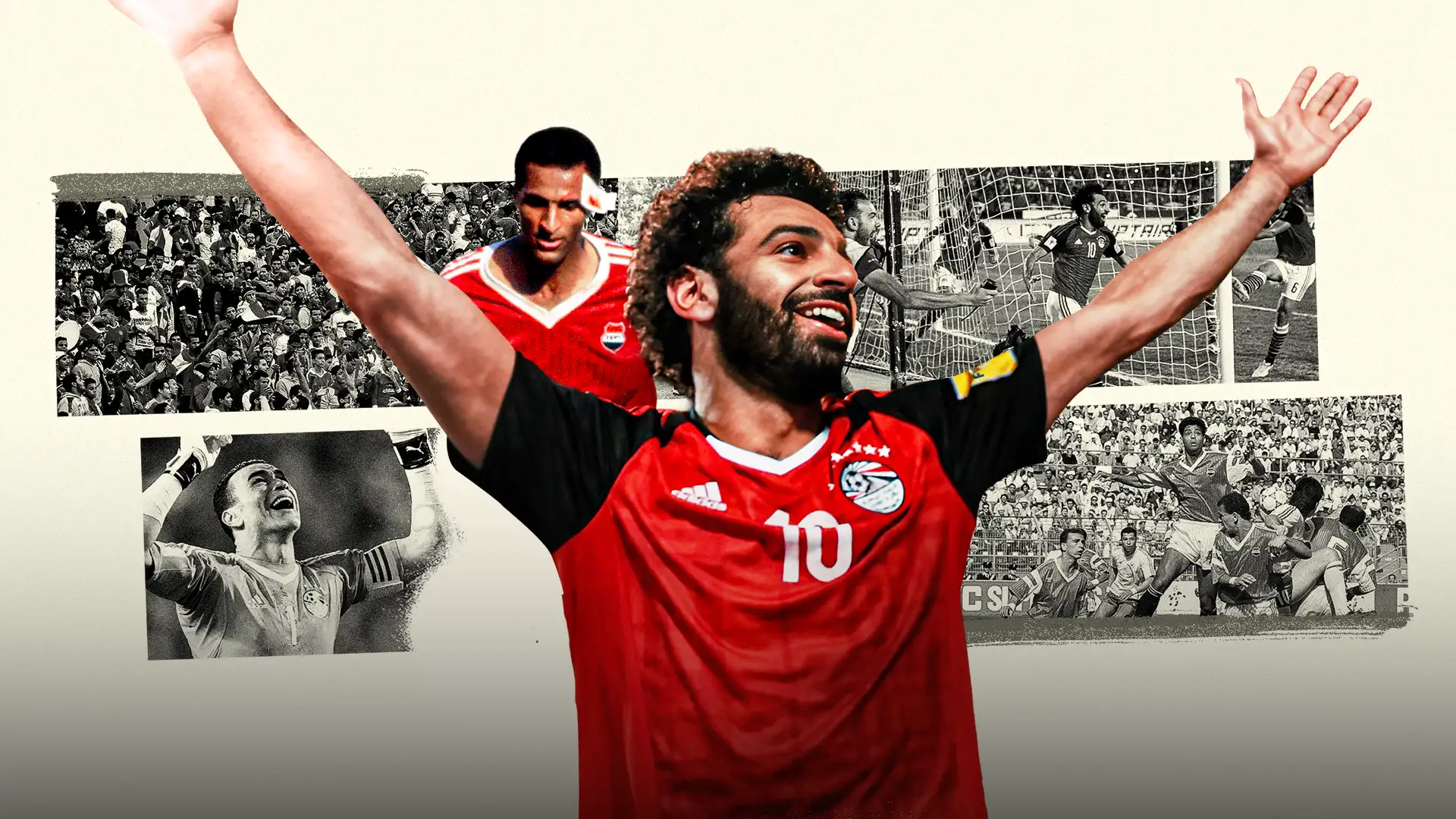
Egypt’s qualification for the 2018 FIFA World Cup ended a 28-year absence and sparked celebrations across the country.
The campaign was driven largely by the brilliance of Mohamed Salah, whose performances had already elevated him to global superstar status.
Expectations were high, but a shoulder injury sustained during the UEFA Champions League final disrupted Salah’s preparation and affected Egypt’s chances.
The results were disappointing: Egypt 0–1 Uruguay | Egypt 1–3 Russia | Egypt 1–2 Saudi Arabia
Despite scoring twice, Salah could not prevent another winless World Cup campaign. Egypt left Russia with three defeats and renewed questions about why continental success continued to fail translating into global results.
Comparing Egypt to Africa’s World Cup powers
The scale of Egypt’s World Cup struggles becomes clearer when compared with other major African football nations.
| Nation | World Cup Appearances | Best Result |
|---|---|---|
| Morocco national football team | 6 | Semi-finals (2022) |
| Cameroon national football team | 8 | Quarter-finals (1990) |
| Senegal national football team | 3 | Quarter-finals (2002, 2022) |
| Ghana national football team | 4 | Quarter-finals (2010) |
| Nigeria national football team | 6 | Round of 16 (1994, 1998, 2014) |
| Algeria national football team | 4 | Round of 16 (2014) |
| Egypt | 4 | Group Stage |
Every major African football power has recorded memorable World Cup victories. Egypt remains the exception.
Why has Egypt never won?
Football analysts generally identify four structural factors.
Limited participation
Unlike Nigeria, Cameroon and Morocco, Egypt has appeared in relatively few World Cups. Fewer tournaments naturally reduce opportunities to secure victories.
Irregular qualification cycles
The long gaps between appearances have prevented Egypt from building continuity and experience at the highest international level.
Golden generations missing the tournament
Several of Egypt’s strongest teams, including the dominant AFCON-winning squads of the late 2000s, never reached the World Cup.
The difference between continental and global competition
Success in Africa does not automatically translate into success against elite European and South American opposition. Egypt’s World Cup campaigns have often exposed the difference between regional dominance and global competitiveness.
The Numbers Behind the Paradox
The statistics illustrate the extraordinary nature of Egypt’s World Cup record:
7 AFCON titles (African record) | 3 consecutive AFCON titles (2006, 2008, 2010) | 4 World Cup appearances | 7 World Cup matches played before 2026 | 0 victories | 2 draws | 5 defeats | 5 goals scored | 11 goals conceded
Few national teams in world football history have displayed such a stark contrast between continental dominance and World Cup performance.
A historic opportunity ahead
As Egypt looks toward the future under coach Hossam Hassan and the leadership of Mohamed Salah, the objective is no longer merely qualification.
The mission is historical.
African football has already produced quarter-finalists, semi-finalists and giant-killers capable of shocking the world’s best teams. Morocco changed perceptions in Qatar. Cameroon inspired a generation in Italy. Senegal, Ghana, Algeria and Nigeria all delivered defining victories for African football.
Egypt, however, continues to pursue something far more basic, yet equally symbolic.
Its first World Cup victory.
For a nation that has conquered African football more than any other, securing that long-awaited breakthrough would not simply end a statistical anomaly. It would close one of the most fascinating and enduring chapters in the history of African football.