Seychelles, Mauritius and Tunisia lead Africa’s best-performing education systems as the continent bets on human capital
- Culture & Arts
- June 27, 2026

JOHANNESBURG — While Africa continues to grapple with some of the world’s most pressing education challenges, it is also home to several of the strongest-performing education systems among emerging economies, underscoring how sustained investment in human capital remains one of the most powerful drivers of long-term economic growth and social development.
An analysis of education indicators compiled from UNESCO, the World Bank, the education component of the United Nations Human Development Index (HDI) and other internationally recognized statistical sources shows that Seychelles, Mauritius, Tunisia, South Africa and Botswana rank among Africa’s leading education performers. However, experts caution that no single official ranking exists, as education outcomes are measured using a broad range of indicators, including literacy rates, average years of schooling, school enrolment, higher education quality, research output and public investment.
Unlike financial or economic indices, education systems cannot be reduced to a single metric. Their performance reflects a combination of access, quality, equity, learning outcomes and institutional capacity.
Small Island States set the benchmark
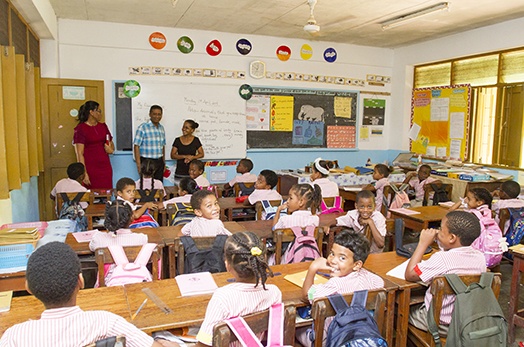
Seychelles and Mauritius top the list after decades of placing education at the centre of their national development strategies. Seychelles boasts an adult literacy rate above 95%, near-universal school enrolment and one of Africa’s highest Human Development Index scores.
Mauritius combines literacy rates exceeding 90% with high secondary school completion rates and a rapidly expanding higher education sector, reinforcing its position as one of the continent’s leading knowledge-based economies.
For development economists, both countries demonstrate that consistent investment in education translates into stronger institutions, higher productivity and sustained economic prosperity.
North Africa strengthens its academic leadership
Tunisia, ranked third, continues to distinguish itself through compulsory education, substantial public investment in schooling, high youth literacy rates and a well-established university system that supplies skilled graduates to labour markets across Africa, Europe and the Middle East.
Algeria and Morocco also feature prominently, reflecting decades of investment in expanding access to education, reducing illiteracy and strengthening higher education institutions.
Over the past two decades, Morocco has accelerated university expansion while implementing reforms aimed at reducing school dropout rates, particularly in rural communities.
South Africa remains the continent’s research powerhouse
In Sub-Saharan Africa, South Africa continues to lead in higher education and scientific research, the country hosts the region’s largest university system and several of Africa’s highest-ranked universities, producing a significant share of the continent’s academic research in medicine, engineering, artificial intelligence, natural sciences and technology.
Its higher education sector also maintains one of Africa’s highest university enrolment rates, making South Africa a key supplier of highly skilled professionals and researchers.
Botswana and Cape Verde highlight the returns on Long-Term Investment
Among Africa’s strongest education success stories are Botswana and Cape Verde, both of which have consistently prioritised education as a pillar of national development.
Botswana has maintained high levels of public investment in education for decades, resulting in strong school attendance rates and one of Southern Africa’s highest primary school completion rates.
Cape Verde, meanwhile, has developed one of the continent’s most effective education systems among small island states, supported by high literacy levels, continuous improvements in education quality and sustained investment in teacher training.
Egypt and Ghana expand higher education
Egypt continues to operate one of Africa’s largest higher education systems, educating millions of students through an extensive network of public and private universities while serving as an important academic hub for North Africa and the Middle East.
Ghana has made steady progress in expanding access to basic education while investing heavily in tertiary education and technical and vocational training, supporting the country’s broader industrialisation agenda.
What sets Africa’s top performers apart?
Despite their different economic structures, geographic realities and population sizes, Africa’s highest-performing education systems share several common characteristics.
They generally record adult literacy rates above 90%, near-universal primary school enrolment, average years of schooling ranging between nine and thirteen years, sustained public investment in education and relatively mature higher education institutions, equally important is policy continuity.
Rather than pursuing short-term reforms, these countries have largely maintained long-term national education strategies focused on teacher training, curriculum development, universal access and institutional quality.
No single measure defines educational excellence
Education experts caution against interpreting any ranking as definitive, there is no universally accepted indicator capable of identifying the world’s, or Africa’s,”best” education system.
Countries such as Seychelles and Mauritius excel in literacy and universal access, while South Africa and Egypt stand out for the scale of their university systems, research capacity and scientific output.
Other measures, including learning outcomes, digital skills, innovation, graduate employability and teaching quality, could produce significantly different rankings.
Human capital is becoming Africa’s greatest competitive advantage
As Africa’s population is projected to approach 2.5 billion people by 2050, economists increasingly argue that education is evolving from a social policy priority into one of the continent’s most important economic assets.
In an era defined by technological transformation, industrialisation and the implementation of the African Continental Free Trade Area (AfCFTA), countries capable of producing a highly skilled workforce, strengthening universities and aligning education systems with labour market demands are expected to enjoy stronger productivity growth, attract greater investment and enhance long-term competitiveness.
More than a social indicator, education is rapidly emerging as Africa’s most strategic investment, and one of the defining factors that will shape the continent’s economic future in the decades ahead.