Africa’s Refining Race: Dangote towers over a continent still struggling to process its own oil
- Business and NetworkingEconomic
- July 22, 2026

The Nigerian mega-refinery has redrawn Africa’s downstream map, but idle plants, ageing infrastructure and unreliable crude supply continue to constrain the continent’s refining ambitions.
LAGOS/ALGIERS — For decades, Africa has lived with one of the oil industry’s greatest paradoxes. The continent produces roughly 8% of global crude oil, yet imports a substantial share of the petrol, diesel and aviation fuel consumed by its own economies. The result has been a costly dependence on overseas refineries, exposing governments to volatile international prices, foreign-exchange shortages and recurring supply disruptions.
On paper, Africa possesses between 3.5m and 4m barrels a day (bpd) of installed refining capacity. In reality, much of that infrastructure has spent years operating well below design capacity, or not operating at all, as a result of chronic underinvestment, ageing equipment, inadequate maintenance and political instability stretching from Libya to South Africa.
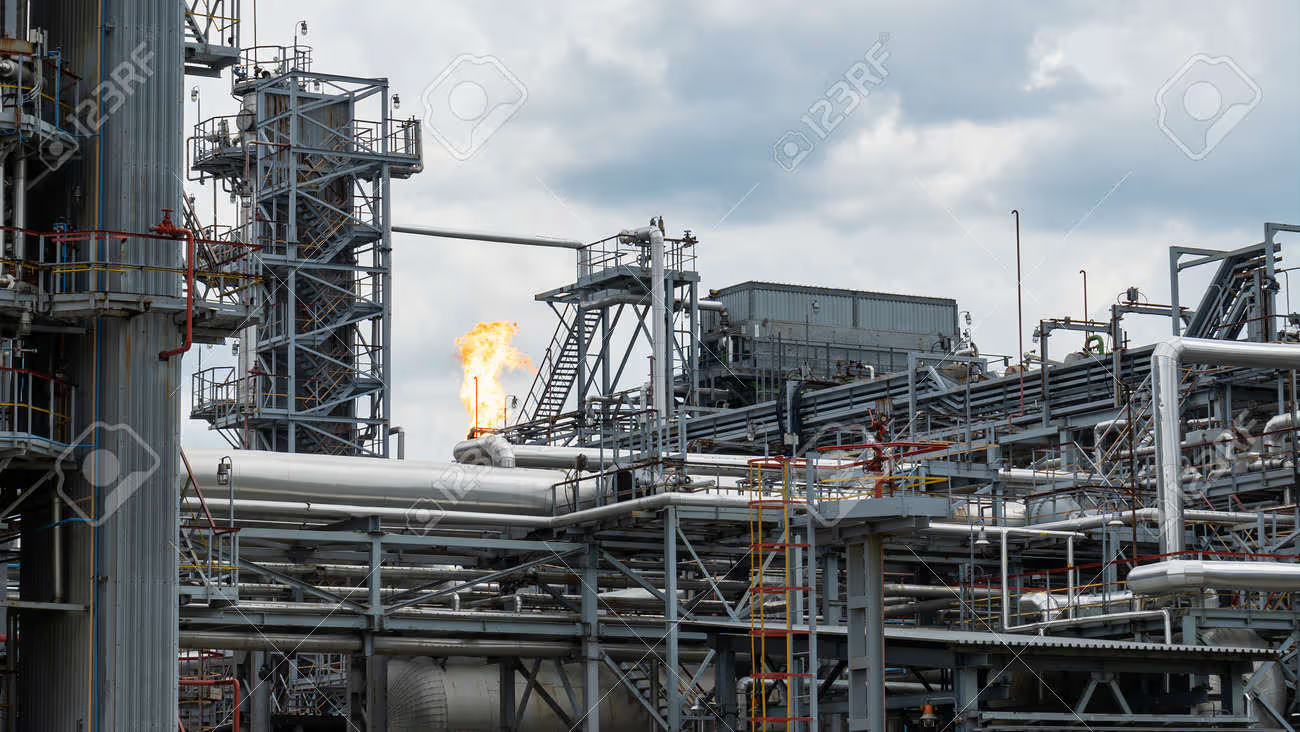
The arrival of Dangote Refinery has begun to alter that equation. Commissioned in Nigeria, the $20bn project is now the largest refinery in Africa and one of the biggest single-train refining facilities ever built. It has also shifted the balance of power within the continent’s downstream industry.
1. Dangote Refinery — Lekki, Nigeria
Nameplate capacity: 650,000 bpd, although the company says throughput reached 700,000 bpd following performance tests completed in June 2026.
Owner: Dangote Industries, controlled by billionaire Aliko Dangote.
Status: Operational and ramping up production.
The refinery reported an average utilisation rate of 93.6% in March 2026 and says it can supply up to 75m litres of petrol daily to the Nigerian market, potentially transforming a country that was until recently one of the world’s largest fuel importers.
Yet its greatest challenge remains securing crude. Between October 2025 and mid-March 2026, the refinery received only 29.2m barrels against estimated requirements of 108.7m barrels, equivalent to just 26.9% of planned supply. The figures underline a broader weakness in Nigeria’s oil sector, Africa’s largest crude producer still struggles to guarantee feedstock for its own flagship industrial project.
Dangote says it intends to expand capacity to 1.4m bpd within the next 30 months, a move that would make it the world’s largest refinery by capacity.
2. Skikda Refining Complex — Algeria
Capacity: Approximately 478,500 bpd, comprising 356,500 bpd at Skikda I and 122,000 bpd at Skikda II.
Owner: Sonatrach.
Status: Operational.
For decades, Skikda has formed the backbone of Algeria’s refining industry. Beyond crude processing, the complex also hosts a 4.5m-tonne-a-year LNG export terminal, making it one of North Africa’s most strategic energy hubs.
Sonatrach is investing around $8.2bn to modernise and expand the facility, with construction expected to conclude in 2028.
3. Ras Lanuf Refinery — Libya
Capacity: Around 220,000 bpd.
Owner: National Oil Corporation (NOC), through Libyan Emirates Oil Refining Company (LERCO).
Status: Under rehabilitation.
Once Libya’s flagship refinery, Ras Lanuf has become a symbol of the country’s prolonged political fragmentation. After recovering full ownership in May 2026, ending a 13-year dispute with Trasta Energy, NOC aims to restart operations within 12 months.
Maintenance and restart costs are estimated at $60m, although industry analysts believe commercial production is unlikely before the second half of 2027.
Tripoli plans to raise national refining capacity from roughly 380,000 bpd to 660,000 bpd, with Ras Lanuf expected to carry much of that expansion.
4. SAPREF — Durban, South Africa
Capacity: 180,000 bpd.
Owner: Central Energy Fund (CEF).
Status: Idle since 2022.
South Africa’s largest refinery remains offline after former owners Shell and BP concluded that the investment required to comply with cleaner-fuels legislation was commercially unjustifiable.
Although Pretoria has repeatedly pledged to restore operations under state ownership, no comprehensive investment programme has yet materialised.
The closure illustrates a broader decline in South Africa’s refining industry. Domestic refining capacity has fallen by roughly half since 2020, while repeated disruptions at Sasol’s Natref refinery have increased dependence on imported fuels.
5. Mostorod Refinery — Cairo, Egypt
Capacity: 161,000 bpd.
Owner: Cairo Oil Refining Company (CORC), a subsidiary of Egyptian General Petroleum Corporation (EGPC).
Status: Operational.
Egypt has embarked on a $4bn investment programme to expand domestic refining capacity as Cairo seeks to reduce fuel imports and strengthen its position as an eastern Mediterranean energy hub.
Nearby MIDOR refinery in Alexandria, also controlled by EGPC and state-backed partners, adds a further 160,000 bpd, reinforcing Egypt’s position among Africa’s largest refining markets.
A Continent Still Short of Refining Capacity
The ranking reveals more than differences in scale. It highlights the structural weaknesses of Africa’s downstream oil industry.
Dangote alone now possesses nearly 36% more refining capacity than the combined output of South Africa’s SAPREF and Egypt’s Mostorod, and almost twice the capacity of Algeria’s Skikda, historically the continent’s largest refinery.
Equally striking is that two of Africa’s five largest refineries remain either idle or under rehabilitation, reflecting years of deferred investment and political disruption rather than a shortage of crude resources.
The continent’s refining challenge is therefore no longer simply about building new plants. It is about financing maintenance, securing reliable crude supplies, modernising ageing infrastructure and creating commercially sustainable downstream industries capable of replacing billions of dollars in annual fuel imports.
For Africa’s oil-producing economies, refining has become less a question of industrial prestige than of economic resilience. The countries able to convert crude into domestic value-added products will increasingly shape the continent’s energy balance over the coming decade.