OPINION | The MPLA’s greatest test Is not electing a new President
- Opinions
- June 25, 2026

It is proving Its political renewal is real.
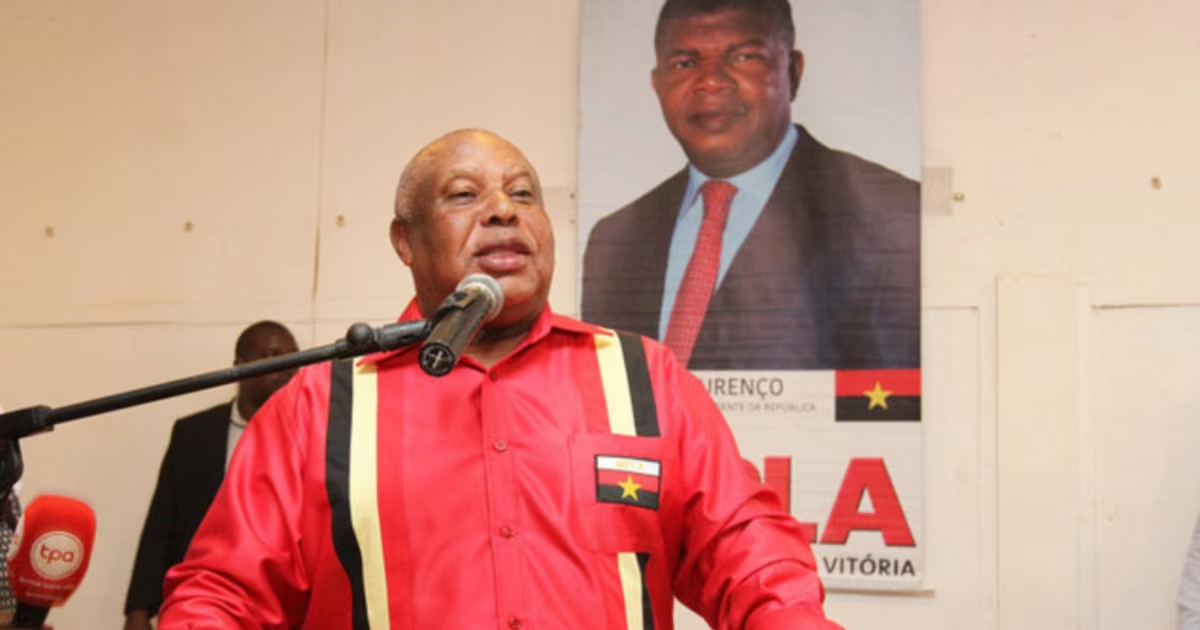
MAPUTO – There are defining moments in the life of every political party. Angola’s ruling MPLA is approaching one of them. Its upcoming Ordinary Congress will not simply determine who leads the party into the next electoral cycle. It will serve as the ultimate test of whether the political renewal launched in 2017 was a genuine transformation or merely a response to a particular moment in the country’s history.
By João Carlos Dombaxi
Political Analyst | Specialist in Governance and Public Policy
For nearly a decade, President João Lourenço has sought to redefine the MPLA’s political identity. Fighting corruption, strengthening public accountability, promoting good governance and reinforcing the rule of law became the cornerstones of the government’s agenda.
The message was unambiguous: no one would stand above the law, public office would no longer serve private interests, and state institutions would regain the trust of the Angolan people.
That strategy came at a political cost, it reshaped the internal balance of power within the MPLA, sidelined influential figures, challenged long-established interests and created a visible divide between those committed to institutional reform and those nostalgic for the party’s traditional power structure.
Regardless of how one judges the results of these reforms, one expectation emerged clearly: the MPLA appeared willing to redefine its own political culture.
It is against this backdrop that the possible candidacy of General Higino Carneiro for the party’s presidency carries significance far beyond personal political ambition. The issue is not whether he has the right to contest the leadership. That right belongs to any party member who satisfies the MPLA’s internal rules.
The real question is what such a candidacy would symbolize for a party that has spent years presenting itself as the driving force behind Angola’s anti-corruption agenda and institutional reform.
Political candidacies are never merely personal, they are statements of values, priorities and direction. Whoever seeks to lead Angola’s governing party also becomes the public face of its future. For that reason, the upcoming congress will inevitably be viewed as a referendum on the credibility of the reforms the MPLA has championed since 2017.
In recent weeks, some supporters have portrayed Higino Carneiro as a leader somehow “destined” to become President of Angola. Such rhetoric deserves careful scrutiny.
Constitutional democracies are not built around predetermined leaders or historical entitlement. Political legitimacy does not arise from destiny, military rank or political longevity, it derives exclusively from the sovereign will of citizens expressed through free and credible elections.
Angola does not need political messiahs, it needs strong institutions, credible political parties and leaders willing to submit themselves to public scrutiny.
The greater a politician’s ambitions, the greater the obligation to answer legitimate public questions about their record, their decisions in public office and their vision for the country’s future, transparency is no longer optional; it has become an essential condition for democratic legitimacy.
This is where the MPLA faces its greatest challenge, after nearly a decade of presenting political reform and public accountability as defining principles, can the party now make leadership choices without considering their broader political and reputational consequences?
Political coherence is measured precisely when principles collide with internal interests, it is easy to defend reform in speeches, it is considerably harder to demonstrate that those same principles guide the party’s most consequential decisions.
The presumption of innocence remains a fundamental pillar of the rule of law and must be respected without exception, yet politics demands standards that extend beyond legal requirements.
Those who seek to lead the country’s largest political party must also demonstrate that they embody integrity, public accountability, institutional responsibility and a genuine commitment to strengthening democratic governance.
The forthcoming congress will decide far more than the succession to the current leadership, it will determine whether the MPLA intends to consolidate a new political culture or whether it risks reinforcing the perception that the reforms of the past decade depended more on the determination of one leader than on a lasting institutional transformation within the party itself.
That decision will resonate well beyond the MPLA, Angolan citizens will judge whether the party’s actions match its promises, investors will assess the country’s political stability and institutional predictability, international partners will closely watch whether Angola remains committed to strengthening governance, the rule of law and public accountability.
Trust is one of the most valuable assets in politics. It takes years to build and only a single defining moment to undermine.
Ultimately, the MPLA’s greatest challenge may not come from the political opposition, economic headwinds or mounting social pressures, its greatest challenge may be proving that the political renewal launched in 2017 was not simply a change in leadership, but a lasting transformation of the party’s values, institutions and governing culture.
Some party congresses merely elect leaders, others define the future of political movements and, in doing so, shape the future of nations.
The MPLA’s upcoming congress is likely to be remembered as one of those moments.