Lunda Norte, Lunda Sul and Cunene lead economic growth and redraw Angola’s diversification map
- AngolaEconomic
- November 27, 2026

Regional economic expansion highlights the importance of provincial governance, agricultural investment and job creation in reducing poverty and addressing territorial inequalities.
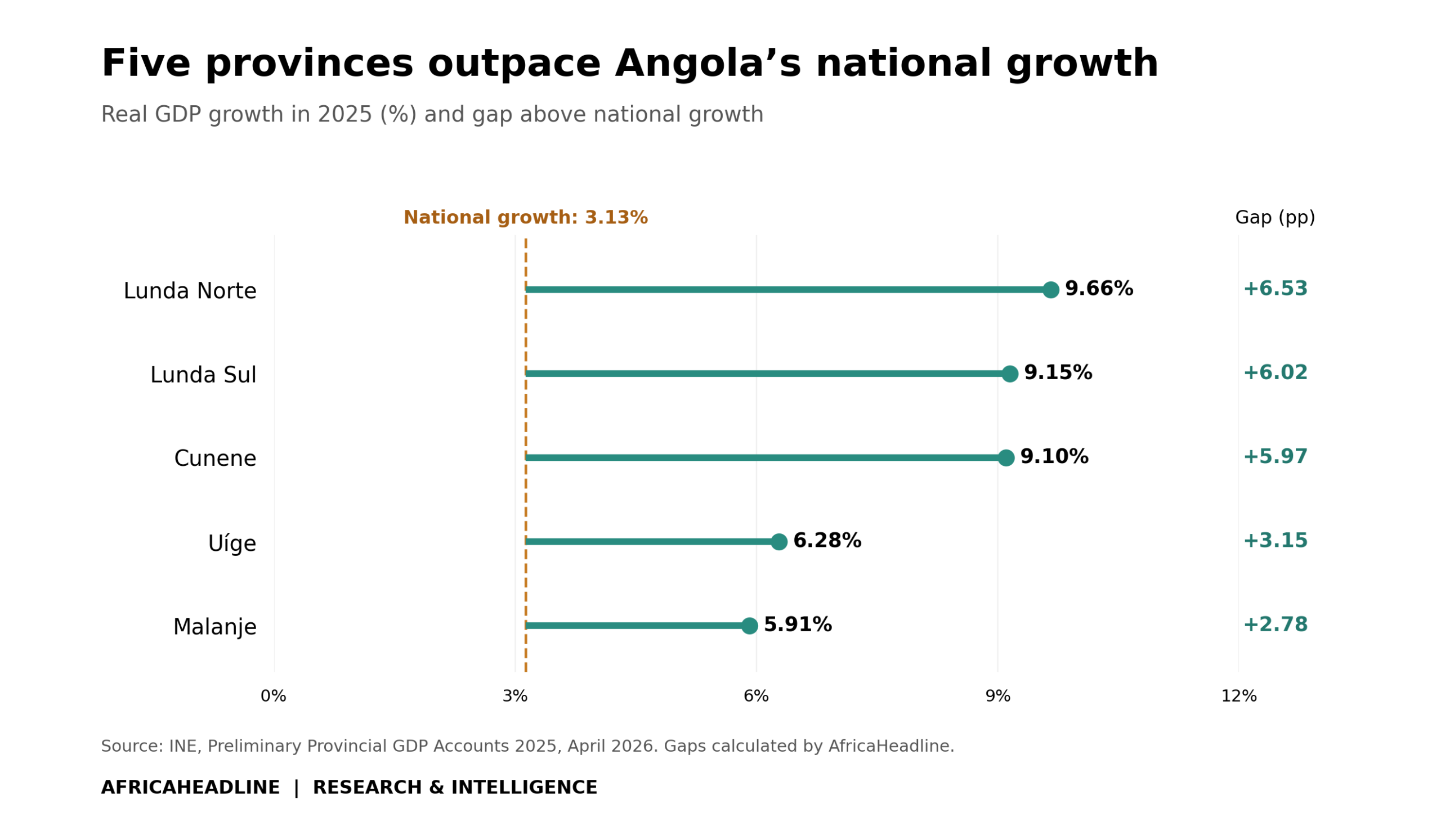
MAPUTO — Angola’s economic diversification is acquiring an increasingly pronounced regional dimension. Lunda Norte, Lunda Sul, Cunene, Uíge and Malanje recorded the highest rates of real gross domestic product growth in 2025, according to preliminary provincial accounts published by the National Statistics Institute (INE) in April 2026.
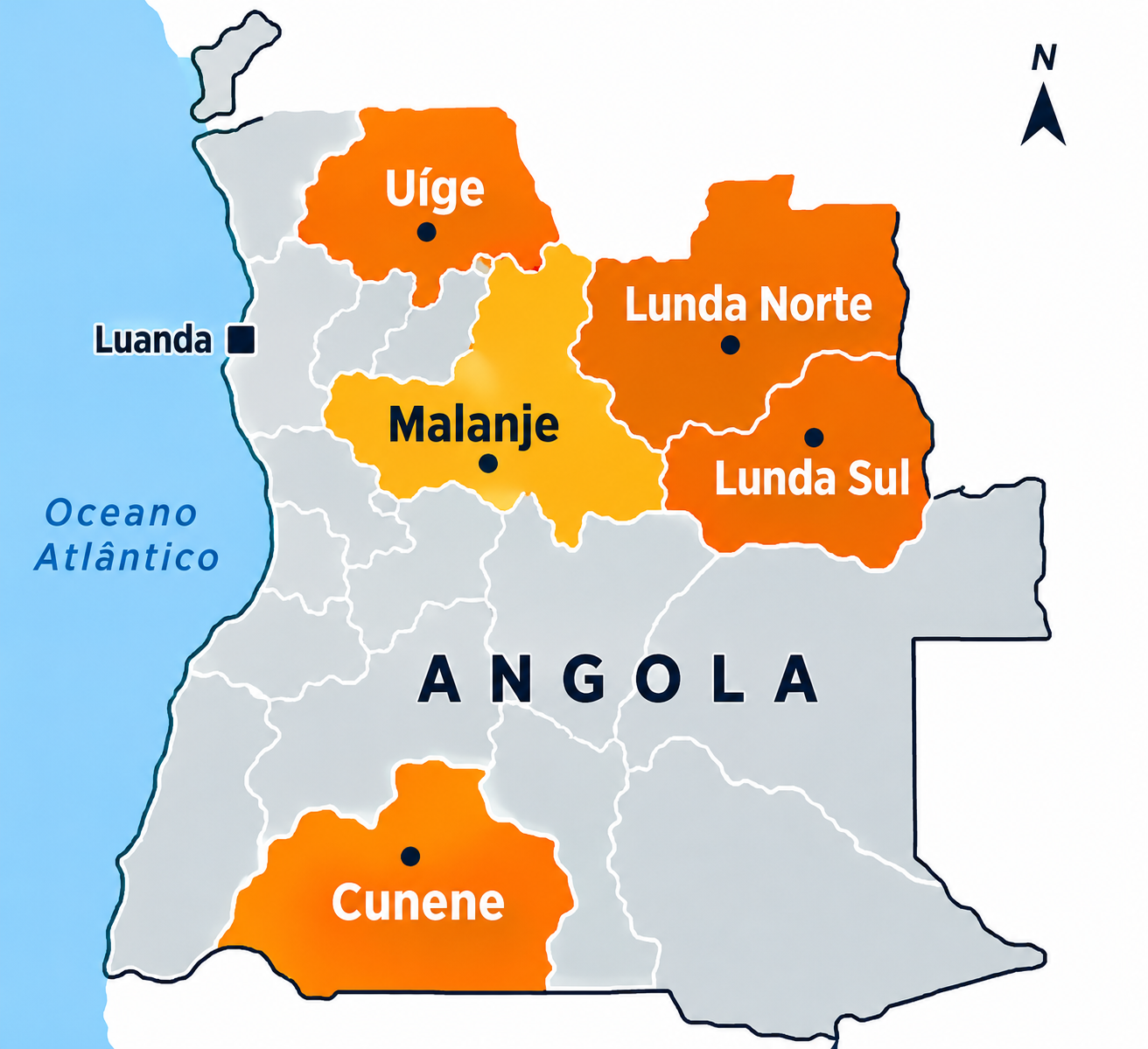
Together, the five provinces accounted for 17.62 per cent of national GDP, equivalent to approximately $24.6bn, reflecting distinct development models ranging from diamond mining to commercial agriculture, agro-processing and livestock production.
Their performance came as Angola’s economy expanded by 3.13 per cent, supported by non-oil growth of 5.11 per cent, despite a 5.23 per cent contraction in the petroleum sector.
Lunda Norte: converting mineral wealth into employment
With economic growth of 9.66 per cent, Lunda Norte, administered by Governor Filomena Miza Aires since July 2024, expanded at more than three times the national rate.
Between the 2023/24 and 2024/25 agricultural seasons, the number of farming enterprises increased by 3.3 per cent, from 83,299 to 86,023, although cultivated land declined to 95,839 hectares.
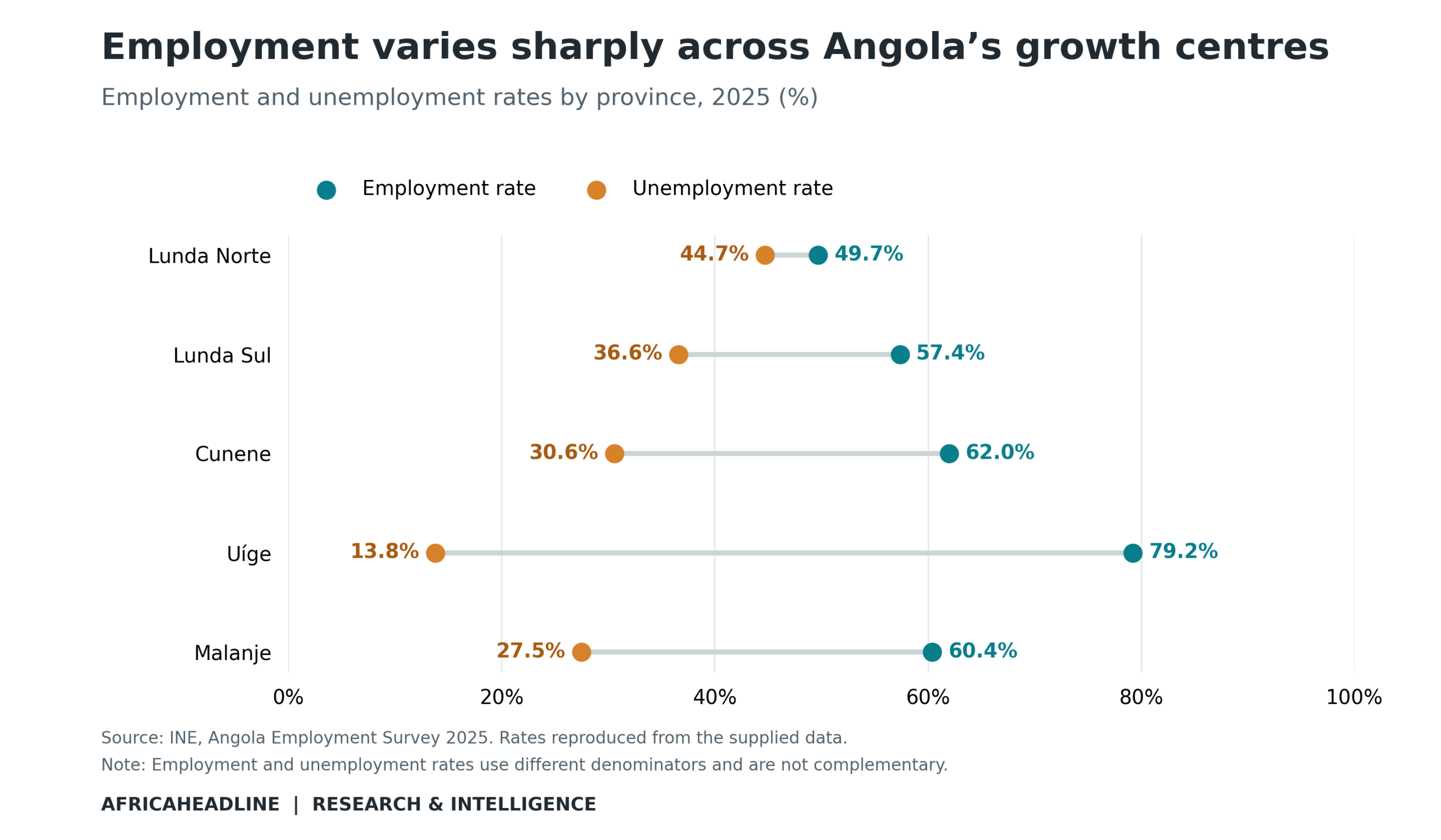
With unemployment standing at 44.7 per cent, diversification into agriculture, manufacturing and services remains a structural priority. The province’s economic performance illustrates the challenge of translating capital-intensive mineral production into broader employment opportunities and household income.
Lunda Sul: industrialisation beyond diamond extraction
Lunda Sul expanded by 9.15 per cent, reversing a 6.20 per cent contraction in 2024. The number of agricultural enterprises increased by 8.5 per cent to 49,277.
On November 26, 2026, Governor Gildo Matias José launched the 2026/27 agricultural season in Muconda, where prepared farmland was made available to 367 families.
Provincial authorities also announced plans for a rice-processing facility capable of handling 35 tonnes every eight hours.
With unemployment at 36.6 per cent, integrating mining, agriculture and manufacturing could broaden the province’s productive base and increase formal employment.
Cunene: water security as an economic catalyst
Cunene recorded growth of 9.10 per cent, supported by an agricultural economy comprising 117,763 farming enterprises and 559,073 hectares of cultivated land during the 2024/25 season.
Under Governor Gerdina Didalelwa, the province hosted the national launch of the agricultural season on October 24, 2026, presided over by José de Lima Massano, Angola’s minister of state for economic coordination.
By October, the Agricultural Development Support Fund (FADA) had approved 83 projects worth more than $1.09mn, of which approximately $781,000 had been disbursed.
Investment in water infrastructure, irrigation and livestock production could strengthen climate resilience, improve food security and address unemployment, which stands at 30.6 per cent.
Uíge: agriculture as a vehicle for economic inclusion
Under Governor José Carvalho da Rocha, Uíge recorded growth of 6.28 per cent, accounting for 6.66 per cent of national GDP.
The province registered 193,519 agricultural enterprises in 2024/25, compared with 191,788 during the previous season.
Its employment rate of 79.2 per cent and unemployment rate of 13.8 per cent contrast sharply with those of Angola’s diamond-producing provinces.
However, labour informality of 90.7 per cent underscores the importance of agricultural productivity, business formalisation, coffee production and agro-industrial investment in improving employment quality.
Malanje: agricultural financing and food security
Malanje, administered by Governor Marcos Nhunga, expanded by 5.91 per cent and accounted for 4.76 per cent of national GDP.
The province has 180,664 agricultural enterprises and, according to provincial authorities, produces more than 250,000 tonnes of maize and approximately 40,000 tonnes of rice annually, while supplying about half of Angola’s sugar consumption.
In November 2026, FADA provided approximately $745,000 in agricultural and mechanisation financing. Cumulative investment in 56 pieces of agricultural equipment exceeded $2.5mn.
Agro-industrial expansion could help address provincial unemployment of 27.5 per cent while strengthening domestic food supply chains.
From economic expansion to social prosperity
Angola’s agricultural production increased by 7.1 per cent during the 2025/26 season, reaching approximately 33mn tonnes, according to Massano.
The provincial accounts provide President João Lourenço’s administration with an additional instrument for assessing territorial development, directing investment and monitoring public policy outcomes.
Sustaining regional growth will require closer coordination between agricultural financing, infrastructure development, vocational training, healthcare, education and access to markets.
Angola’s diversification strategy will ultimately depend on its ability to convert regional economic expansion into productive employment, higher household incomes, stronger businesses and measurable improvements in living standards.
Economic and social intelligence dashboard
Combined provincial GDP
$24.6bn
17.62% of national GDP
Average real GDP growth
8.02%
Unweighted provincial average
Agricultural enterprises
627,246
Across the five provinces
Agricultural enterprise growth
+2.2%
2024/25 agricultural season
■ Employment rate ■ Unemployment rate
Agricultural expansion by province
| Province | Farming enterprises 2023/24 | Farming enterprises 2024/25 | Growth |
|---|---|---|---|
| Lunda Norte | 83,299 | 86,023 | 3.3% |
| Lunda Sul | 45,407 | 49,277 | 8.5% |
| Cunene | 116,308 | 117,763 | 1.3% |
| Uíge | 191,788 | 193,519 | 0.9% |
| Malanje | 176,672 | 180,664 | 2.3% |
| Total | 613,474 | 627,246 | 2.2% |
Angola’s emerging regional growth engines offer an encouraging indication that economic diversification is extending beyond the country’s traditional centres of wealth.
Yet the contrast between rapid GDP expansion in the diamond-producing provinces and higher employment rates in agricultural regions underscores the importance of inclusive development.
The next phase of President João Lourenço’s economic reform agenda will depend increasingly on the capacity of provincial administrations to mobilise private investment, strengthen agricultural and industrial value chains, expand formal employment and improve public services.
Ultimately, the success of Angola’s economic transformation will be measured not merely by how fast its provinces grow, but by their ability to translate economic expansion into sustainable prosperity, greater social mobility and tangible improvements in the living standards of their populations.