China deepens Gabon mining ties with $198mn manganese project as Oligui Nguema pushes industrialisation
- GabonPolitics
- November 9, 2026

Beijing’s expanding role in Gabon’s mineral sector highlights a wider African shift towards domestic processing, as Libreville seeks to turn manganese reserves into industrial capacity, export revenues and economic diversification.
AfricaHeadline | Mining, Investment & African Economies | November 2026
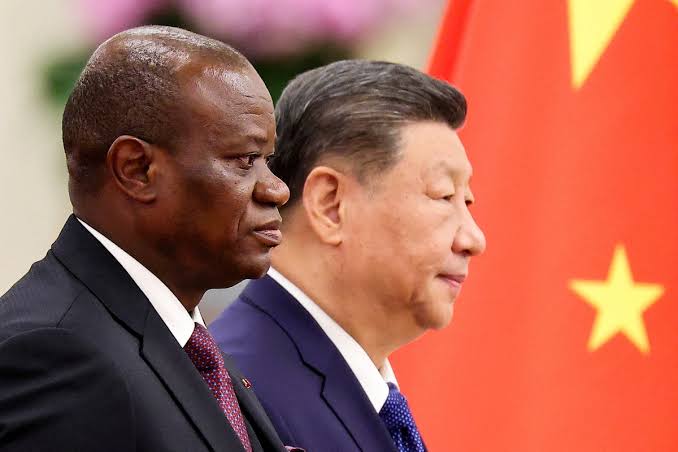
LIBREVILLE/BEIJING — China is expanding its involvement in Gabon’s mining industry through a proposed $198mn manganese processing investment, as President Brice Clotaire Oligui Nguema seeks to move the central African economy beyond the export of raw materials and reduce its dependence on oil.
The agreement, signed on November 6 during Oligui Nguema’s visit to Beijing, envisages a processing facility linked to the M’Bembélé manganese deposit near Ndjolé. South Manganese Investment Limited plans to invest CFA116.7bn in the project, which targets an initial annual output of 180,000 tonnes of metallurgical products, rising to 1.08mn tonnes by 2030.
If achieved, the expansion would increase planned processing capacity sixfold. But the figures remain project targets rather than committed production, with financing arrangements, construction schedules and technical specifications yet to be fully disclosed.
The agreement is part of a broader package of preliminary understandings between Libreville and Beijing covering mineral exploration, extraction, processing, industrial infrastructure and transport.
For Gabon, the significance extends beyond a single processing plant. The country is seeking to capture more value from its mineral wealth at a time when African governments are increasingly questioning the economic benefits of exporting unprocessed resources while importing higher-value industrial products.
A mining heavyweight seeking greater industrial value
Gabon is already among the world’s most important manganese producers. According to the US Geological Survey, the country accounted for approximately 25 per cent of global manganese production in 2024, ranking second behind South Africa.
The USGS estimates Gabonese manganese mine output at 5mn tonnes of contained manganese in 2025, compared with 7.6mn tonnes in South Africa, 2mn tonnes in Ghana and 1.6mn tonnes in Australia. These figures measure manganese content rather than the gross weight of ore extracted.
Yet Gabon’s position in global mineral production has not translated into an equivalent dominance in downstream manufacturing.
USGS data indicate that mining and quarrying, excluding fuels, contributed 3.1 per cent of real GDP in 2023, while mineral processing and metallurgy accounted for another 3 per cent. China and the European Union each received 38 per cent of Gabon’s manganese ore and concentrate exports in 2024, with India accounting for 13 per cent.
Economic growth and fiscal pressures sharpen the industrial imperative
The mining agreement comes as Gabon faces a challenging macroeconomic environment.
The International Monetary Fund projects real GDP growth of 2.7 per cent in 2026, while inflation is forecast at approximately 2.5 per cent. A regional economic assessment published in March estimated that growth had slowed from 3.4 per cent in 2024 to 1.9 per cent in 2025, although subsequent institutional estimates differ.
The fiscal backdrop is equally significant. IMF-based estimates published by Gabon Eco place gross public debt at 83.7 per cent of GDP in 2026 and the fiscal deficit at 10.4 per cent.
These pressures strengthen the case for mobilising private foreign capital rather than relying exclusively on public investment to finance industrial expansion.
At roughly $198mn, the proposed manganese investment would represent close to 1 per cent of Gabon’s annual economic output, using a nominal GDP benchmark of approximately $20bn. This is a scale comparison, not a forecast of the project’s direct contribution to GDP.
Its economic impact would depend on domestic procurement, employment, energy supply, export earnings and the share of profits retained locally.
China and France compete for positions in Gabon’s mineral value chain
China’s latest agreement also comes as established European operators pursue their own downstream industrial projects.
French mining group Eramet, through its Comilog subsidiary, remains a major participant in Gabon’s manganese industry. In July, Gabon and Eramet agreed to examine industrial processing options involving up to 700,000 tonnes of manganese ore annually by the end of 2031.
During Oligui Nguema’s China visit, the Gabonese authorities, Eramet Comilog and Sinohydro also signed a letter of intent concerning electricity supplies for a future manganese processing facility.
The agreement highlights a complex industrial landscape in which Chinese capital and engineering expertise may complement, as well as compete with, established French mining interests.
The proposed development of the Belinga iron ore project, together with associated rail and power infrastructure, further broadens China’s potential involvement in Gabon’s industrial economy.
Energy, infrastructure and financing remain decisive
The proposed M’Bembélé complex faces substantial execution risks.
Metallurgical processing requires reliable electricity, efficient freight infrastructure and consistent access to mineral feedstock. Energy-intensive operations are particularly exposed to power shortages and elevated industrial tariffs.
There is also a technical question surrounding production targets. The USGS previously identified M’Bembélé’s mining capacity at approximately 500,000 tonnes of ore annually, while the newly announced project envisages eventual output of 1.08mn tonnes of processed products.
The two figures are not directly comparable because ore volumes and metallurgical output are measured differently. Nevertheless, the discrepancy makes disclosure of planned mine expansion, additional feedstock sources and processing technology important for assessing the project’s feasibility.
The commercial case remains difficult to quantify. No detailed product mix, capital structure, operating-cost assumptions or binding financing commitments have been publicly established.
Without those figures, projected annual revenues, operating margins and investment returns cannot be calculated reliably.
A wider African contest for mineral processing
Gabon’s industrial ambitions reflect a broader shift across resource-rich African economies.
South Africa has long maintained manganese alloy-processing capacity alongside its mining industry. Ghana is seeking greater value from its manganese resources, while Zambia and the Democratic Republic of Congo are pursuing deeper integration into copper and cobalt processing.
The economic logic is similar: retain more industrial activity, skills and export value within producing countries.
But the experience of African mineral economies also demonstrates that local processing does not automatically guarantee higher national income. Electricity costs, economies of scale, technology access and international commodity prices can determine whether domestic manufacturing is commercially competitive.
For Gabon, the policy challenge is therefore not simply to increase the quantity of manganese processed domestically, but to ensure that additional processing generates sustainable value after accounting for capital, energy and logistics costs.
Oligui Nguema’s industrial strategy faces its execution test
The agreements signed in Beijing fit into President Oligui Nguema’s National Growth and Development Plan for 2026–2030, which places greater emphasis on industrialisation, infrastructure and domestic value creation.
The two governments signed six memorandums in Beijing, while China announced a grant of Rmb300mn, equivalent to approximately CFA24bn, for public infrastructure projects. Their joint declaration also upgraded bilateral relations and committed the countries to deeper economic co-operation.
The manganese project is therefore part of a wider effort to link foreign investment with Gabon’s domestic development priorities.
Yet the distinction between diplomatic commitments and realised industrial investment remains critical.
The proposed sixfold increase in processing capacity by 2030 would be significant if delivered. For now, the absence of a confirmed construction timetable, final financing package and detailed commercial projections limits any assessment of its eventual contribution to economic growth.
For Beijing, Gabon offers access to an important manganese supply base and opportunities in African industrial infrastructure. For Libreville, Chinese investment provides another route towards reducing dependence on raw-material exports.
The central economic question is whether Gabon can turn its mineral advantage into a competitive manufacturing industry, and retain enough of the resulting value to strengthen public finances, employment and long-term growth.
That, rather than the headline value of the agreements signed in Beijing, will ultimately determine the economic significance of Oligui Nguema’s industrialisation strategy.