Nigeria leads African banana production with 6.9mn tonnes, but exports expose structural weaknesses
- Business and NetworkingNigeria
- November 9, 2026

AFRICAHEADLINE | ECONOMIC INTELLIGENCE & AGRIBUSINESS
Africa’s largest banana producer recorded 8.6% output growth in 2024, yet its international trade remains negligible. Angola is its closest continental competitor, while productivity gaps with Kenya and Egypt highlight the investment challenge facing Nigeria’s agricultural economy.
LAGOS — Nigeria produced an estimated 6.91mn tonnes of bananas in 2024, reinforcing its position as Africa’s largest producer and the world’s sixth-largest, according to figures attributed to the UN Food and Agriculture Organization (FAO).
Output rose 8.6% from approximately 6.36mn tonnes in 2023, placing Africa’s most populous country ahead of Angola, Tanzania, Rwanda and Kenya.
Nigeria’s production exceeded Angola’s 5.21mn tonnes by almost 1.7mn tonnes. Together, the two countries accounted for approximately 45.5% of the combined output of Africa’s 10 leading producers in the dataset.
The figures illustrate Nigeria’s agricultural scale, but also expose a central weakness: the country has yet to translate its substantial production capacity into a competitive export industry.
The latest comparable figures used in this analysis cover 2024 rather than the current year. Nigeria’s production estimates are also subject to revision, making statistical consistency particularly important when assessing its position in African agriculture.
A decade of agricultural expansion
Nigeria’s banana industry has expanded substantially over the past decade, supported by domestic demand, favourable growing conditions and the importance of fruit cultivation to rural livelihoods.
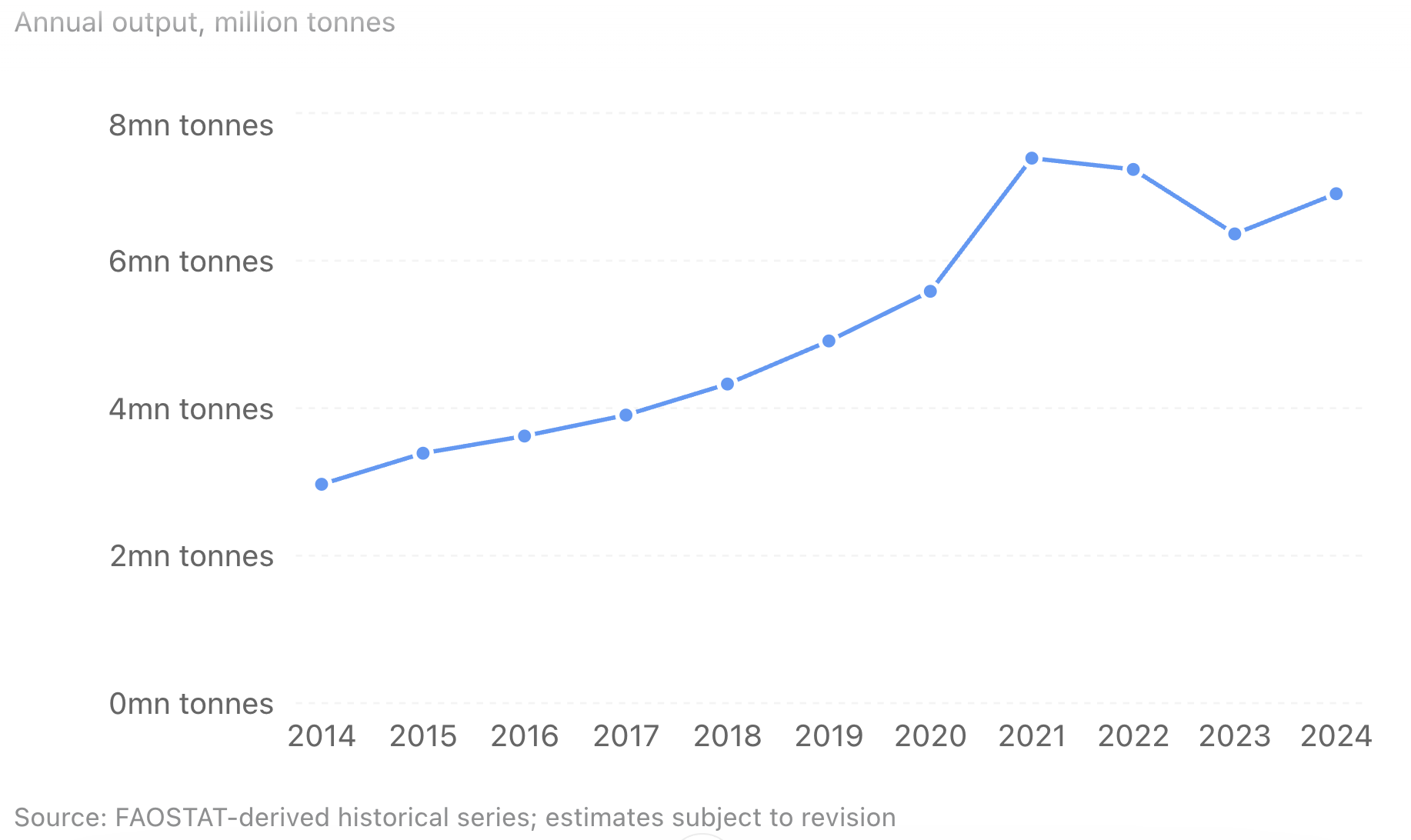
Production increased from approximately 2.97mn tonnes in 2014 to 6.91mn tonnes in 2024, representing cumulative growth of about 133%.
The expansion has nevertheless been uneven.
Output reached an estimated 7.39mn tonnes in 2021 before declining to 7.24mn tonnes in 2022 and 6.36mn tonnes in 2023. The recovery in 2024 left production approximately 6.5% below its previous peak.
The figures point to a large but vulnerable agricultural sector, exposed to changing weather patterns, high transport costs, limited financing and persistent weaknesses in rural infrastructure.
For President Bola Ahmed Tinubu’s administration, agricultural development remains central to efforts to strengthen food security, contain food-price pressures and reduce the economy’s dependence on hydrocarbons.
Yet higher production alone offers limited evidence of improved competitiveness. Productivity, processing capacity and access to international markets provide a more revealing measure of the sector’s economic potential.
Productivity gap raises questions over competitiveness
Nigeria harvested bananas from an estimated 468,358 hectares in 2024, achieving an average yield of 14.75 tonnes per hectare.
That compares with 27.16 tonnes per hectare in Kenya and 43.61 tonnes in Egypt, according to the FAOSTAT-derived figures.
Banana yields reveal Africa’s productivity divide
Nigeria’s average yield was equivalent to approximately 54% of Kenya’s and 34% of Egypt’s.
Differences in crop varieties, irrigation, growing conditions and production systems complicate direct comparisons. Nevertheless, the gap highlights the potential economic gains from improved agricultural technology, better planting materials and more efficient farm management.
An illustrative calculation suggests that matching Kenya’s average yield across Nigeria’s existing harvested area would lift annual production to approximately 12.7mn tonnes, assuming unchanged acreage.
That is not a forecast. It demonstrates the potential scale of productivity improvements, although achieving such gains would require sustained investment and favourable agronomic conditions.
Export performance remains negligible
Nigeria’s international banana trade presents a striking contrast with its domestic production.
According to World Bank WITS data drawn from UN Comtrade, the country exported just 43.8 tonnes of bananas and plantains, fresh or dried, in 2024, worth approximately $49,330.
Canada, India and Gabon were among the recorded destinations.
A separate FAOSTAT trade series reported exports of approximately 70.3 tonnes for the same year, highlighting differences in statistical coverage and reporting methodologies.
The production and trade figures cover different product classifications and should not be used to calculate a precise export share. Official trade statistics may also understate informal cross-border activity.
Even allowing for these limitations, the recorded export volumes suggest that Nigeria has yet to establish a significant formal presence in international banana markets.
A domestic population exceeding 230mn provides a substantial market for agricultural produce, reducing the immediate need for producers to seek foreign buyers.
But strong domestic demand does not fully explain the export gap.
Inadequate cold-chain infrastructure, inconsistent quality standards, fragmented supply networks and high logistics costs continue to constrain the development of internationally competitive agricultural value chains.
For investors, these weaknesses also represent potential opportunities in refrigerated transport, packaging, processing and commercial distribution.
Angola emerges as Nigeria’s closest continental rival
Angola ranks second in the dataset, with 5.21mn tonnes produced in 2024, followed by Tanzania at 3.27mn tonnes, Rwanda at 2.44mn tonnes and Kenya at 2.06mn tonnes.
Africa’s 10 largest banana producers — 2024
| Rank | Country | Production |
|---|---|---|
| 1 | Nigeria | 6.91mn tonnes |
| 2 | Angola | 5.21mn tonnes |
| 3 | Tanzania | 3.27mn tonnes |
| 4 | Rwanda | 2.44mn tonnes |
| 5 | Kenya | 2.06mn tonnes |
| 6 | Egypt | 1.25mn tonnes |
| 7 | Burundi | 1.21mn tonnes |
| 8 | Ethiopia | 1.19mn tonnes |
| 9 | Malawi | 1.13mn tonnes |
| 10 | Sudan | 0.95mn tonnes |
Source: FAOSTAT-derived 2024 figures. Values rounded. The ranking concerns the bananas category rather than a combined bananas-and-plantains measure; some country figures are estimates.
Kenya recorded particularly strong growth, with production rising an estimated 15.9% in 2024, compared with Nigeria’s 8.6%.
Angola, meanwhile, is seeking to turn its agricultural production into a stronger export industry.
The southern African country exported approximately 9,591 tonnes of bananas and plantains in 2025, generating $5.39mn in revenue, with Portugal accounting for the overwhelming majority of sales.
The comparison illustrates different market structures.
Nigeria benefits from a vast domestic consumer base, while Angola’s Atlantic coastline and commercial relationships with Europe and southern Africa offer opportunities for export-oriented agricultural investment.
However, Angola’s export performance remains modest relative to its own production, suggesting that both countries face significant challenges in developing higher-value agricultural industries.
Industrialisation offers the next growth opportunity
For Nigeria, the economic opportunity extends beyond fresh banana production.
Processing into flour, chips, purées, dried fruit and food ingredients could improve value addition, diversify rural incomes and reduce some post-harvest losses.
The commercial viability of these activities will depend on reliable electricity, financing costs, transport infrastructure and consistent supplies of suitable raw materials.
Nigeria’s location in west Africa also offers access to regional markets through the Economic Community of West African States, while the African Continental Free Trade Area could eventually support broader cross-border agricultural trade.
Trade liberalisation alone, however, will not overcome inadequate infrastructure or the costs associated with meeting international food-safety standards.
More detailed agricultural statistics would also help investors assess opportunities. State-level production volumes, yields, farmgate prices, post-harvest losses and processing capacity remain essential to evaluating the sector’s commercial prospects.
The outlook to 2030
Nigeria’s position in African banana production provides a foundation for agricultural industrialisation, but its future competitiveness will depend increasingly on productivity rather than acreage alone.
Investment in irrigation, improved planting materials, rural roads, storage facilities and processing capacity could lift yields and strengthen supply chains.
Export growth would require additional improvements in certification, quality control, cold-chain logistics and access to overseas buyers.
The country’s large domestic market should remain an important source of demand. Yet converting agricultural output into higher-value products could create opportunities for employment, private investment and foreign-exchange earnings.
The central challenge for Nigeria is therefore not simply to produce more bananas, but to extract greater economic value from each tonne harvested.
Nigeria has the scale to dominate African banana production. Whether it can convert that advantage into a competitive agribusiness industry will depend on productivity, infrastructure and its ability to move beyond domestic consumption towards higher-value markets.