France plunges into political crisis after Prime Minister Sébastien Lecornu resigns, the shortest tenure in modern history
- EuropePolitics
- October 6, 2025
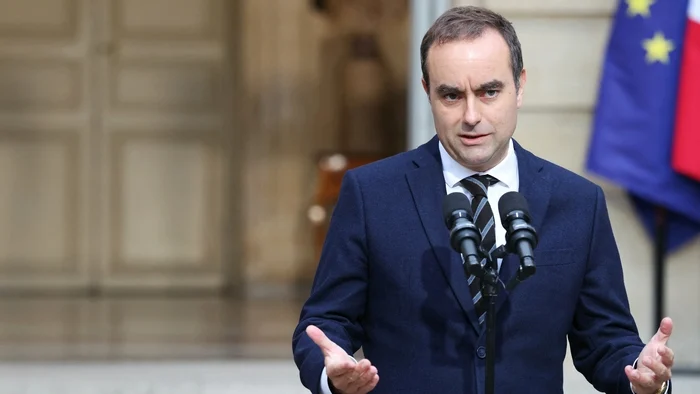

France is once again in turmoil. Prime Minister Sébastien Lecornu resigned on Monday, ending the shortest premiership in the country’s modern history and leaving President Emmanuel Macron searching for direction. His abrupt departure marks another chapter in the growing instability that now defines Macron’s presidency.

AfricaHeadline Reports Team
editorial@dw-demosnewstaion.online
Lecornu was appointed only weeks ago, tasked with restoring political stability, rebuilding public trust, and forming a government capable of bridging France’s deep divisions. Instead, his brief time in office exposed with painful clarity the widening gap between the Élysée Palace and the French public.
From the start, Lecornu faced an impossible equation. Efforts to build a new cabinet collapsed amid partisan gridlock and a hostile parliament. Fiscal and energy reforms meant to anchor his short-lived government were swiftly rejected by an unlikely alliance between the far-left and far-right.
Inside the administration, tensions quickly escalated. Advisers say Lecornu wanted a technocratic cabinet focused on efficiency, while Macron pushed for a broader political coalition. “The disconnect between them became untenable,” one senior official said, speaking on condition of anonymity.
For Macron, Lecornu’s resignation is both a political and personal defeat. The president now faces a perilous choice: dissolve the National Assembly and risk handing an electoral victory to Marine Le Pen’s far-right party, or maintain a caretaker government trapped in paralysis.
Neither path is appealing. Financial markets reacted nervously, the euro dipped slightly, and polls show a weary electorate split between apathy and anger.
“The problem isn’t just Lecornu, it’s Macron,” said political analyst François Heisbourg. “The president has lost his ability to build consensus, and that’s fatal in a system without a parliamentary majority.”
Across Paris and Marseille, protesters once again filled the streets, denouncing what they call a crisis of legitimacy. French flags waved alongside banners demanding a new republic, as chants against the political elite echoed through city squares.
Beyond France’s borders, the reaction has been one of quiet alarm. In Brussels and Berlin, diplomats worry that France’s leadership vacuum comes at a moment when the European Union faces overlapping crises, from war in Ukraine to energy insecurity and the strain of far-right populism.
Halfway through his second term, Macron finds himself more isolated than ever. Lecornu was meant to be his loyal executor, a pragmatic operator who could restore discipline to the government. His fall, however, has left the president politically exposed and vulnerable.
As Le Monde put it in a stark editorial, “France is not just facing a government crisis; it is facing a crisis of confidence.”
Macron now confronts a moment of reckoning. Every decision he takes will be seen as a test of his political survival and of the Fifth Republic’s resilience itself.
Lecornu’s resignation reshapes France’s political map and places Macron under immediate pressure to act. Three potential paths now dominate the conversation in Paris:
Appointing a centrist prime minister with parliamentary experience, a figure able to negotiate across party lines and avoid snap elections.
Forming a short-term technocratic cabinet, limited to budgetary and institutional management while buying time for political recalibration.
Dissolving parliament and calling new elections, a high-risk gamble that could empower Marine Le Pen’s National Rally and push France further toward the far-right.
Inside the European Union, unease is growing. France remains central to the bloc’s policy balance, and a prolonged power vacuum in Paris could disrupt collective decisions on defense, energy, and foreign policy.
For Macron, the next thirty days may define the rest of his presidency, a countdown to prove whether he still governs France or merely presides over its uncertainty.