Inflation returns to Côte d’Ivoire but remains within the BCEAO’s comfort zone
- Economic OutlookIvory Coast (Côte d'Ivoire)
- September 8, 2026

Consumer prices rose 1.9 per cent in July, driven by food costs. The acceleration remains moderate, but higher energy and import prices could test stability in the largest economy of the West African monetary union.
ABIDJAN — Inflation in Côte d’Ivoire accelerated for a second consecutive month in July 2026, signalling a gradual return of price pressures after the sharp disinflation recorded last year. The increase nevertheless remains contained enough to avoid threatening the country’s growth outlook or prompting an immediate monetary policy response from the Central Bank of West African States, or BCEAO.
The Harmonised Index of Consumer Prices rose 1.9 per cent year on year in July, up from 1.8 per cent in June, according to the National Statistics Agency. Average inflation over the 12 months to July stood at 0.9 per cent, compared with 0.7 per cent a month earlier.
The trajectory since the start of the year points to inflation that is low but uneven. The annual rate increased from about 1.5 per cent in January to almost 2 per cent in February and March, before falling to 1.4 per cent in April and 1.3 per cent in May. It then rose to 1.8 per cent in June and 1.9 per cent in July.
The gap between the latest annual reading and the 12-month average suggests that recent price increases have not yet spread broadly across the economy. But the renewed upward movement warrants attention, particularly because it is concentrated in items that carry the greatest weight in poorer households’ budgets.
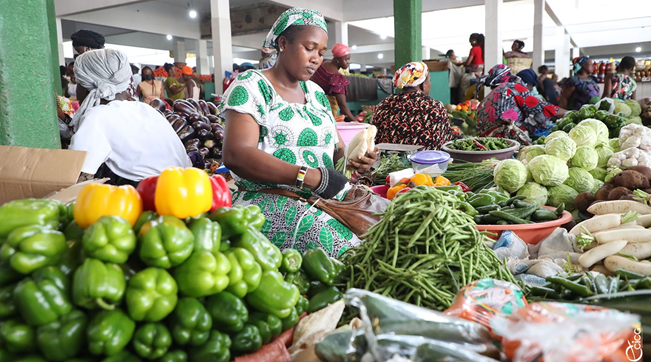
Food is the main source of pressure. Higher prices for fresh produce and other essential goods disproportionately affect lower-income families, even when headline inflation remains subdued. For those households, the inflation experienced in local markets may be considerably higher than the national rate because food and transport absorb a larger share of monthly spending.
From inflation shock to price stability
The current picture marks a sharp reversal from the pressures experienced earlier in the decade. Average inflation reached 5.2 per cent in 2022, driven by the global surge in food, fuel and fertiliser prices following Russia’s invasion of Ukraine.
Inflation slowed to 4.4 per cent in 2023 and 3.5 per cent in 2024, before falling to about 0.1 per cent in 2025, according to international data compiled by the World Bank.
| Period | Inflation |
|---|---|
| 2022, annual average | 5.2% |
| 2023, annual average | 4.4% |
| 2024, annual average | 3.5% |
| 2025, annual average | about 0.1% |
| January 2026, year on year | 1.5% |
| March 2026, year on year | 1.9% |
| May 2026, year on year | 1.3% |
| June 2026, year on year | 1.8% |
| July 2026, year on year | 1.9% |
The decline reflected stronger agricultural supply, better market availability, the normalisation of international supply chains and government measures aimed at containing the cost of living. The stability of the CFA franc, which is pegged to the euro, has also limited the transmission of exchange-rate volatility into import prices.
Growth without overheating
July’s inflation reading remains within the BCEAO’s 1 to 3 per cent price-stability range. For the West African Economic and Monetary Union as a whole, the central bank expects average inflation to rise from zero in 2025 to 1.6 per cent in 2026 and 2.1 per cent in 2027.
Regional core inflation, which excludes fresh food and energy, stood at 1.3 per cent in the first quarter of 2026. That suggests the underlying increase in prices remains relatively contained despite renewed pressure from food and energy markets.
The International Monetary Fund forecasts average inflation of 1.8 per cent in Côte d’Ivoire in 2026, alongside real gross domestic product growth of 6.2 per cent. The combination places the country in an unusually favourable position: economic expansion well above the regional and global averages without clear evidence of price overheating.
That margin of safety could nevertheless narrow. Higher international oil prices would feed into fuel, transport, electricity and fertiliser costs. Geopolitical tensions could also raise freight charges and the price of imported food. Domestically, irregular rainfall or disruptions to rural transport routes could reduce supplies of fresh produce and push prices higher in urban markets.
The most likely path is for inflation to remain close to, but generally below, 2 per cent during the remainder of 2026 before moving gradually higher in 2027. That would allow the BCEAO to maintain a measured policy stance, balancing price stability against the financing needs of one of Africa’s fastest-growing economies.
The central question for Côte d’Ivoire is no longer simply whether inflation has been brought under control. It is whether stability in the national index will be reflected in the prices households encounter when buying food, paying for transport or meeting the rising cost of housing.