South Sudan: Election could test peace before consolidating it
- South Sudan
- September 28, 2026
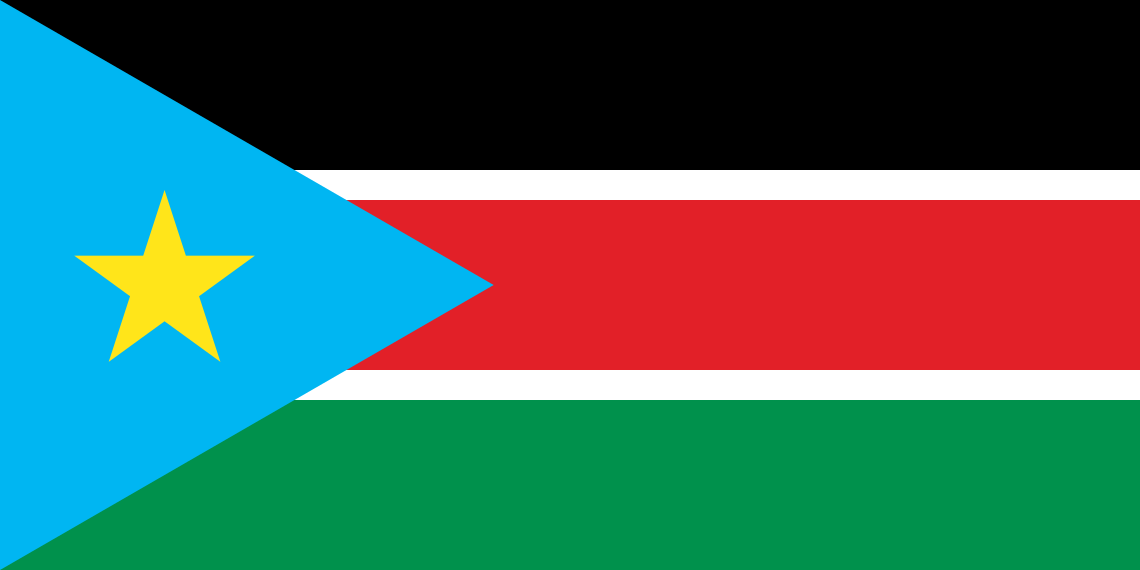

Lasting peace in South Sudan remains unlikely in the short term without a minimum political understanding between the government and the country’s main opposition groups.
The election scheduled for December could become the most important test yet of South Sudan’s ability to complete the political transition launched by the 2018 peace agreement. But it could also become the next flashpoint for political confrontation and, under certain circumstances, violence.
The central question is no longer simply whether South Sudan can hold elections, it is whether the election can transform a struggle for control of the state into political competition governed by rules accepted by the country’s main political forces. If the parties do not regard the process as sufficiently inclusive and credible, the vote could produce a formally constituted government without resolving the dispute at the heart of the current crisis.
The deterioration must be understood against the backdrop of the progressive erosion of the 2018 peace agreement, which established a power-sharing arrangement between President Salva Kiir and Riek Machar and remains the main political framework for the transition.
Machar’s arrest in 2025, growing deadlock among the signatories, and changes to government structures and the electoral process have weakened trust between the parties. The African Union has reported persistent disagreements, armed clashes in Jonglei and Upper Nile, and difficulties in advancing political dialogue.
In September, the government held a dialogue on electoral issues without the participation of some of the main opposition factions. During the same period, Kiir dissolved the Unity Government and removed vice presidents associated with the 2018 political arrangement.
The removal of the head of the electoral commission added another layer of uncertainty over the continuity and perceived independence of the institutions responsible for the vote. These developments increase the risk of an electoral dispute, although they do not, by themselves, establish that the election will be postponed or that the opposition will return to a nationwide war.
Confidence in this assessment is moderate regarding the overall direction of events and low to moderate regarding the precise trajectory of each scenario.
Public information does not allow for a definitive assessment of the cohesion of the armed forces, the chains of command of different groups or the actual mobilization capacity of individual factions. In a country where national political violence can coexist with local conflicts driven by different dynamics, that uncertainty is particularly significant.
From the 2018 peace deal to the current crisis
South Sudan’s current crisis is not the result of a single event. It is the product of an incomplete transition in which the political commitments established in 2018 were not matched by an equivalent consolidation of institutions and security mechanisms.
The agreement created a framework intended to end the conflict and establish power-sharing, its implementation, however, remained marked by delays, mistrust and partially overlapping political and military structures. The result has been the persistence of political, regional and communal loyalties that continue to compete with national institutions.
Political deterioration since 2025 has widened the divide between the government and parts of the opposition. Machar’s arrest reduced the space for opposition participation through the institutional mechanisms established under the agreement, while clashes in different parts of the country demonstrated the fragility of existing security arrangements.
In 2026, the combination of localized violence, difficulties in implementing the agreement and disputes over the electoral timetable began to challenge the political system’s ability to deliver a consensual transition.
The December election has therefore become the focal point of these tensions. It could provide an institutional path to completing the transition, but only if the main political forces consider the rules on participation, administration, observation and dispute resolution sufficiently credible. Otherwise, the election could shift the crisis into a new arena, from a dispute over the transition to a dispute over the legitimacy of the outcome.
Three Scenarios for the Next 6 to 12 Months
The outlook can be organized around three principal trajectories, a contested election accompanied by localized violence is the dominant scenario, estimated at 40% to 50%. A temporary agreement that changes the electoral timetable or rules and reduces tensions in the short term is estimated at 30% to 40%. An escalation into a broader armed conflict remains in the 15% to 25% range, making it the lower-probability but potentially highest-impact scenario.
These ranges are analytical estimates, not statistical forecasts. Their purpose is to organize the principal risks rather than suggest a degree of precision that the available information cannot support.
Contested election and localized violence
Under this scenario, the government proceeds with the December election, while significant parts of the opposition reject the process, boycott the vote or challenge the result. Violence would likely remain concentrated in areas already affected by fighting, resource disputes, rival forces or communal tensions.
The likely sequence would be a lack of agreement over electoral rules and participation, followed by challenges to the legitimacy of the vote, protests, boycotts or repression, and eventually localized clashes and further political restrictions. The principal risk would be the transformation of an electoral dispute into a broader dispute over the legitimacy of the state itself.
The government could secure a formal mandate through the election without generating enough political acceptance to reduce violence. In that case, the vote would not end the transition. It would shift the dispute toward the legitimacy of the result, recognition of the new government and control of state institutions.
Temporary agreement and electoral timetable changes
The second scenario assumes that pressure from regional mediators, deteriorating security conditions and the lack of political consensus force the parties back to negotiations. An agreement could modify the timetable, establish guarantees for opposition participation or create independent mechanisms to monitor the electoral process.
Mediation by the African Union and IGAD, potentially with support from the United Nations, could temporarily reduce incentives for armed mobilization. But the effectiveness of any postponement would depend on concrete commitments, verifiable deadlines and mechanisms to hold the parties accountable.
A negotiated postponement could create space for a more inclusive transition. An imposed, open-ended or purely political delay designed to preserve the existing power structure could have the opposite effect, increasing perceptions of exclusion and prolonging the crisis.
The key issue would therefore not simply be whether the election is delayed or held, but whether the electoral timetable is used to create political and institutional conditions that make the vote acceptable to the main actors.
Escalation into a broader armed conflict
The third scenario would emerge from a combination of political rupture, military mobilization and the breakdown of existing coordination mechanisms. Localized clashes could develop into sustained operations across several regions if rival forces acquire greater coordination, logistical capacity and support.
The sequence could begin with the removal of actors from the power-sharing structure, followed by the breakdown of security mechanisms, the mobilization of fighters, retaliatory attacks and the formation of new armed alliances. A crisis that begins as a political dispute could therefore acquire a military dimension that becomes much harder to control through conventional negotiations.
The impact would be severe. A wider conflict could trigger further population displacement, disrupt oil production and transportation, reduce state revenues and further weaken already fragile institutions.
An August attack on a UN mission convoy that killed two peacekeepers in Jonglei is a sign of a dangerous operational environment. But the incident, on its own, does not demonstrate a political decision to launch a new nationwide war. Responsibility was not immediately claimed, and violence in South Sudan often involves local actors and motivations that do not directly respond to the country’s principal political leaders.
Actors and the distribution of power
The presidency and government’s immediate interest is to preserve control of the state and keep the election on the announced timetable. The government controls the main central institutions and state security forces, but that does not translate into uniform control across the country. Its ability to sustain operations and maintain security also depends on public resources, regular payments and the cohesion of the chain of command.
Riek Machar and his allies remain an important component of the political dispute despite the reduction of their institutional space. His arrest and removal from the government arrangement have reduced his ability to participate through formal mechanisms. However, it cannot be assumed that all opposition forces operate under a single chain of command or share the same objectives.
The opposition is heterogeneous. Some groups oppose specific electoral changes; others seek a broader revision of the 2018 agreement; still others are primarily concerned with local security, resources and authority. This fragmentation makes a national consensus harder to achieve, but it also means the crisis cannot be reduced to a simple confrontation between Kiir and Machar.
Local leaders and community groups can also influence the trajectory of the crisis. Disputes involving cattle, land, resources and local authority can generate violence independently of negotiations in Juba. This local dimension is critical because a communal incident can widen the national crisis without necessarily resulting from a decision by the country’s main political leaders.
The African Union, IGAD and the United Nations continue to play important roles in mediation, monitoring and civilian protection. Their ability to influence events, however, depends on the willingness of South Sudanese parties to accept negotiated commitments. None of these actors can impose a sustainable political settlement on their own.
Oil, revenue and state capacity
The economy is central to South Sudan’s political and military calculations. Oil revenues constitute one of the main financial foundations of the state and directly affect the government’s ability to fund institutions, pay public employees and maintain security forces.
The country’s dependence on exports through infrastructure crossing Sudan adds an external vulnerability. A significant disruption to production or transportation could reduce available revenues and constrain the government’s ability to maintain regular payments. In a fragile institutional environment, salary arrears can quickly become a security problem.
The relationship is direct: oil generates revenue; revenue finances the state; the state finances security forces and institutions; the ability to pay influences discipline; and discipline affects political stability. A significant deterioration at any point in that chain can affect the rest of the system.
For that reason, oil exports, regular payments to security forces and transparency over public revenues should be monitored as political and military risk indicators. The economy is not a separate dimension of the crisis. It is one of the material conditions determining the state’s ability to manage the transition.
The Problem of Military Unification
The creation of a unified military remains one of the most sensitive elements of implementing the peace agreement. The formal integration of fighters does not, by itself, guarantee the creation of a functioning national army. If different groups retain separate chains of command, political loyalties and financial structures, integration could simply place rival forces inside the same institution.
The real test will be whether there is a recognized chain of command, regular pay, effective discipline and credible accountability mechanisms. Security assessments should therefore focus less on the number of fighters formally integrated and more on how orders are transmitted, implemented and enforced in contested areas.
This issue becomes particularly important during the electoral period. If security forces are perceived as instruments of one side, an electoral dispute could quickly acquire a military dimension. If they operate under an institutional chain of command and common rules, they could instead serve as a mechanism of restraint.
What would be needed to consolidate peace
A pause in fighting would not be enough. A more durable peace would require a combination of political understanding, security guarantees, credible electoral institutions, transparent management of public revenues and local mechanisms for protection and participation.
A political understanding would need to establish rules accepted by the main parties for the transition, electoral participation and the resolution of disputes. Without a mechanism agreed in advance for handling electoral challenges, a disputed result could quickly become a political crisis.
Security guarantees would have to go beyond the formal integration of forces. They would require clarity over command, payment, discipline, operational integration, monitoring and consequences for violations.
Electoral institutions would also need sufficient credibility for political actors to believe that losing an election would not mean permanent exclusion from the political system. Trust would depend not only on election day, but on the rules governing the campaign, access for opposition candidates, independent observation, counting procedures and appeals.
Management of oil revenues is another important condition. In a state heavily dependent on natural resources, a lack of transparency can intensify political competition and patronage networks. Disclosure of relevant revenues and expenditures, combined with effective oversight, could reduce some of the uncertainty surrounding competition for control of the state.
Finally, any national settlement would need a local dimension. Communal violence, disputes over cattle and resources and conflicts over local authority cannot be resolved solely through a pact among political elites in Juba. Peace consolidation will require local mediation, civilian protection and humanitarian access.
Indicators that could change the outlook
The trajectory over the coming months will depend on political, military and economic signals that need to be assessed together. The simultaneous movement of troops, weapons or military vehicles toward disputed areas would be an important warning sign, particularly if accompanied by a breakdown in political channels. Defections, parallel chains of command or public declarations that joint security mechanisms are no longer functioning would also indicate institutional deterioration.
Politically, new arrests or removals of leaders accompanied by a suspension of negotiations would increase the risk of confrontation. Restrictions on opposition campaigning, limitations on observers or the exclusion of significant groups from the electoral process would provide additional warning signs.
Internationally, the emergence of new armed alliances, verified evidence of external support to factions or restrictions on the activities of mediators and peacekeepers could indicate that the crisis is moving beyond an exclusively domestic confrontation.
Economically, a prolonged disruption to oil exports or the government’s inability to pay security forces and public employees would be particularly significant. In a system where public resources are directly linked to institutional functioning, a prolonged financial crisis could accelerate security deterioration.
The opposite signals would also matter. Effective participation by major opposition groups in a mediated dialogue, a public agreement on electoral rules, independent observation, the restoration of ceasefire-monitoring mechanisms and regular payments to security forces would point toward reduced tensions.
The fragmented nature of the conflict and limited transparency over military command structures warrant caution. Even so, the available signals point to a clear conclusion: the election will be the principal test of the stability of South Sudan’s current political transition.
The Central Implication
The December election is a pressure point for South Sudan’s political system, not an automatic solution to the crisis.
If it is held without significant opposition participation, credible security guarantees and meaningful mechanisms for challenging the result, it could produce a formally constituted government without resolving the fundamental dispute over legitimacy and the distribution of power.
If it is preceded by a limited political agreement, effective regional mediation and verifiable measures on security and participation, it could reduce tensions and create conditions for a more stable transition.
The decisive question will not simply be whether the vote is held or postponed, but whether the country’s main political and military forces recognize common rules and accept verifiable limits on the exercise of power.
South Sudan’s prospects for peace will depend less on signing another document than on the parties’ ability to turn political commitments into verifiable behavior. The real test of the election will be whether it helps complete the transition or merely moves the struggle into another phase of political and potentially military confrontation.
The central question for the next six to 12 months is therefore whether the electoral process can turn competition for power into an institutional contest, or deepen the divisions that have kept South Sudan trapped in an incomplete peace.