South Africa’s ANC: A decade of electoral decline, social transformation and the struggle to retain political influence
- Opinions
- November 8, 2026

AFRICAHEADLINE | OPINION & POLITICAL ANALYSIS
The African National Congress has lost much of the electoral dominance it once enjoyed, but its political influence remains deeply embedded in South Africa’s institutions, communities and democratic history. A decade of election results, economic reforms and social indicators reveals a more complicated picture than the party’s declining vote share suggests.
Johannesburg | November 2026
For more than three decades, the African National Congress has occupied a central place in South African politics. The party that helped dismantle apartheid, brought Nelson Mandela to power and oversaw the construction of a democratic state is now confronting a fundamental change in its relationship with the electorate.
Its political authority, once sustained by the moral legitimacy of liberation and successive electoral majorities, is increasingly judged against a different set of expectations, jobs, reliable electricity, functioning municipalities, economic opportunity and accountable government.
The numbers tell a story of considerable electoral decline. Yet they also reveal a political organisation whose influence has proved more durable than its shrinking share of the vote might suggest.
Between 2016 and 2026, the ANC lost support across successive elections, surrendered its parliamentary majority and faced the emergence of new competitors. At the same time, South Africa expanded access to essential services, maintained an extensive social protection system and pursued reforms intended to address long-standing weaknesses in energy, transport and public administration.
The central question is not simply why the ANC has lost votes. It is how a party associated with substantial social transformation has struggled to translate that record into continued electoral confidence.
A decade of losses, but not political disappearance
The scale of the ANC’s electoral retreat is striking. It won approximately 53.9 per cent of the vote in the 2016 municipal elections, falling to 45.6 per cent in 2021. Provisional results from the November 2026 local elections put its support at about 30.8 per cent, a decline of more than 23 percentage points over a decade.
The party’s national vote followed a similar trajectory, dropping from 57.5 per cent in 2019 to 40.2 per cent in 2024, when it lost its parliamentary majority for the first time.
Yet the latest municipal figures still place the ANC ahead of the Democratic Alliance, on 24.6 per cent, and former president Jacob Zuma’s uMkhonto weSizwe party, on approximately 9.7 per cent.
The ANC also retains thousands of municipal council seats and an extensive presence across the country’s provinces.
This distinction matters. Electoral decline and institutional influence are related, but they are not identical. A party can lose support while remaining embedded in local political structures, parliamentary institutions and communities.
The ANC’s challenge is that such influence no longer guarantees governing majorities.
The social transformation that electoral figures cannot capture
South Africa’s political debate often concentrates on unemployment, corruption and deteriorating public services. These are substantial problems, but they do not tell the entire story of the democratic era.
According to Statistics South Africa’s census data, household access to electricity rose from 84.7 per cent in 2011 to 94.3 per cent in 2022. Access to improved sanitation increased from 68.9 per cent to 80.7 per cent over the same period.
Access to water and municipal waste collection also expanded.
These improvements form part of the social transformation achieved under successive ANC-led administrations. They reflect public investment, institutional development and the gradual extension of essential services to communities historically excluded under apartheid.
But there is a crucial qualification: access does not necessarily mean reliability.
A household connected to the electricity grid may still experience interruptions. A community with water infrastructure may face shortages lasting days. A municipality may have expanded its services while struggling to maintain them.
For voters, that distinction has become increasingly important.
The political expectations of a society that has gained access to basic infrastructure are different from those of a society still fighting for initial access.
The ANC is consequently confronted by a generation of voters who are less inclined to judge government solely by the historical expansion of services.
Ramaphosa’s reforms and the limits of economic recovery
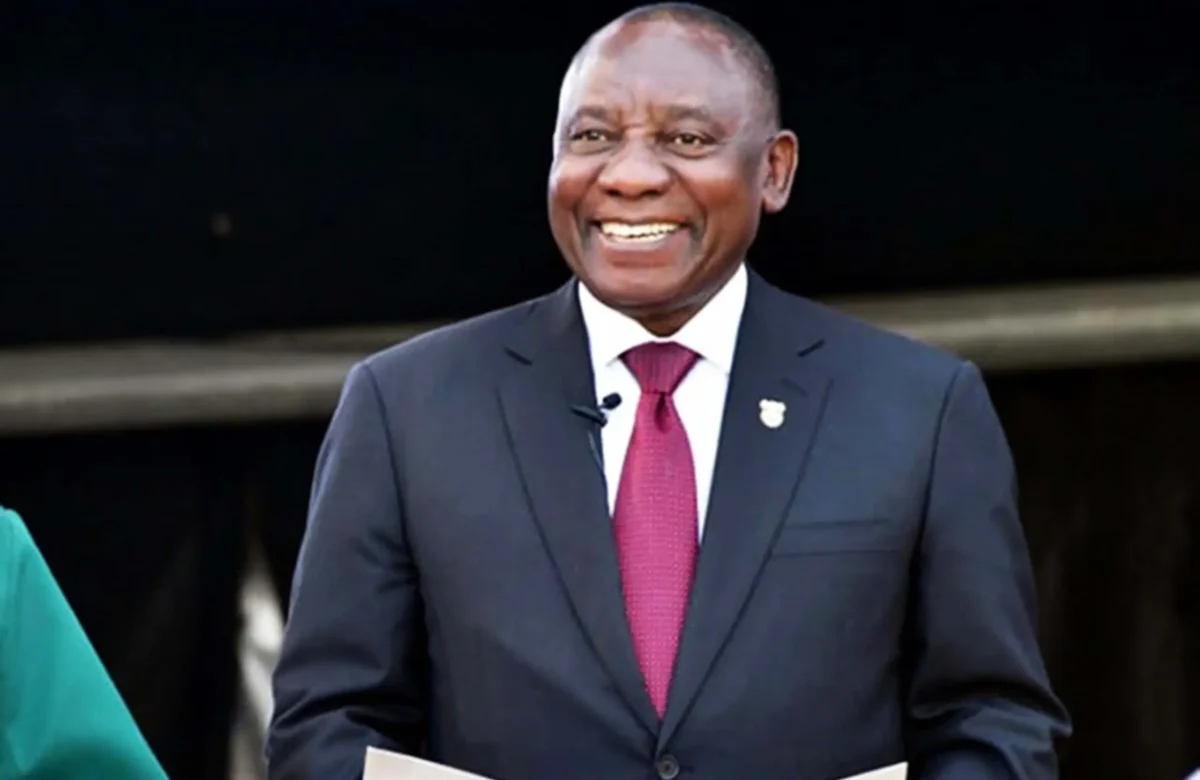
President Cyril Ramaphosa, who took office in 2018, inherited an economy constrained by unreliable electricity, deteriorating logistics infrastructure, weak investment and institutional damage associated with state capture.
His administration pursued reforms in energy generation, electricity transmission, transport and state-owned enterprises.
The improvement in electricity supply has been particularly significant.
According to the OECD, South Africa experienced 289 days of scheduled power cuts in 2023, falling to 69 days in 2024. Privately owned solar generation capacity also expanded sharply, from approximately 1.2 gigawatts in 2021 to 6.1 gigawatts by 2024.
The figures demonstrate operational progress, although the improvement cannot be attributed exclusively to government policy. Lower electricity demand, private investment and changes in Eskom’s generating performance also contributed.
The reforms nevertheless illustrate an important feature of Ramaphosa’s presidency: an attempt to address structural constraints rather than rely exclusively on public spending.
The difficulty is that improved electricity supply has not yet translated into sufficiently strong economic growth.
South Africa’s economy has expanded slowly for much of the past decade, while unemployment has remained exceptionally high.
This creates a political dilemma. Reforms may improve economic conditions without producing immediate gains in household incomes, employment or public confidence.
Why economic inequality remains the defining issue
South Africa’s democratic transformation has produced a larger black professional and middle class, expanded educational opportunities and created a substantial social protection system.
Policies such as Black Economic Empowerment were designed to address the economic exclusion inherited from apartheid.
Their results, however, have been uneven.
Greater access to professional employment and business opportunities has coexisted with persistent poverty, concentrated wealth and high youth unemployment.
For millions of South Africans, the most immediate economic question is not whether the country has become more inclusive since 1994, but whether they can secure stable employment and improve their living standards today.
The ANC’s historical association with social transformation remains politically relevant. But the economic frustrations of younger voters demonstrate the limits of relying on historical achievements to explain contemporary electoral behaviour.
There is also a danger in assuming that beneficiaries of social grants or public services automatically support the governing party. Social protection is a public policy instrument, not a reliable measure of partisan allegiance.
The political cost of corruption
No serious assessment of the ANC’s decade in government can avoid the issue of corruption.
The judicial commission chaired by Raymond Zondo documented extensive evidence of state capture, including improper influence over public institutions and state-owned enterprises during Jacob Zuma’s presidency.
The findings exposed weaknesses in procurement, political accountability and institutional oversight.
Ramaphosa’s administration has sought to strengthen anti-corruption measures and restore institutional credibility, but the distinction between announcing reforms and delivering accountability remains important.
Corruption is not simply an ethical issue. It has economic consequences.
Mismanaged procurement, poorly maintained infrastructure and weakened public institutions can undermine investment, increase costs and reduce the quality of essential services.
These failures also complicate the ANC’s claim to a legacy of social development. Improvements achieved over decades can be diminished when institutions struggle to maintain them.
The geography of a changing electorate
The ANC’s electoral decline has not occurred evenly across South Africa.
Limpopo, Eastern Cape and North West have remained important areas of support, while Gauteng and KwaZulu-Natal have become increasingly competitive.
The emergence of Zuma’s MK party has been particularly consequential in KwaZulu-Natal, where it has challenged the ANC’s traditional political networks.
In Gauteng, the country’s economic centre, dissatisfaction with municipal services has become a prominent feature of electoral competition.
The November 2026 results illustrate these differences. Provincial figures showed the ANC maintaining substantial support in Limpopo, Eastern Cape and North West, while the DA led in Gauteng and MK dominated KwaZulu-Natal.
These patterns cannot be explained by a single national narrative.
Urbanisation, income inequality, local political leadership, unemployment and the quality of municipal administration all influence the political environment.
The emergence of multiple opposition parties also means that former ANC supporters do not necessarily move towards the same political alternative.
Coalition government changes the rules
Perhaps the most consequential institutional change is the spread of coalition government.
By the morning of 8 November, 135 of 209 declared municipal councils had no party holding an outright majority, according to an election tracker using IEC data, the implications extend beyond party politics.
Municipal coalitions determine budgets, infrastructure programmes, senior administrative appointments and the delivery of everyday services.
For the ANC, this represents a substantial departure from decades of governing through comfortable majorities.
For opposition parties, it creates opportunities to exercise authority but also exposes them to the difficulties of managing fragmented administrations.
The Reuters report on the latest election results highlighted the scale of the ANC’s setback and the negotiations now facing parties in municipalities including Johannesburg. ANC secretary-general Fikile Mbalula described the outcome as “catastrophic”, signalling recognition within the party of the seriousness of the losses.
Coalitions may encourage accountability and compromise. They can also produce instability when agreements are driven by competition for office rather than coherent programmes.
The decisive measure will be whether municipalities can approve budgets, maintain services and implement development projects.
South Africa’s regional influence adds another dimension
The ANC’s history also carries significance beyond South Africa’s borders.
The country’s role in the African Union, SADC, G20 and BRICS gives its political and economic decisions regional importance.
South Africa remains a major financial, industrial and commercial centre, with extensive trade and investment relationships across southern Africa.
Changes in its political system therefore matter for neighbouring economies, particularly in logistics, energy, manufacturing and regional integration.
However, the distinction between the ANC and the South African state has become increasingly important since the formation of the Government of National Unity in 2024.
Foreign policy and economic reforms now operate within a more complex political environment involving several parties and institutions.
The question facing the ANC is bigger than its vote share
The ANC’s political history presents a contradiction that cannot be resolved by either celebrating its achievements or concentrating exclusively on its failures.
Successive ANC-led governments expanded access to essential services, developed social protection programmes and oversaw important changes in economic participation.
Yet those advances have coexisted with weak growth, persistent unemployment, corruption and uneven municipal performance.
The party’s continued national presence demonstrates that its historical influence and institutional structures remain significant. Its declining vote share shows that these factors are no longer sufficient to sustain the electoral dominance it once enjoyed.
South Africa’s political transformation is therefore about more than the fortunes of a single party.
It reflects a democracy in which voters have more alternatives, political authority is increasingly shared and governments face greater pressure to demonstrate measurable results.
The defining lesson of the ANC’s past decade is that historical legitimacy and social progress do not automatically produce lasting electoral loyalty. Political confidence must increasingly be understood through the quality of institutions, economic opportunity and the everyday experience of government.
That is the central tension shaping South Africa’s changing democracy, and one of the most important questions confronting its political institutions.