Samora Machel and the unfinished decolonisation of Southern Africa
- Opinions
- August 24, 2026
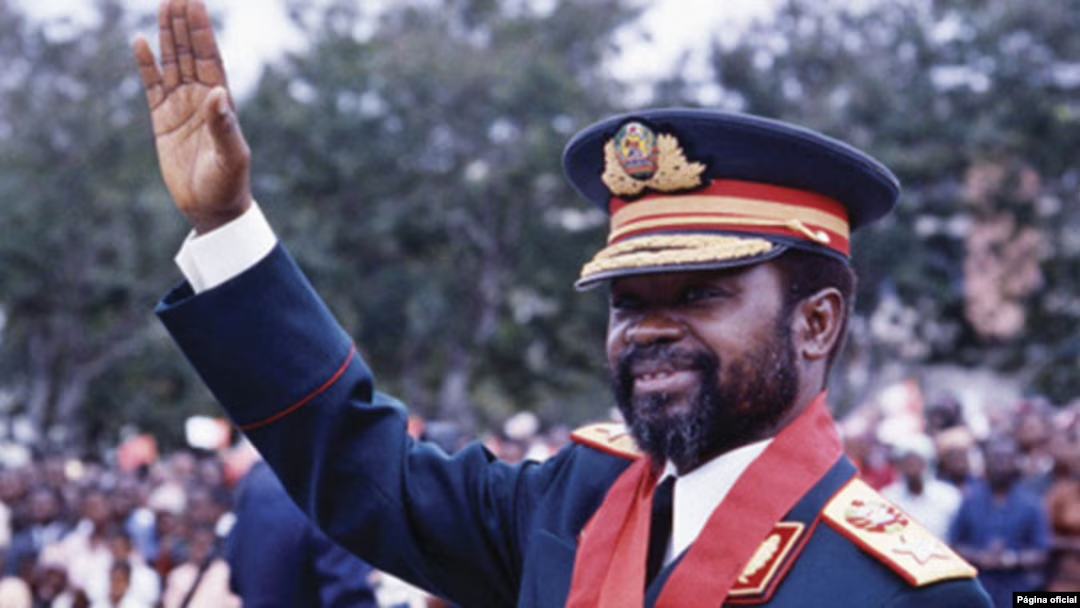

Keynote address at the Symposium hosted by the Samora Machel Foundation and Rhodes University, Makhanda on the 40th Anniversary of Samora Machel’s death. The two-day symposium was held under the theme; “Samora Machel, Liberation Movements and the Unfinished Decolonial Project”.
By Dr. Mbuyiseni Ndlozi
Independence cannot be reduced to replacing a foreign flag with a national one. Nor is it completed by electing black governments to administer institutions designed under colonialism. Independence acquires real substance only when it transforms relations of power, restores land and wealth to the people, and reorganises the economy to serve the majority.
It is precisely for this reason that Samora Machel’s legacy continues to challenge Southern Africa: we have achieved formal sovereignty, but we have yet to complete material decolonisation.
Samora understood that Mozambique’s liberation could not survive in isolation. As long as apartheid ruled South Africa, white-ruled Rhodesia attacked the peoples of the region, and Angola was subjected to proxy war, no Frontline State could be truly secure.
His vision was not sentimental. It was a concrete reading of the geography of power: our destinies were interconnected because colonialism had built a single regional machinery of exploitation, even as it divided us through artificial borders.
That machinery has not disappeared. It has changed administrators, language and, in some cases, shareholders. The region’s economies remain organised as extractive enclaves. We export minerals, energy and raw agricultural commodities; we import technology, manufactured goods and even processed food.
The most modern economic zones coexist with communities without clean water, decent employment, adequate hospitals or schools capable of preparing young people for the future. Wealth crosses borders rapidly; workers, small traders and refugees encounter walls, suspicion and violence.
This is the anatomy of neocolonialism, legally sovereign states trapped within economic structures they do not control.
A mine may operate on African soil, employ African workers and extract African resources, yet its financing, technology, markets and the largest share of its profits remain outside Africa. When that happens, the flag is national, but command of the economy remains external.
It would also be intellectually dishonest to attribute all our failures to foreign forces. A significant part of the crisis lies within the post-liberation states themselves. Political elites have turned liberation credentials into permanent licences to govern.
Corruption, nepotism and private enrichment have eroded the moral authority of movements born to serve the people. Instead of democratising wealth, some leaders have democratised only hope, asking the poor for patience while accumulating privileges for their families and allies.
That betrayal is not merely ethical; it is constitutional and political. A government loses legitimacy when it treats elections as a formality, tolerates violence, captures oversight institutions or abandons the social rights enshrined in constitutions.
Popular sovereignty does not mean periodically voting between factions of the same elite. It means that the people possess effective power to determine how land, public budgets, natural resources and state institutions are used.
The history of the “third force” offers an additional warning. The apartheid regime promoted covert operations, proxy wars, economic sabotage and violence presented as spontaneous conflict among Africans. The objective was to fragment liberation forces and conceal the hand that benefited from the chaos. Today, the methods may be less visible, but the logic persists whenever ethnic, national or partisan divisions are manipulated to prevent a common agenda for transformation.
Xenophobia against another African is, in this sense, a belated victory for the colonial map: the exploited person comes to see his neighbour, rather than the structure of exploitation, as the enemy.
This is where the SADC must choose between remaining a protocol-driven association of governments and becoming a genuine historical project of its peoples. Regional integration cannot be limited to summits, communiqués and corridors that transport raw materials to ports. It must encompass coordinated industrial policy, regional production chains, shared public infrastructure, energy security, scientific research and common rules that protect labour and the environment.
A region rich in lithium, cobalt, copper, gas, coal, sunlight and water should not compete to offer multinational corporations the lowest taxes and cheapest labour.
It should negotiate collectively, process its resources locally and use the resulting revenues to finance healthcare, education, housing and innovation. South Africa, given the weight of its economy, bears a particular responsibility. It cannot relate to its neighbours as a sub-imperial power, using integration merely to expand markets for its largest corporations. It must place its industrial capacity at the service of balanced regional development.
Such a transformation also requires stronger legal mechanisms: transparent public contracts, regional cooperation against illicit financial flows, tax harmonisation, independent electoral institutions and courts capable of holding power to account. Regional unity cannot be built at the expense of democracy.
On the contrary, it will be legitimate only if it expands the voices of citizens, workers, women, young people and communities affected by resource extraction.
The technological challenge makes this urgency even greater. Artificial intelligence, automation and the global control of data could create a new international division of labour in which Africa supplies minerals, data and consumers while others control algorithms, patents and platforms.
If each country negotiates alone, dependency will deepen. The SADC needs a common strategy for digital infrastructure, data protection, scientific training, intellectual property and the taxation of technology companies.
Technology should free human time and increase social productivity, not produce an extraordinarily wealthy minority alongside a majority regarded as economically disposable.
To remember Samora Machel, therefore, is not to repeat slogans or turn a revolutionary into a harmless statue. It is to recover the radical demand that animated his politics: the liberation of one people is inseparable from the liberation of others, and power is legitimate only when it materially improves the lives of the majority.
The present generation cannot continue administering poverty in the name of prudence, nor justify privilege in the name of history. Decolonisation will be complete when political sovereignty commands economic wealth; when borders cease to divide peoples destined to cooperate; when public service replaces private accumulation as the measure of leadership; and when technological progress is organised for the collective good.
The future of Southern Africa will not be handed to it by former colonial powers, global markets or individual saviours. It will have to be built by politically conscious peoples, democratic institutions and states capable of acting together. That is the task Samora’s legacy places before us. And it is also the test by which history will judge our generation.